Colombia Defeats Ghana in World Cup Round of 32 Clash
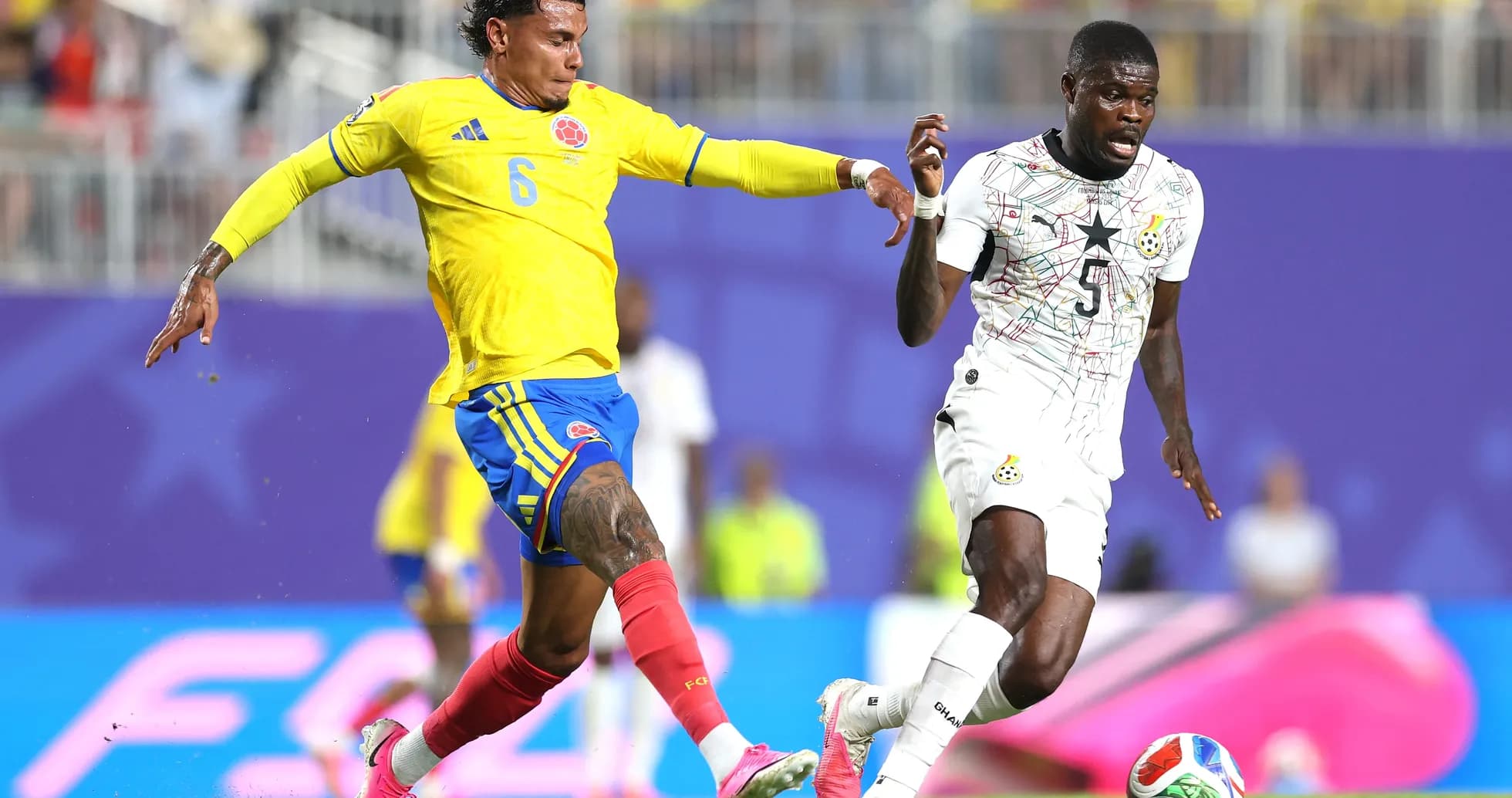
Arrowhead Stadium in Kansas City hosted a World Cup Round of 32 tie that felt like a clash of identities as much as a knockout match. Colombia, top of Group K with 7 points and a goal difference of 3 from 3 matches, arrived with the swagger of an unbeaten side whose seasonal DNA blends control and incision. Ghana, third in Group L with 4 points and a goal difference of 0, came as the dangerous underdog: compact, reactive, and reliant on transition moments.
Final Score: Colombia 1 - 0 Ghana
Following this result, a 1–0 Colombian win in regular time, the scoreline mirrored much of what the season’s numbers had been whispering. Overall this campaign, Colombia had played 4 matches, winning 3 and drawing 1, scoring 5 and conceding just 1. That gives them an overall average of 1.3 goals scored and 0.3 conceded, a profile of a side that rarely blows teams away but almost never loses control. Ghana, by contrast, entered with 4 matches played, only 1 win and 1 draw, scoring 2 and conceding 3 overall. Their overall average of 0.5 goals for and 0.8 against underlined the margin for error they would face against a team as defensively stringent as Colombia.
Team Formations
Nestor Lorenzo stayed loyal to his template: Colombia in a 4‑3‑3. C. Vargas in goal behind a back four of D. Munoz, D. Sanchez, J. Lucumi and J. Mojica. Ahead of them, the midfield triangle of G. Puerta, J. Lerma and J. Arias formed the structural spine, freeing a front three of J. Rodriguez, J. Cordoba and L. Diaz to attack from varied angles. The continuity is no accident; this formation has been used in all 4 of their matches in this World Cup, and it shows in the fluency of their spacing.
Carlos Queiroz responded with Ghana’s now-familiar 4‑1‑4‑1. L. Ati Zigi started in goal, shielded by a back line of M. Senaya, D. Luckassen, J. Opoku and G. Mensah. T. Partey anchored as the single pivot, with a bank of four in front: I. Williams and A. Semenyo wide, C. Yirenkyi and K. Sibo inside, and J. Ayew as the lone forward. On paper, it is a system designed to compress space in midfield and spring forward quickly when possession is won.
Tactical Analysis
Tactically, the first fault line ran through the Colombian midfield. J. Lerma’s role as the enforcer was critical: his positioning in front of D. Sanchez and J. Lucumi allowed Colombia to hold a high line without being exposed to direct counters into Ayew’s feet. Alongside him, G. Puerta acted as the metronome, while J. Arias provided the connective tissue between the double pivot and the front three, drifting into half-spaces to overload Ghana’s interior midfielders.
On the other side, the “engine room” battle pitted T. Partey and C. Yirenkyi against Colombia’s trio. Partey’s screening responsibilities were enormous. Ghana’s overall defensive record – only 3 goals conceded in 4 matches, with 2 clean sheets – suggests they can be disciplined without the ball. But the structure of a 4‑1‑4‑1 means that if Partey is dragged out of position by J. Rodriguez’s drifting or L. Diaz’s inside runs, the back four can be left exposed without immediate cover.
The “Hunter vs Shield” matchup centred on Colombia’s forward line against a Ghana defence that, on their travels this campaign, had conceded 3 goals in 3 away matches, an away average of 1.0 goal against. Colombia’s attack has been strangely split: at home they have scored only 2 goals in 3 matches, an average of 0.7, but on their travels they have been far more ruthless with 3 goals in 1 away match, an away average of 3.0. This neutral-site Round of 32 contest therefore leaned more towards Colombia’s “away” attacking personality: more vertical, more willing to commit numbers forward.
L. Diaz, starting from the left, was the primary “hunter.” His direct running tested M. Senaya and D. Luckassen, forcing Ghana’s right side to constantly decide whether to step out or drop. J. Rodriguez, notionally on the right of the front three, often inverted into the right half-space, looking to receive between the lines and dictate tempo. That movement drew G. Mensah and J. Opoku into uncomfortable zones, stretching the back four horizontally and opening channels for J. Cordoba to attack.
Defensively, Colombia’s “shield” was as advertised. With only 1 goal conceded overall in 4 matches and 3 clean sheets, all of them at home, they have shown a remarkable ability to manage game states. Even when they fail to score – which has happened once overall this campaign – they rarely lose structural discipline. Here, the centre-back pairing of D. Sanchez and J. Lucumi controlled the aerial duels and front-foot defending against Ayew, while the full-backs, Munoz and Mojica, balanced their overlaps with cautious rest-defence positions to guard against Ghana’s counters.
Discipline and Yellow Cards
Discipline was another subtle battleground. Colombia’s yellow-card distribution this campaign shows a late-game edge: 33.33% of their yellows have come in the 0–15 minute window, another 33.33% between 76–90 minutes, and 16.67% in the 46–60 window, plus 16.67% between 91–105. It hints at a team that starts aggressively, then is willing to take tactical fouls late to protect a lead. Ghana’s yellows, by contrast, are more evenly spread across 16–30, 46–60, 61–75, 76–90 and 91–105, each at 16.67%. That pattern suggests a side that is frequently firefighting in different phases rather than controlling when and where to foul.
Within that context, C. Yirenkyi stands out as Ghana’s card magnet and emotional barometer. Across the tournament he has 2 yellow cards, 7 fouls committed and 3 fouls drawn, plus 2 successful blocks and 3 interceptions. Those numbers paint him as an aggressive presser who steps out of the line to confront ball-carriers. Against a technician like J. Rodriguez, that duel was pivotal: step too late and Rodriguez turns; step too early and a quick combination exposes the space behind.
Conclusion
In the end, the statistical prognosis that favoured Colombia’s blend of control and defensive solidity played out. With no penalties taken by either side in the tournament – both have a total of 0 penalties, 0 scored and 0 missed – the margin was always likely to come from open play or a single moment of quality. Colombia’s superior overall goal difference heading into this game (4 scored, 1 conceded, GD +3) against Ghana’s balanced but modest output (2 scored, 2 conceded, GD 0 in their group) foreshadowed a tight contest tilted toward the South Americans.
Following this result, Colombia’s unbeaten run extends, their 4‑3‑3 further entrenched as the tournament’s most coherent blueprint. Ghana depart having defended with courage and structure, but their overall average of 0.5 goals per game ultimately betrayed them. In knockout football, the side that can both absorb and create tends to survive. In Kansas City, Colombia were exactly that side.