Argentina Edges Cape Verde Islands in Extra Time
Under the Miami lights at Hard Rock Stadium, this Round of 32 tie unfolded as a study in contrast: a reigning powerhouse that expects to glide through knockout openers, and an underdog that has built its identity on resistance and late-game stubbornness. Over 120 minutes, Argentina finally bent Cape Verde Islands to their will, winning 2–1 after extra time, but the route they took revealed as much about their evolving squad dynamics as it did about the Cape Verdean resolve.
I. The Big Picture – Two Paths into the Knockouts
Heading into this game, Argentina arrived as the tournament’s form side. They topped Group J with 9 points from 3 matches, a perfect record backed by a goal difference of 7 (8 scored and 1 conceded overall in the group). The broader World Cup campaign only reinforced that dominance: across all venues they had played 4 matches, winning all 4, with 11 goals for and 3 against in total. At home in this World Cup environment they had been particularly ruthless, scoring 8 and conceding 2, an average of 2.7 goals for and 0.7 against at home.
Cape Verde Islands came from a very different place. In Group H they survived rather than surged, finishing second with 3 points from 3 games, drawing all three with a goal difference of 0 (2 scored, 2 conceded overall in the group). Across the full tournament sample they had played 4 matches, drawn 3 and lost 1, with 4 goals scored and 5 conceded in total. On their travels specifically, they averaged 1.3 goals for and 1.7 against, a profile that hinted at vulnerability but also a knack for staying in games.
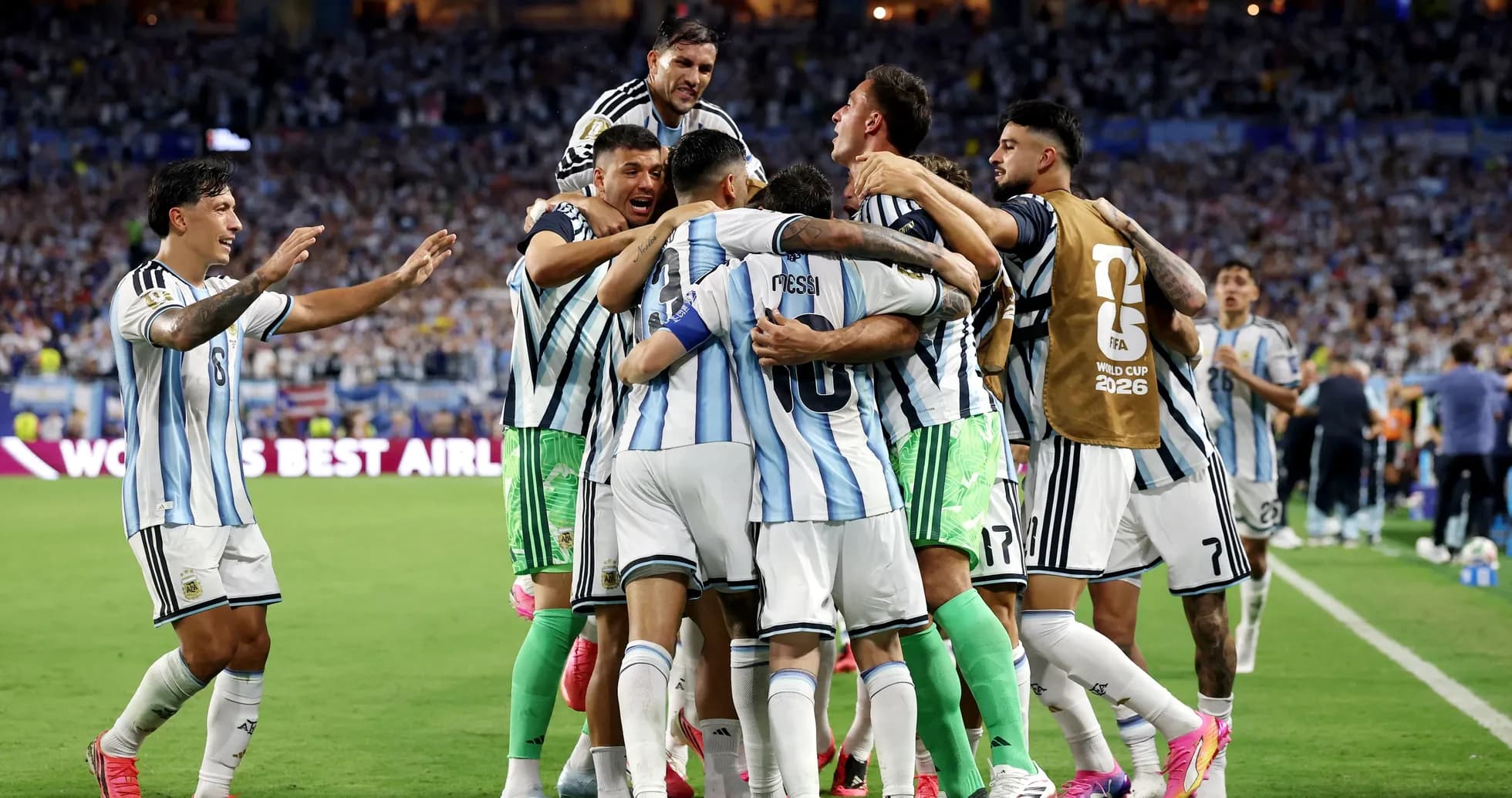
The scoreline in Miami told a compressed version of those arcs: Argentina raced ahead, were dragged into a stalemate by Cape Verde’s refusal to fold, and then, deep into extra time, their superior attacking ceiling finally broke the deadlock.
II. Tactical Voids and Discipline – Edges at the Margins
There were no listed absentees, so both coaches could lean on their preferred structures. Lionel Scaloni doubled down on familiarity, rolling out Argentina in a 4-4-2 that has become their World Cup template, and which they had already used in all 4 matches of this campaign. Pedro Leitao Brito stayed faithful to Cape Verde’s 4-1-4-1, a shape they had also used in all 4 of their fixtures, designed to compress space between the lines and funnel attacks into crowded central channels.
Discipline, though, was always going to be a subtle fault line. Argentina’s yellow-card distribution this tournament has been heavily back-loaded: all their cautions have come from the 76th minute onward, split evenly across 76–90, 91–105 and 106–120, each window accounting for 33.33% of their total yellows. It paints a picture of a side that grows edgy as the finish line nears, especially in tight knockout scenarios.
Cape Verde’s profile is different but equally telling. Forty percent of their yellow cards arrive in the opening 0–15 minutes, with another 20% between 16–30, making the first half-hour their most combustible period. They then have smaller disciplinary spikes at 61–75 (20%) and 91–105 (20%). Against a technically superior Argentina, that early aggression risked dangerous free-kicks in Messi territory and early pressure on defenders walking a disciplinary tightrope.
On the penalty front, Argentina’s record demanded mention. Overall this tournament they had been awarded 2 penalties, scoring 1 and missing 1, a 50.00% conversion rate. That miss, coupled with Lionel Messi’s own record of 1 penalty missed in this World Cup, meant that even from the spot there was a sliver of doubt—an unusual psychological wrinkle for a side otherwise brimming with attacking certainty. Cape Verde, by contrast, had neither scored nor missed a penalty in this campaign; the shootout specter never materialized as the match ended after extra time.
III. Key Matchups – Hunter vs Shield, Engine Room vs Enforcer
The headline duel was always going to be Lionel Messi against the Cape Verde back line. Messi entered this tie as the World Cup’s most devastating individual: 7 goals in 4 appearances, with 22 shots (15 on target), 141 completed passes and 10 key passes. His average rating of 9.28 underscored a player not just finishing moves but orchestrating entire games. He had also drawn 11 fouls, a magnet for contact in zones where Cape Verde’s early yellow-card tendency could be brutally punished.
Directly across from him stood a defensive unit anchored by R. Lopes and D. Borges, shielded by the single pivot K. Lenini in front of the back four. Cape Verde’s overall defensive record—5 goals conceded in 4 matches, with 2 clean sheets in total—spoke to structure and commitment rather than outright dominance. On their travels, conceding 1.7 goals per game, they were used to living on the edge, absorbing pressure, and trusting their shape to survive.
The “engine room” battle ran straight through Argentina’s central quartet of R. de Paul, A. Mac Allister, E. Fernandez and T. Almada against Cape Verde’s compact midfield band of K. Lenini, R. Mendes, L. Duarte and D. Duarte. Argentina’s midfield is built to supply and recycle: de Paul as the tireless shuttler, Mac Allister as the connector, Fernandez as the vertical passer, Almada as the creative drifter between lines. Cape Verde’s response was more conservative: Lenini as the enforcer in front of the defence, with the two Duartes and R. Mendes collapsing inward to crowd Messi’s pockets of influence.
Up front, Lautaro Martinez partnered Messi in Argentina’s 4-4-2, offering penalty-box presence and depth runs to stretch the Cape Verde line. For Cape Verde, N. Da Costa led the line in the 4-1-4-1, a lone forward tasked with chasing lost causes, holding up clearances, and giving J. Cabral and the advanced midfielders a platform to break from deep.
IV. Statistical Prognosis – Why Argentina Were Always Likely to Edge It
Strip away the drama of extra time and the numbers still pointed firmly towards Argentina. Overall this World Cup, they averaged 2.8 goals per game in total, while conceding just 0.8. At home specifically, that attacking average of 2.7 and defensive average of 0.7 created a profile of a side that routinely scores twice before their opponent finds the net once.
Cape Verde’s broader numbers were those of a team that can frustrate but rarely overwhelm. Across all venues they averaged 1.0 goal scored and 1.3 conceded per match. On their travels, that crept to 1.3 for and 1.7 against, suggesting that when they opened up even slightly, their back line could be exposed.
Overlaying those trends on this fixture, the likely pattern was always Argentina dominance in territory and chances, with Cape Verde hoping to compress the game into moments: set-pieces, transitions, and spells where Argentina’s late-game yellow-card spikes hinted at possible loss of control.
In the end, the extra-time winner felt less like a twist and more like statistical gravity reasserting itself. Argentina’s superior attacking volume, their perfect record of 4 wins from 4 overall, and the presence of a generational finisher in Messi made it improbable that Cape Verde’s resistance could last the full 120 minutes without a decisive breach.
Following this result, Argentina’s World Cup campaign remains immaculate, their aura of inevitability intact but tested. Cape Verde exit with their identity confirmed: organized, combative, and capable of dragging giants into deep water. Yet in Miami, as in the numbers, the difference between surviving and advancing was the thin line that separates a resilient collective from a squad that can call on Lionel Messi when the night stretches into its 120th minute.