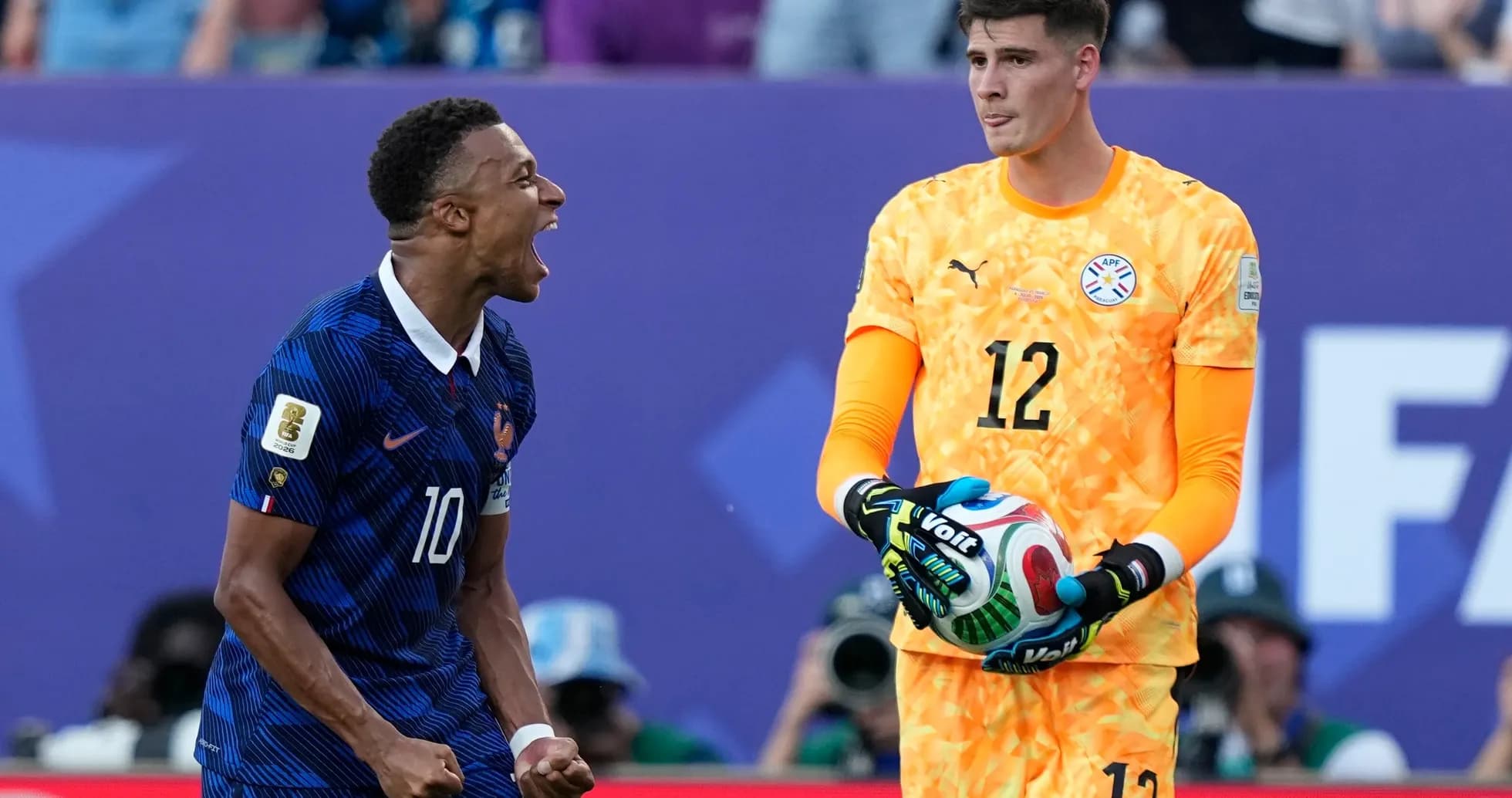
France Edges Paraguay 1-0 in Tactical Battle
Paraguay approached this Round of 16 tie at Lincoln Financial Field with a clearly conservative 5-4-1, intent on compressing space and surviving long stretches without the ball. France, in a 4-2-3-1, dominated territory and possession but had to rely on a second-half penalty from Kylian Mbappé to edge a 1-0 win.
From the outset, Gustavo Alfaro’s side accepted a deep block: a back five of Juan Cáceres, Gustavo Velázquez, Gustavo Gómez, Omar Alderete and Junior Alonso sat on the edge of their own box, with Andrés Cubas screening and Miguel Almirón and Matías Galarza dropping in alongside Diego Gómez to form almost a 5-4-0 out of possession. The plan was to funnel France wide, allow crosses into a crowded box, and trust Orlando Gill in goal.
The statistical profile underlines the asymmetry: France had 76% of the ball, 15 total shots (5 on goal) and 12 corners, while Paraguay managed just 24% possession, 5 shots (1 on goal) and 2 corners. Yet the expected goals figures – 1.36 xG for France versus 0.15 for Paraguay – show that, although France controlled the game, they did not carve out a flood of clear chances from open play. Much of their threat came from sustained pressure, second balls and set-piece situations rather than repeated one‑on‑ones.
France’s structure with Manu Koné and Adrien Rabiot as the double pivot was crucial to that territorial lock. With Jules Koundé and Lucas Digne pushing high from full-back, France often built in a 2-3-5: Dayot Upamecano and William Saliba stayed as the rest defence, Koné and Rabiot provided circulation and counter-pressing security, while Ousmane Dembélé, Michael Olise, Bradley Barcola and Mbappé formed a fluid front line. Mbappé’s nominal centre-forward role frequently saw him drifting left, with Barcola tucking into half-spaces and Olise operating between the lines.
Paraguay’s resistance was based on compactness and volume defending. The back five plus Cubas reduced France’s shots inside the box to 5, despite the visitors taking 15 in total. Blocked shots (France 4, Paraguay 1) reflect how often the French had to shoot through traffic. Gill (Paraguay) made 4 saves, a solid return that, combined with 0.37 goals prevented, indicates he marginally outperformed the average expectation on the quality of efforts faced. His shot-stopping, particularly against mid-range efforts from outside the box, allowed Paraguay to stay in the tie deep into the second half.
On the other side, Mike Maignan (France) had a relatively quiet evening, facing just 1 shot on goal and making 1 save. Paraguay’s 0.15 xG and 5 total shots – with only 1 inside the box – show how rarely they transitioned with enough numbers to truly test France’s back line. Julio Enciso, the lone forward, was largely isolated, tasked with chasing clearances and trying to win fouls to relieve pressure. The midfield quartet’s primary job was lateral shifting and plugging half-spaces rather than supporting counters, which limited Paraguay’s attacking ceiling.
The substitution pattern underlined the tactical battle. At 58', Josè Canale (IN) came on for Omar Alderete (OUT), a like-for-like defensive change that kept the back five intact but refreshed legs in the line that was doing most of the physical work. Three minutes later, Paraguay tried to inject some vertical threat: at 61', Gustavo Caballero (IN) came on for Julio Enciso (OUT), offering fresh running up front, while France replaced Bradley Barcola (OUT) with Désiré Doué (IN), a move that added more direct dribbling and central penetration.
The key turning point arrived on 68', when VAR confirmed a penalty for France following an incident involving Désiré Doué. Two minutes later, at 70', Mbappé converted from the spot to give France the 1-0 lead their pressure had been building towards. That sequence encapsulated the match: Paraguay’s low block finally cracked not from open play combination, but from sustained territorial dominance and an individual action in the box that drew a foul.
Alfaro responded quickly. At 71', Gabriel Ávalos (IN) came on for Miguel Almirón (OUT), and Mauricio (IN) for Gustavo Gómez (OUT). Those changes subtly shifted Paraguay’s shape towards something closer to a back four in certain phases and added a second more natural forward profile in Ávalos, signalling a belated attempt to contest territory higher and offer a target for direct balls. However, with France still controlling 76% possession and circulating the ball with 568 total passes and 510 accurate (90%), Paraguay’s late attempts to open up never truly destabilised Didier Deschamps’ structure.
France’s ball circulation and counter-press were efficient. The double pivot and centre-backs repeatedly smothered Paraguay’s first pass after regains, preventing meaningful counters. Paraguay completed 183 total passes, with 99 accurate at 54%, a reflection of how often they were forced into rushed clearances or speculative long balls under pressure. France’s pressing triggers – especially when the ball went into Paraguay’s full-backs or wide centre-backs – kept the game tilted towards Gill’s goal.
Discipline
Discipline also shaped the rhythm. France collected three yellow cards, all reflective of their aggressive approach to duels and game management:
- 19' Bradley Barcola (France) — Foul
- 81' Manu Koné (France) — Foul
- 90+7' Michael Olise (France) — Unsporting behaviour
Paraguay, despite 13 fouls to France’s 11, avoided any bookings, which aligns with their more reactive, block-based defending where challenges were often made with the play in front of them rather than in transition.
Statistically, France’s 1.36 xG to Paraguay’s 0.15 and the 5–1 advantage in shots on goal justify the 1-0 scoreline, even if it came via a penalty. The identical goals prevented figure (0.37) for both sides hints that, on the rare occasions either goalkeeper was truly tested, both responded at a similar level. The core difference was volume and field position: France lived in Paraguay’s half, accumulated pressure and set-pieces, and eventually forced the decisive error, while Paraguay’s ultra-low block kept them competitive but left them without the attacking tools to threaten an equaliser once behind.