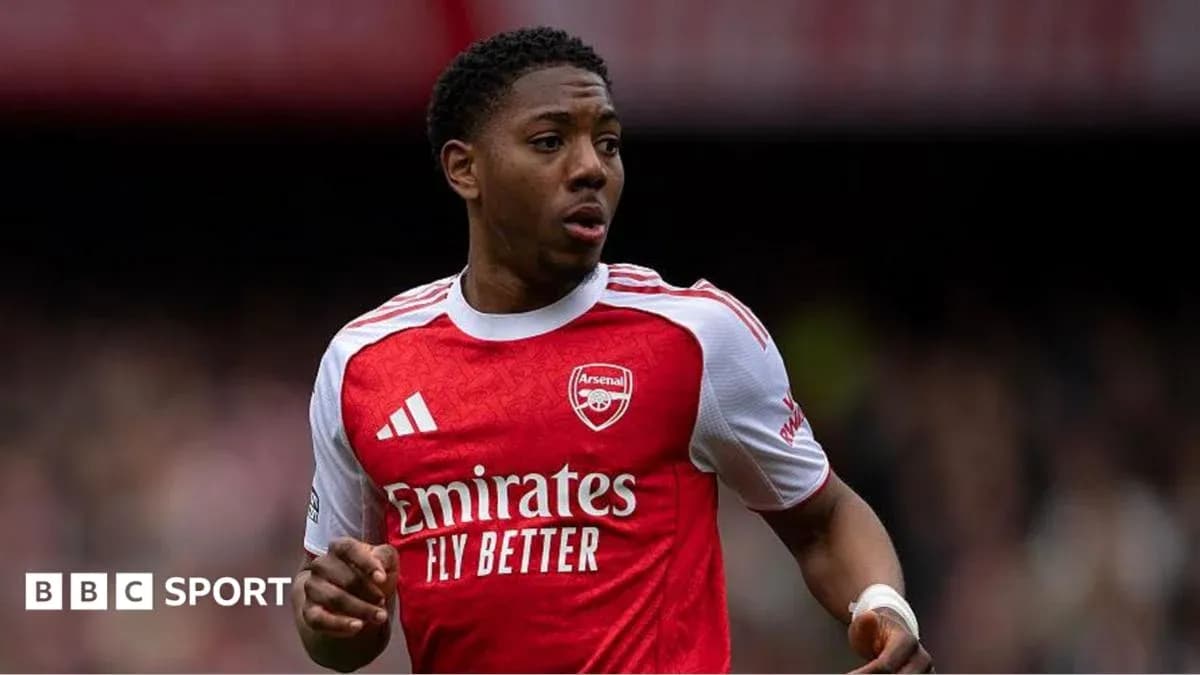
Myles Lewis-Skelly: Arsenal's Rising Star in Midfield
Myles Lewis-Skelly has never taken the easy road into Arsenal’s first team. He has had to squeeze through gaps, not stroll through open doors.
At 19, he already looks like he belongs at the top level, but nothing about his rise has been straightforward. His breakthrough came in the chaos of the 2024-25 season, when injuries ripped through Mikel Arteta’s squad and forced the manager to turn to the academy. Lewis-Skelly grabbed that chance with both hands, reinventing himself as one of the Premier League’s standout young full-backs.
He did it from a position that is not even his own.
A midfielder trapped at left-back
Lewis-Skelly grew up at Hale End as a midfielder, always convinced the middle of the pitch was his natural habitat. Arsenal’s staff saw the same thing: a player built to operate in tight spaces, receive under pressure, and accelerate away from opponents. The left-back role simply became the doorway to the big stage.
From there, his qualities were impossible to miss. He inverted into midfield as if he had been doing it in the Premier League for years, slipped away from challenges in crowded areas, and carried the ball past pressing lines with a swagger that belied his age. By the end of that first campaign, he was not just filling in at left-back. He was shaping games from it.
England took notice. In March 2025, he stepped out at Wembley, scored the opener in a 2-0 win over Albania, and became the youngest man ever to score on his England debut. A few months later, Arsenal handed him a new five-year contract. The club were not just rewarding promise; they were banking on a future cornerstone.
Then came the reality check.
Squeezed out by experience
Last season bit back. Riccardo Calafiori, signed for £42m in 2024, returned to full fitness and quickly reminded everyone why Arsenal had invested so heavily. The Italian’s range, his ability to surge forward and disrupt defensive structures, is central to how Arteta wants his team to attack.
On top of that, Piero Hincapie arrived from Bayer Leverkusen, initially on loan, then on a permanent deal. Another left-sided defender. Another international. Another obstacle.
Both Calafiori and Hincapie had age, experience and reputation on their side. Lewis-Skelly had momentum, but not minutes. Arteta admitted he had been “tough” on the teenager, and it showed in the team sheets.
The message was clear: talent alone would not guarantee a place.
Yet football seasons rarely move in straight lines. Martin Zubimendi’s form dipped as the campaign wore on, and with four league games remaining, Arteta finally turned back to the academy product, this time in his preferred role in central midfield, away at Fulham.
The response was emphatic.
A late surge that changed the conversation
Lewis-Skelly ran that game. From the centre, he looked like what he always claimed to be: a midfielder by instinct and by trade. He protected the ball, drove through lines, and gave Arsenal a different rhythm in possession.
The performance was so convincing that he kept his place. He started all but one of Arsenal’s remaining fixtures as they surged to the Premier League title and reached the Champions League final, where they fell to Paris St-Germain. On the biggest stage, with the season on the line, Arteta trusted a 19-year-old academy graduate in the heart of his team.
That kind of finish does not just win medals. It forces boardrooms to pause.
Because away from the emotion of the pitch, Lewis-Skelly sits at the centre of a colder debate. As a Hale End product, any sale would go down as “pure profit” in Arsenal’s accounts. In an era where balance sheets shape squads as much as tactics do, that label carries weight.
Supporters hate that phrase. They hear it and think of a kid who grew up in their colours being reduced to a number on a spreadsheet. Lewis-Skelly hears it too. When Arsenal celebrated the title at Selhurst Park, he posted a picture with the Premier League trophy and captioned it, pointedly, “pure profit”.
He knows exactly how he is being discussed.
Profit or pillar?
Arsenal want to operate as a sustainable club. Trading is no longer optional; it is part of the model, especially after last summer’s outlay of around £250m on new signings. Every major arrival nudges someone else towards the exit door.
At one stage, the club were open to listening to offers for Lewis-Skelly. The logic was brutal but familiar: sell an academy player for a big fee, reinvest, and keep the cycle turning.
His form at the end of last season has complicated that calculation. When he finally got a run in midfield, he did not just look promising; he looked ready. That has sparked a rethink over his status this summer, even as Arsenal edge closer to another huge midfield signing.
The club are moving towards completing a deal for Newcastle captain Bruno Guimaraes, a transfer that could rise to £80m. A player of that calibre does not arrive to sit on the bench. For Lewis-Skelly, it threatens to slam the door just as he has begun to step through it.
Yet he is not drifting to the fringes. His talent, his versatility, and his history with Arsenal keep dragging him back into the frame. This season might give him a clearer run at what he has always wanted: a starting role in midfield, on his own terms.
A head start on the stars
The World Cup’s late finish has reshaped Arsenal’s pre-season. A cluster of key midfielders are still easing their way back: captain Martin Odegaard, England pair Declan Rice and Eberechi Eze, plus Zubimendi and Mikel Merino, both fresh from winning the tournament with Spain. None of them are yet fully integrated into Arteta’s preparations.
Lewis-Skelly is. He has started and impressed in friendlies against Girona and Real Betis, using the extra minutes to sharpen his case.
Against Betis, Arteta stationed him at the base of midfield, the deepest-lying player in the centre. It is a role that demands calm, vision and discipline. He looked comfortable with the responsibility, stepping into pockets to receive the ball, then driving it upfield when Arsenal needed someone to break the lines.
The chemistry with Calafiori, so important on that left side, flickered into life again. When the Italian launched one of his trademark forward runs, Lewis-Skelly instinctively dropped into left-back, closing the gap and protecting the space. It looked rehearsed, but it was not.
“We just speak in the last few days about this connection that we have - we don’t need to speak,” Calafiori said afterwards. “I really like to play with him, a really good player.”
Those are the small details that stick with managers. The understanding. The adaptability. The willingness to cover, then step back into midfield and dictate.
Nine days to stake a claim
The Community Shield against Manchester City is nine days away. For most, it is a curtain-raiser. For Lewis-Skelly, it feels like something else entirely: an early audition for the role he has been chasing since his first days at Hale End.
With senior stars still chasing fitness and a new £80m midfielder on the horizon, he has a narrow window to remind everyone that Arsenal already own a central midfielder capable of shaping big games.
He has fought for every minute so far. Now the question is simple: will Arsenal treat him as “pure profit” or as the foundation of their next great midfield?