Napoli vs AS Roma: A 3-3 Draw Reflecting Serie A Dynamics
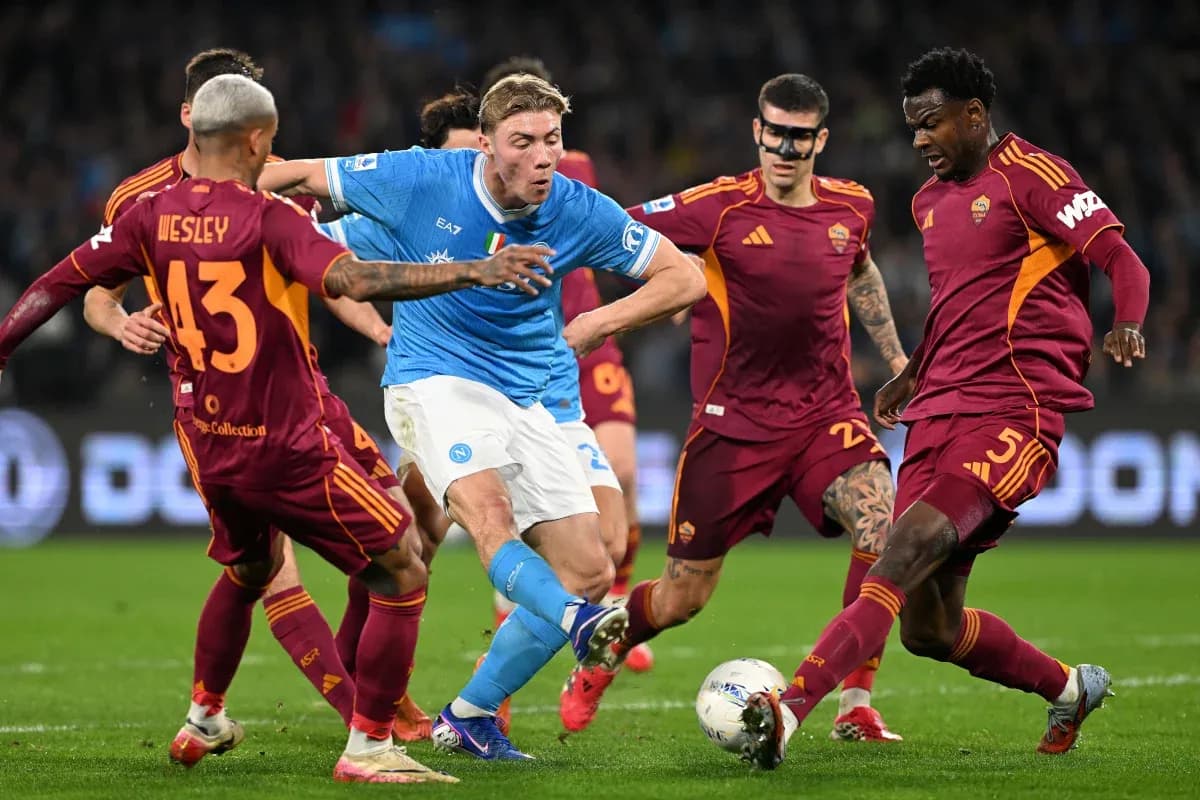
The night at Maradona Stadium ended 3–3, a scoreline that felt less like chaos and more like an x-ray of where Napoli and AS Roma stand in this Serie A season. It was Round 8, but it carried the weight of something larger: a clash between a project still searching for its true shape and another already humming at near-elite levels.
Following this result, the league table snapshot is revealing. Napoli sit 10th with 11 points from 8 matches, their overall goal difference of +3 (13 scored, 10 conceded) mirroring a side that can hurt opponents but cannot yet control them. AS Roma, by contrast, are 3rd with 18 points from 8, unbeaten, and carrying a commanding overall goal difference of +13 (19 scored, 6 conceded). The draw in Naples did not break Roma’s stride so much as confirm their resilience.
Napoli's Volatility
Napoli’s seasonal DNA is that of volatility. At home they have played 4, winning 2, drawing 1 and losing 1, with 8 goals scored and 5 conceded. An average of 2.0 goals at home against 1.3 conceded underlines why the Maradona is still a place of attacking promise, but also why no lead feels entirely safe. Their form line of WLLWDWLD tells of short streaks and sudden stumbles; the biggest losing margins (1–2 at home, 3–2 away) show that even their defeats are rarely quiet.
Roma's Control
Roma arrive from a different universe of control. Across the season they have played 8, winning 5 and drawing 3, with no defeats. On their travels they have 4 away matches, 2 wins and 2 draws, scoring 9 and conceding 3. An away scoring average of 2.3 against just 0.8 conceded paints the picture of a side that can impose itself in hostile territory. Their form of WWWWDDWD and a longest winning streak of 4 speak to a team that knows exactly what it is.
Tactical Lineups
In that context, the lineups told a tactical story even before the first whistle. Massimiliano Allegri rolled out Napoli in a 4-3-3, a shape he has used most often this season (4 league matches), doubling down on verticality and wide overloads. Gian Piero Gasperini, on the opposite bench, leaned into his principles with a 3-5-2, a variation of the three-at-the-back structures Roma have used all year (most frequently 3-4-2-1).
Napoli’s back four of Giovanni Di Lorenzo, Rafa Marín, Benoît Badiashile and Mathías Olivera is physically imposing but still a developing unit. The absence of A. Buongiorno through a knee injury robbed Allegri of another left-footed centre-back option and some aerial security. Higher up, the missing David Neres and C. Favasuli reduced Napoli’s ability to rotate wide creativity and bench dribbling threat.
In midfield, the trio of Kevin De Bruyne, André-Frank Zambo Anguissa and Scott McTominay offered a blend of control, power and late runs. De Bruyne’s season so far has been quietly influential: 8 appearances, 3 goals, 1 assist, 300 completed passes with 19 key passes. He has also taken on penalty responsibility, scoring 1 but missing 1; Napoli’s penalty record this campaign is 2 taken, 1 scored and 1 missed, a detail that hovers over every set-piece in the box.
Up front, Matteo Politano, Rasmus Højlund and Noa Lang formed a fluid front three. Politano, with 1 goal and 2 assists in 8 appearances and 9 key passes, remains Napoli’s most reliable wide playmaker, drifting inside to connect with De Bruyne. Lang and Højlund supply the depth runs that make that 4-3-3 feel like a 4-2-4 in transition.
Roma's Absentees
Roma’s absentees were just as significant, if not more so. Paulo Dybala, the league’s top assist provider with 4, missed out through a calf injury; Lorenzo Pellegrini was also sidelined with a thigh problem, and M. Kone and M. Bah were unavailable. For a side that usually leans on Dybala’s 25 key passes and Pellegrini’s connective play, this forced Gasperini to rewire the attack.
He did so by putting Donyell Malen and Matías Soulé together up front in the 3-5-2. Malen’s numbers are those of a classic “hunter”: 6 goals and 1 assist in 7 appearances, 21 shots with 11 on target, and 22 successful dribbles. He is also walking a disciplinary tightrope: 1 yellow card and 1 red this season, a reminder that his aggression can cut both ways. Soulé, with 3 goals, 1 assist and 25 dribble attempts (16 successful), is the more elastic of the pair, dropping between the lines to link with the midfield.
Behind them, the “engine room” belonged to Marten de Roon and Bryan Cristante. De Roon’s role as the enforcer allowed Cristante and the young N. Pisilli to step into advanced pockets, while Wesley and D. Rensch provided the width that turned Roma’s 3-5-2 into a five-lane attacking machine. At the back, Mario Hermoso, Evan Ndicka and Gianluca Mancini formed a line that has underpinned Roma’s defensive record: just 6 goals conceded overall, split evenly between home and away.
Hermoso, in particular, embodies Roma’s defensive intelligence. In 8 appearances he has 14 tackles, 5 successful blocks and 18 interceptions, plus 404 completed passes at 88% accuracy. He reads wide overloads early and steps into midfield, a key trait against Napoli’s 4-3-3. Soulé also appears in the disciplinary charts with 2 yellow cards, another sign that Roma’s front line is not shy of defensive work.
Card Profiles and Risk
The card profiles of both teams shaped the risk calculus. Napoli’s yellow cards peak late, with 42.86% of their bookings coming between 76–90 minutes, and they have already seen a red card in that same window. Roma, meanwhile, accumulate 29.41% of their yellows between 61–75 minutes and 23.53% between 76–90, with a single red card shown between 46–60. This is a match where intensity grows as the clock ticks, and where late-game discipline is as decisive as fresh legs.
From a minute-distribution standpoint, Roma’s offensive surge is most dangerous between 61–75 minutes (21.05% of their goals) and 76–90 (26.32%). Napoli, while lacking detailed minute splits, concede a chunk of their overall goals in phases where Roma are historically strong. That intersection – Roma’s late offensive wave against Napoli’s tendency to wobble in chaotic endings – was always going to define the final act, and the 3–3 scoreline bears that out.
Tactical Overview
Tactically, this fixture was “hunter vs shield” writ large: Malen and Soulé, supported by wing-backs and aggressive half-spaces, pressing into a Napoli defence that, overall, concedes 1.3 goals per match both at home and away. Napoli’s answer lay in their own creativity: De Bruyne’s passing lanes into Lang and Højlund, Politano’s cut-ins, and the physical surges of Zambo Anguissa and McTominay.
The statistical prognosis from here is nuanced. Roma’s overall scoring average of 2.4 goals per match, combined with an overall concession rate of just 0.8, still marks them as a genuine title contender, especially with 5 clean sheets and only 1 match all season where they have failed to score. Napoli, averaging 1.6 goals overall and conceding 1.3, remain a high-variance side whose ceiling is visible but whose floor is still too low.
Yet in a six-goal draw at Maradona Stadium, both projects revealed their truth. Roma’s structure and late-game punch are real. Napoli’s 4-3-3, even amid absences and penalty misses, can still turn a match into a shootout that few opponents truly enjoy. For Allegri, the path forward is about tightening the back line without blunting De Bruyne’s influence. For Gasperini, it is about reintegrating Dybala and Pellegrini into a machine that already works – and making sure Malen’s fire burns opponents, not Roma themselves.