Napoli Defeats Bologna 1-0 in Serie A Showdown
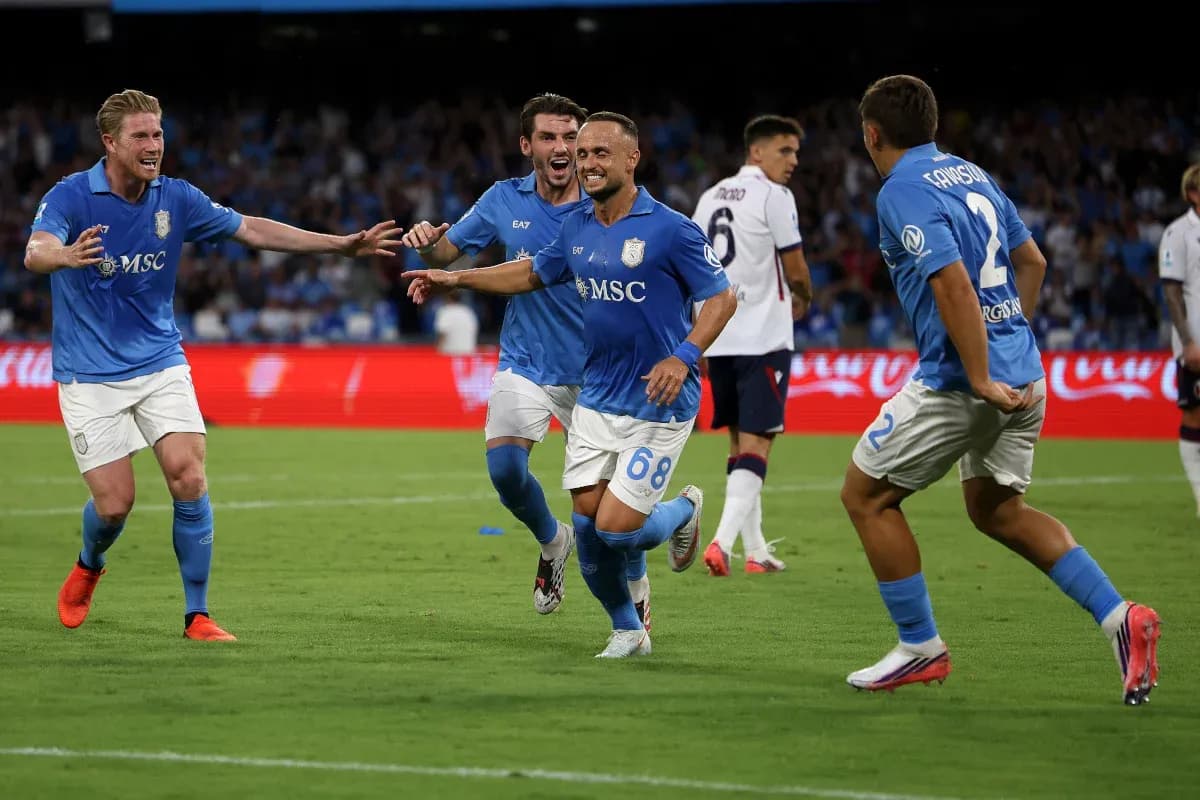
Under the early autumn light at Stadio Diego Armando Maradona, this Regular Season - 4 fixture in Serie A closed with a narrow but telling verdict: Napoli 1–0 Bologna. Following this result, the table snapshots the different trajectories of the two sides. Napoli sit 10th with 6 points from 4 matches, a goal difference of +1 (6 scored, 5 conceded). Bologna, by contrast, are 16th with just 1 point from 4, their goal difference at -3 (2 scored, 5 conceded). The scoreline in Naples felt like a distillation of those wider trends: a home side still shaping its new identity, and a visitor trapped between structural solidity and offensive anemia.
Massimiliano Allegri sent Napoli out in a 4-2-3-1, a subtle evolution from the 4-3-3 that has been their most-used shape this season (3 appearances versus 1 for the 4-2-3-1). In goal, V. Milinkovic-Savic stood behind a back four of G. Di Lorenzo, A. Rrahmani, R. Marin, and L. Spinazzola. Ahead of them, the double pivot of B. Gilmour and S. Lobotka was the hinge on which the entire structure turned. The attacking band of three – M. Politano to the right, K. De Bruyne central, and A. Vergara to the left – worked behind lone striker R. Hojlund.
For Bologna, Domenico Tedesco mirrored the 4-2-3-1 but with a different personality. M. Pessina kept goal behind E. Holm, T. Heggem, A. Theate, and J. Miranda. The double pivot of L. Ferguson and T. Pobega formed a robust, combative spine. Ahead, F. Bernardeschi, M. Amondarain, and N. Cambiaghi supported R. Piccoli, who was asked to lead the line in the absence of injured A. Dovbyk.
The absentees cast a long tactical shadow. Napoli were without Alisson Santos, F. Anguissa, A. Buongiorno, Giovane, L. Marianucci, S. McTominay, and A. Meret – a cluster that strips depth from every line. Anguissa’s missing ball-carrying and McTominay’s physicality forced Allegri to lean heavily on Gilmour’s distribution and Lobotka’s metronomic control as a double pivot rather than a more dynamic three-man midfield. At the back, the absence of A. Buongiorno made Rrahmani and Marin the undisputed central axis, increasing their workload in both build-up and defensive duels.
Bologna’s injury list was equally decisive: A. Dovbyk, O. El Azzouzi, R. Orsolini, and N. Zortea all sidelined. Dovbyk’s penalty-box presence and Orsolini’s cutting in from wide are precisely the kind of weapons a struggling attack needs. Without them, Bologna arrived in Naples already burdened by a bleak offensive record: heading into this game, they had scored only 2 goals in total this campaign from 4 matches, with 0 on their travels and an average of 0.5 goals per game overall, 0.0 away. The clean-slate promise of a new match never quite erased those structural problems.
Napoli, conversely, came in with a more balanced statistical profile. Heading into this game, they had 6 goals in total this campaign across 4 fixtures, split as 2 at home and 4 on their travels, for an average of 1.5 goals per game overall (1.0 at home, 2.0 away). Defensively they had conceded 5 in total (2 at home, 3 away), an average of 1.3 per match overall. The raw numbers suggested a side that can score, occasionally leak, but rarely collapse – underlined by 2 clean sheets in total and no matches yet where they failed to score, either at home or away.
Hunter vs Shield
Within that framework, the “Hunter vs Shield” duel centered on R. Hojlund against a Bologna defense that, despite the team’s lowly rank, is not catastrophically porous. Bologna had conceded 5 goals in total this campaign before kickoff, with an average of 1.3 per game, and only 2 on their travels. Hojlund arrived as Napoli’s spearhead and one of Serie A’s early-season focal points: 4 appearances, 4 starts, 305 minutes, and 2 goals in total, with 6 shots and 4 on target. He is not just a finisher but a disruptive presence, engaging in 32 duels and winning 8, constantly stretching back lines. Against a pairing of Heggem and Theate, his movement between the lines and into the channels forced Bologna’s back four to retreat a few meters deeper than they would have liked, creating the pockets that De Bruyne thrives in.
Engine Room
That leads to the “Engine Room” confrontation. Napoli’s creative core – De Bruyne between the lines, flanked by Politano and Vergara – met Bologna’s central shield of Ferguson and Pobega. With Napoli’s season-long card profile showing a late-first-half spike in yellows (50.00% of their cautions between 31-45 minutes) and further discipline questions in the 46-60 and 76-90 windows, Allegri’s double pivot needed to manage tempo without sliding into reckless challenges. Bologna, for their part, had their own disciplinary pattern: 37.50% of their yellows arriving between 31-45 minutes, 25.00% between 46-60, and another 25.00% between 76-90, plus a late 12.50% in stoppage time. That timing hinted at a side often forced into reactive defending as halves wore on – precisely when De Bruyne and Politano would be probing most aggressively around the box.
Tactically, the key intersection lay in Napoli’s ability to sustain pressure in those late-half phases against a Bologna side that statistically tends to accumulate bookings there. With no penalties taken or missed by either team in the league so far – both sides sit at 0 total penalties, 0 scored, 0 missed – the margins were always likely to come from open play rather than the spot. Napoli’s clean-sheet record (2 in total) and Bologna’s habit of failing to score (3 such games in total, including both away fixtures) framed the likeliest storyline: a home side probing, an away side hanging on, and a single moment of quality deciding it.
In the end, the 1–0 felt almost pre-written by the numbers. Napoli’s modest but reliable attacking output met Bologna’s blunt edge on their travels, and Allegri’s choice of a 4-2-3-1, powered by Hojlund’s constant running and De Bruyne’s orchestration, found just enough incision. For Tedesco, the shape is sound but the absences are brutal; until Dovbyk and Orsolini return, Bologna’s structure may remain more shield than sword. For Napoli, this was not a statement win, but a functional one – the kind that quietly underpins a season.