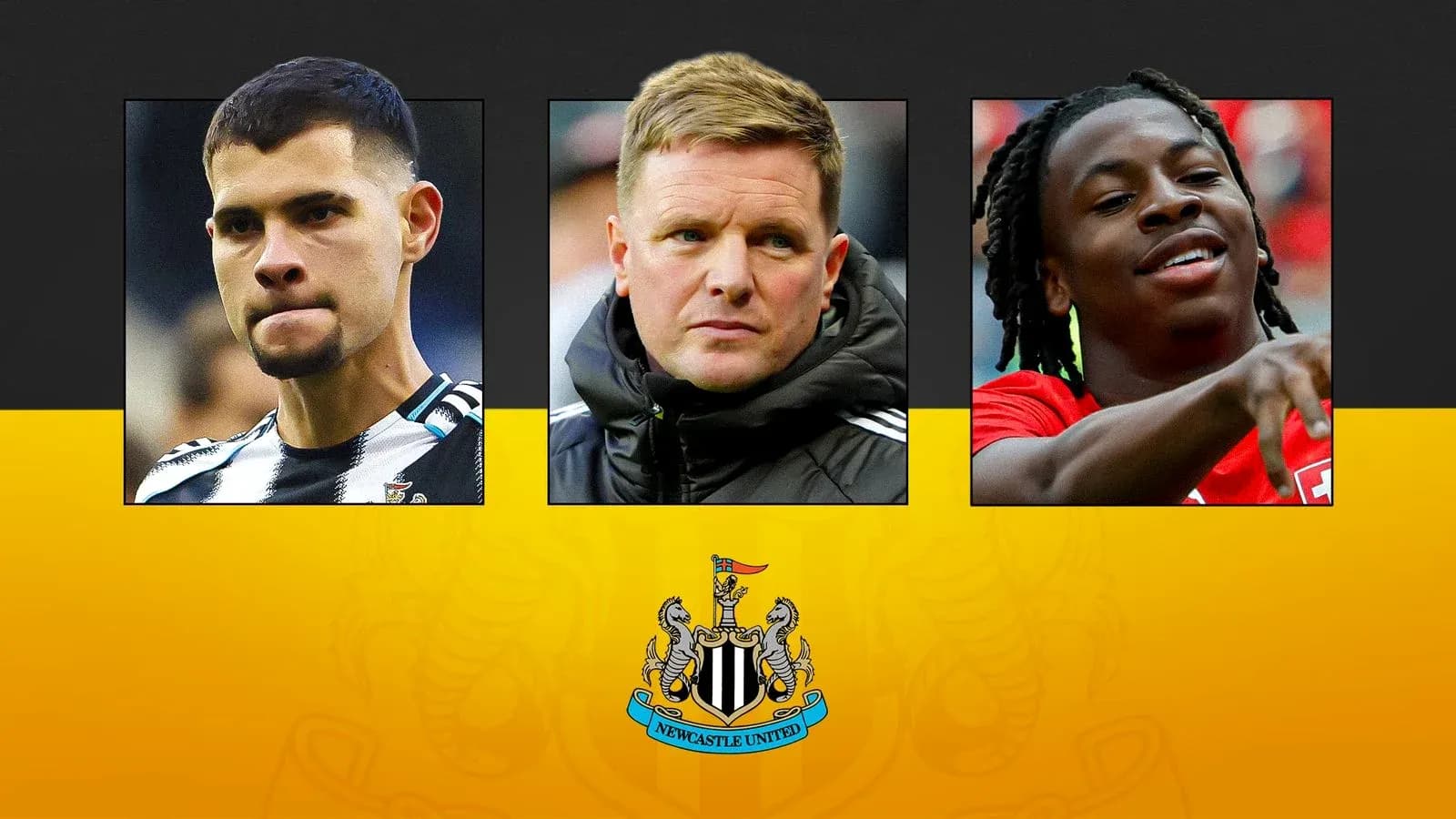
Newcastle’s Summer Overhaul: Youth, Ambition and Transfers
The mood around St James’ Park this summer is not one of quiet tweaking. It’s surgery.
Newcastle are ripping into a squad that only recently felt on the brink of something, and reshaping it around a stricter financial reality and a new sporting philosophy. Eight, nine, even 10 positions could change before the window closes. For a club that has already waved goodbye to Anthony Gordon and Sandro Tonali, this is not evolution. It’s a reset.
At the heart of it all sits one name, one dilemma, one potential flashpoint with the fanbase: Bruno Guimaraes.
Bruno’s Dilemma: Titles vs Tyneside
Bruno has not slapped in a transfer request. He hasn’t gone to war with the club. But he has been clear.
If Arsenal put a serious offer on the table, he wants Newcastle to let him explore it.
This is about medals, not money. He is already Newcastle’s top earner, on strong wages that Arsenal would only marginally improve. The issue is his age and his ambition. At 28, turning 29 later this year, he looks at the next two or three seasons and sees a race against time. He wants to win titles. He doesn’t believe that happens at Newcastle in the short term, on or off the pitch.
So he has told the club: if a “good” offer arrives from Arsenal, he wants the chance to go. Not for a cut-price fee, not via a messy exit. He wants Newcastle properly compensated.
Inside the club, the tipping point is clear enough. Around £80m. Hit that number and Newcastle will have to listen.
The twist? Arsenal haven’t made a move. No bid. No formal contact. Nothing direct to Newcastle at all. All the noise, all the whispers, all the speculation have come through agents and intermediaries. Newcastle, by all accounts, are baffled that talk of Bruno’s departure has escalated without a single call from north London.
Until that changes, the club’s stance is blunt: they are desperate to keep him and consider him not for sale. But everyone knows the figure that would test that resolve. And Bruno, quietly, is already thinking about what comes next.
Manzambi: Deal Agreed, Nerves High
While the Bruno situation hangs in the air, Newcastle have pushed hard at the other end of the pitch.
They have a verbal agreement with Freiburg to sign Johan Manzambi for £49m, one of their priority targets this summer. A club delegation flew to Germany this week, thrashed out terms with Freiburg and shook hands on a fee. Manzambi has also verbally agreed personal terms.
On paper, it’s all lined up. On grass, he’s still busy.
Manzambi remains on World Cup duty with Switzerland, carrying a slight knee issue but playing his part in a run to the quarter-finals. He has already produced five goal involvements at the tournament – the best return of any player of his age since records began. That kind of output at that stage doesn’t go unnoticed.
And that’s exactly what worries Newcastle.
They’ve been here before. Victor Munoz looked done, only for Liverpool to swoop in at the last moment and hijack the move. That sting hasn’t faded. So while Newcastle are confident, they’re also wary. Manzambi has made it clear he will not sign anything until after Switzerland’s World Cup campaign ends.
Until pen hits paper, there is a lingering fear that another heavyweight could step in. Newcastle have done everything they can. Now they wait – and hope that this time, the groundwork holds.
The Plan: Younger, Cheaper, Smarter
Strip away the noise and one theme emerges: Newcastle are changing how they build a squad.
The new transfer model is tight. The core target bracket is players aged 18 to 24, with fees typically between £20m and £40m. There is room to manoeuvre – Ewen Jaouen has arrived for £18m, and Manzambi’s £49m fee stretches the upper limit – but there will be no £80m, £90m or £100m headline signings.
This is Newcastle leaning into a Borussia Dortmund-style approach: identify young players with a high ceiling, develop them, and be prepared to sell at the right time, all while trying to stay competitive for trophies.
The days of last summer’s scattergun splurge are over. That window cost around £250m and too many of those bets failed to pay off. The Alexander Isak saga, dragged out late into the window, cast a cloud over the season. The club do not want a repeat. They want business done earlier, cleaner, smarter.
Within that framework, three or four more signings are expected once the Manzambi deal is finalised. A midfielder remains on the list – especially if Bruno leaves – along with a new No 1 goalkeeper. James Trafford, long admired by Newcastle, is a live target, with moves anticipated for the Manchester City stopper.
A versatile full-back is also a priority, ideally someone comfortable on both flanks but primarily at left-back. Another winger could come in if Jacob Murphy moves on. A striker is also possible, but only if one of Nick Woltemade or Yoane Wissa departs. If both stay, Eddie Howe is content to go into the season with Wissa, Woltemade and Will Osula as his three centre-forward options.
Who Goes Next?
To reshape a squad, you need exits as well as arrivals.
Nick Pope is expected to leave. Ipswich showed interest, but that has cooled. Murphy, a decade at the club behind him, could also move on. Joe Willock is another who may be allowed to depart.
There are no formal offers on the table for any of the three, but Newcastle are open to letting them go as part of a broader overhaul. If all of them do leave, they will have to be replaced, stretching recruitment resources further in a window already loaded with moving parts.
Steur and the New Generation
Not every signing is being brought in to start immediately.
Sean Steur, just 18, is a clear example. Newcastle view him as one for the future. He will train with the first team, see minutes from the bench, and be given time to grow into the physical demands of the Premier League.
The lack of European football next season actually helps that plan. With no midweek fixtures clogging the calendar, Howe will have full weeks on the training pitch to work with players like Steur. That’s where he excels: improving young talent day by day.
Steur will not walk into the XI now. But in a year’s time? If his development tracks as Newcastle hope, he could be pushing for a regular place. This is the type of signing that defines the new model: high potential, lower initial cost, long-term upside.
Bazoumana Toure and, if the deal closes, Manzambi fall into that same category. Howe sees this as a coaching project he can relish.
Howe’s Buy-In and the Cost of Last Summer
Crucially, Howe is not fighting this shift. He is driving it.
Alongside sporting director Ross Wilson and chief executive David Hopkinson, the manager accepts that last summer’s approach cannot be repeated. The spending was huge. The return was underwhelming. The club overreached, and the consequences were felt on the pitch and in the accounts.
This time, Howe wants clarity, youth, and earlier deals. He wants a squad he can mould, not a collection of expensive quick fixes. With no European football, he will have fresher players and more training time, fewer excuses and more control.
No one inside the club is talking about a top-four charge. That feels unrealistic. But a push for the European places? That is seen as attainable, especially with a lighter schedule than many rivals. If the new signings settle quickly and the injury luck improves, Newcastle believe they can re-enter that conversation.
PIF, PSR and the Ceiling Above Newcastle
Over all of this looms the ownership and the balance sheet.
Saudi Arabia’s Public Investment Fund remains committed to Newcastle. There is no sense of an exit, no sign of a cooling interest. The money is still there. But the constraints are tighter than many expected.
Financial rules have bitten. Newcastle recently breached Profit and Sustainability Regulations and were fined. They do not want to go near that line again. That means spending “as much as they can” – but no further. It also means accepting, at least for now, that they cannot go pound-for-pound with the established “big six” in fees and wages.
That reality jars when fans watch Tonali, Gordon, Isak and potentially Bruno leave for clubs perceived as bigger stages. It underlines just how hard it is to break into the elite when commercial revenues are roughly half those of the traditional giants.
Newcastle know they must grow off the pitch as much as on it. More sponsorships. Stronger global deals. A serious look at stadium options, with a new ground seen as a potential game-changer. Progress is being made, year on year, but not yet at the speed required to go toe-to-toe with the Premier League’s financial heavyweights.
So this is where Newcastle stand: a rich club with limits, a proud club forced into a more patient, strategic build, a restless fanbase watching stars walk away while being asked to buy into a longer-term vision.
The question now is simple and brutal. Can a club trying to act like Borussia Dortmund in the market still dream of living with Manchester City, Arsenal and the rest when it matters most – on the final league table?