Nike's England Home Kit: A Blend of Nostalgia and Modernity
Nike’s latest England home kit doesn’t so much arrive as reappear. It feels like something you’ve seen before on a grainy TV, in an old Panini sticker book, in a memory of summer that might be yours or might belong to someone older. Nike call it “familiar”, and they’re right. It’s a deliberate reach back through the decades.
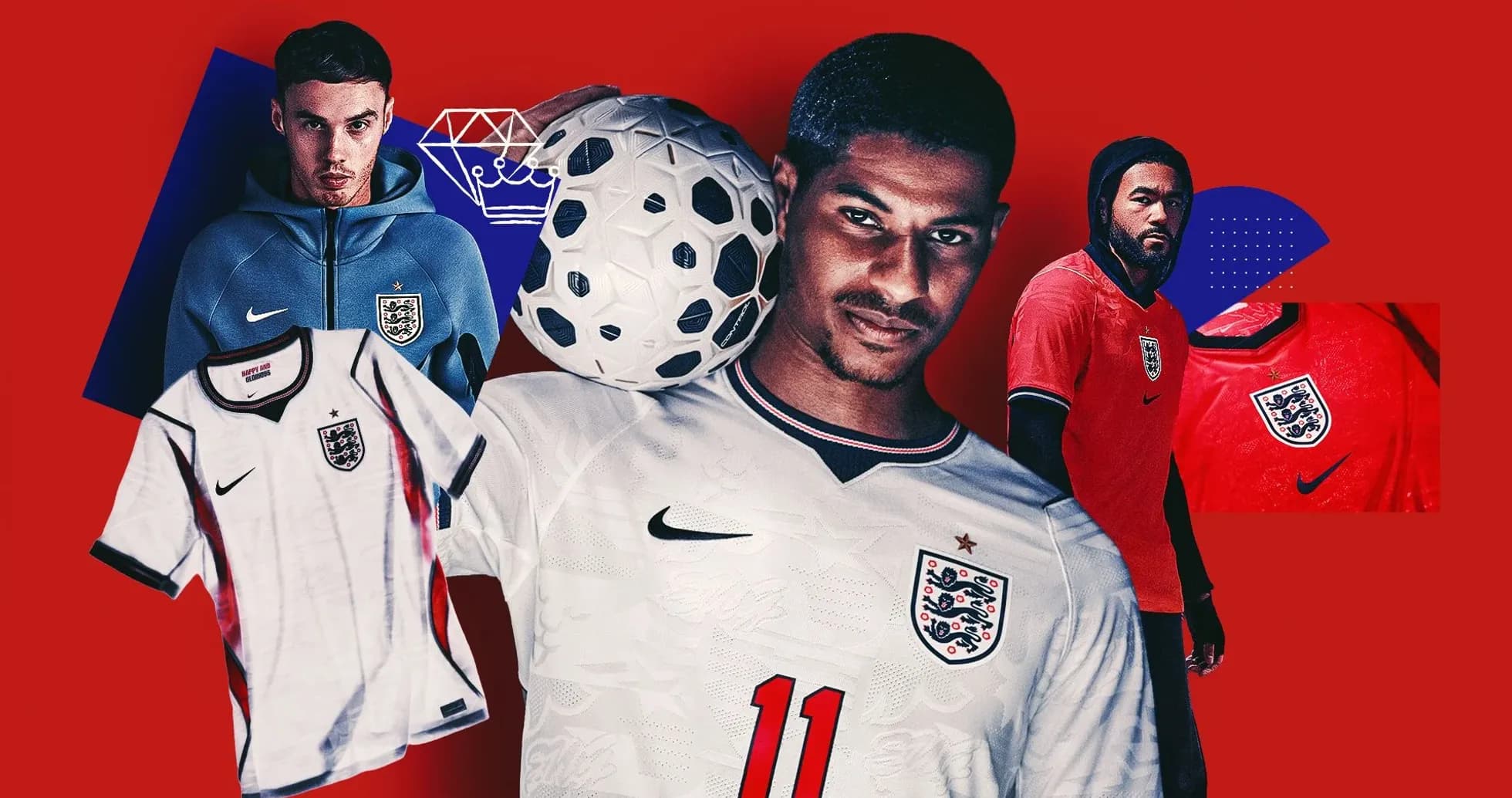
Go through the archives and the reference points jump out. The 2026 home shirt is closest in spirit to the Umbro classic of 2000: clean, unfussy, a solid crew neck, red accents doing the heavy lifting. Look again and there’s a whisper of 1988 in there too, that late‑80s simplicity carried forward into a sharper, modern cut.
This is not nostalgia for nostalgia’s sake, though. Nike have laid a subtle all‑over Three Lions motif across the fabric, a pattern you feel as much as see, with bold red numbering and trim snapping against the white. The collar and cuffs carry that same red detailing, framing a shirt built unapologetically around the heritage of English football. It looks like an amalgam of eras, stitched together into one statement piece.
“The home kit feels familiar yet newly assertive,” Nike say, “honouring history while signalling England’s reawakening on the global stage.”
That’s the pitch: old soul, new edge.
If the home strip leans on memory, the away kit is chasing legacy. It has the potential to become iconic, but only if England under Thomas Tuchel turn promise into something more tangible in North America this summer. Tournament success always decides which shirts end up on bedroom walls for decades.
England are back in red away shirts for the first time since 2022, a colour that always carries extra emotional weight. This time, the red top is paired with navy shorts, a classy combination that nods to the darker blue accents on the shirt itself. The design language mirrors the home: the same Three Lions iconography, the same centralised crest and Nike Swoosh planted firmly on the chest.
The twist comes in the details. Shirt numbers and names are in white, set in a retro‑inspired typeface that feels lifted from an older age of international football. It’s a calculated “historic shift”, as Nike frame it, a bolder visual identity for an England side they describe as “future‑facing, willing to challenge convention while remaining rooted in tradition.”
Beneath the aesthetics, the technology is pure 2026. Both kits are built with Nike’s Aero‑FIT performance cooling system, designed to cope with the brutal summer heat in the United States, Canada and Mexico. Open and closed mesh zones create channels for air, delivering more than twice the airflow of traditional fabrics and carving out space between material and skin when the temperature and stakes spike.
There is another layer to the story: sustainability. The shirts are made from 100% recycled textile waste, transformed through an advanced chemical process into a yarn that, Nike say, matches the quality of virgin material. In an era where fans increasingly scrutinise what their clubs and countries wear as much as how they play, that matters.
No Nike x England launch lands quietly. The kits arrive wrapped in a polished campaign that leans heavily into the mood of a country bracing for another emotionally draining summer with its national team.
Nike’s headline video stars young baller and social media figure Chance Campbell, perched on the famous Wembley arch, deep in conversation with a friend about what it will take for England to finally go all the way. “It takes guts, glory, determination,” he says. “I’m telling you, this time’s gonna be different.” The line hangs there, part belief, part challenge.
As the hype builds, Campbell turns to Cole Palmer, the Chelsea playmaker now central to England’s hopes, and asks if he’s in. Palmer doesn’t hesitate. “I’ve got you boss,” he replies, a simple promise set against the London skyline.
England’s own promotional film hits just as hard, if not harder. A collaboration between DJ Fred Again and The Streets’ Mike Skinner provides the pulse and the voiceover, a euphoric montage of “corner shops to Sunday roasts”, of everyday England in all its quirks and contradictions. The focus is “hope” – the idea that football, at its best, can cut through a time of deep political and social uncertainty.
“Can the Jules Rimet come home again? To England, to this green and pleasant land,” Skinner’s spoken‑word piece concludes, landing on the question that has stalked every generation since 1966.
Nike have read the national mood with precision. They lean into the fractures, the sense of drift, and counter it with the unifying force of a major tournament. When the country feels stretched and divided, the sight of a white or red England shirt still has the power to pull people into the same conversation, the same living room, the same beer garden.
Times are undeniably tough, but as Skinner puts it, “the beautiful game brings hope” and can still act as a vehicle for positive change. If, after six long decades, the World Cup does finally come home this summer, these kits will be instantly elevated, joining the red of 1966 in the national imagination.
Because these are not just pieces of performance fabric. They are declarations. Wearable flags. Statements of pride in a country wrestling with itself yet still capable of coming together for 90 minutes at a time. The question now is simple: can the team inside these shirts live up to the weight they carry?