Pep Guardiola's Emotional Journey in A Beautiful Obsession
Pep Guardiola has never been shy of the camera. But nothing in his Manchester City story has been filmed quite like this.
Amazon’s four-part series, A Beautiful Obsession – shot and controlled by City, yet far from a sanitised club puff-piece – walks straight into the wreckage of his bleakest season and refuses to look away. The winter collapse of 2024-25 is not glossed over; it is the spine of the story.
Nine defeats and a single win in 13 games. A “machine built for winning”, as chairman Khaldoon al-Mubarak calls it, suddenly coughing and spluttering in the cold. The aura gone. The questions relentless.
And at the centre of it all, Guardiola, stripped back.
A manager on the brink
From Wednesday on Prime, viewers will see a version of Guardiola that has never really been public. Not the touchline conductor, not the serial winner. A man flailing for answers, and failing to find them.
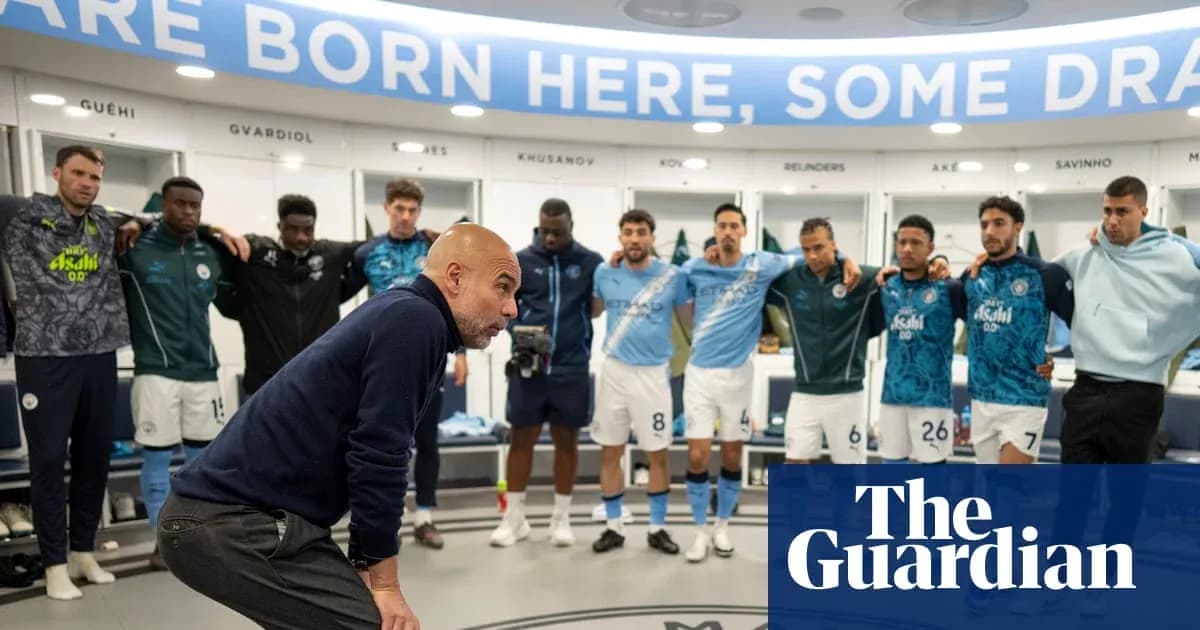
The series dives into the Champions League defeat by Juventus on 11 December 2024, a 2-0 loss that marked City’s seventh reverse in 10 games. In the dressing room, Guardiola reaches for something deeper than tactics or pressing triggers. He reaches for his private life.
“I’m fucking divorced from the most beautiful woman on your planet,” he tells his players, referring to the end of his marriage to Cristina Serra. “I love her unbelievably, but we lost the passion. How do you play football, because you are paid? Or because of something inside? Where is the passion?”
It is a startling choice of ammunition. Guardiola is entitled to use his own life as material, but the effect is jarring. The speech blurs the line between the professional and the personal, and risks making him look exposed in front of a squad he is supposed to command. Especially when, elsewhere in the series, he spells out his own definition of leadership: “You have to convince your players [that they would] go to the penthouse, the roof and jump down [for you].”
The sense of a man carrying too much only grows. A year later, after he makes 10 changes for a Champions League tie at home to Bayer Leverkusen – a gamble that ends in a 2-0 defeat – he returns to the same theme in another address to the dressing room.
“I leave my life, my divorce and my family is away, and everything for all of you. And what do you give back?”
The question hangs heavy.
“You’re seeing a human being”
If Guardiola’s emotional speeches feel raw, the documentary then reveals an even more intimate twist. Manuel Estiarte, his long-time confidant and City’s director of first-team operations, explains that he went to the players himself to spell out what their manager was going through.
Estiarte tells them Guardiola is “anxious, sad, different” because he is getting divorced.
“I said to the team: ‘Please, you have to understand, you’re not playing with a coach who can be a bit impulsive, intense, sometimes a bit up and down. You’re seeing a human being. He’s getting a divorce.’ It was necessary for the team not only to visualise Pep as a manager but for the first time as a human being.”
The admission prompts as many questions as answers. Why did Guardiola not deliver this himself, if the aim was to deepen the bond with his squad? And behind the scenes, did Khaldoon and chief executive Ferran Soriano ever sit down and ask the blunt question: is the manager’s private turmoil affecting his ability to do his job?
Just as the tension seems to peak, the series cuts to a different Guardiola. Smiling. Reflective. “In my life I made a lot of changes – I got divorced and I have to settle a bit. But no complaints at all honestly,” he says, before qualifying his happiness. “In my job, yeah.”
The message is clear: the work still anchors him. But the cost is obvious.
Captains, loyalty and Anfield tears
Relationships run through the documentary like a thread. Episode three is even titled Love and Hugs. Yet the first part, The Desert, shows how fragile those bonds can become when results turn.
In January 2025, with City reeling, Kyle Walker walks away. The club captain leaves at the precise moment his leadership is most needed. Guardiola is close to tears as he addresses the squad, accusing Walker of failing to act like the figurehead they chose.
He then turns the spotlight on them.
Why, he asks, if they voted for Walker as captain, did they not pin him to the wall and demand he stay? Why did no one hold him to the standards the badge demands?
The sequence that triggers Walker’s exit is filmed with cinematic care. In the Anfield dressing room, after Walker’s error leads to a penalty converted by Mohamed Salah in a 2-0 defeat to Liverpool, Guardiola points out the mistake. Walker snaps back, complaining he is being singled out “every meeting”.
The confrontation ends with Guardiola in tears, delivering a monologue about why he signed a new contract only 11 days earlier, in the middle of the crisis. He insists he did it to fight, to stay in the storm. The camera lingers on Walker, silent now, absorbing every word.
“If captains first, then the other ones, for example [feel] that there’s a problem, tell me,” Guardiola says. “It’s not going to change the love I have for all of you. I’m sorry.”
It is one of the most naked moments of his career, captured not in a press conference, but in the sanctity of the dressing room.
Saying goodbye to Kevin De Bruyne
Episode two opens with another rupture. Kevin De Bruyne, the greatest player of City’s modern era, is not offered a new deal. Soriano stresses to Khaldoon that “Kevin gets the respect he deserves as the greatest player in the modern history of City”, but the decision is made: the club must move on.
Guardiola reveals that “Super Kev” broke down in his office when he learned his time at City was over. The manager admits there had to be a cold edge to the call. Sentiment could not outweigh the logic of a rebuild.
The cameras then catch De Bruyne in tears when he is asked what he will miss most. “My kids don’t want to go,” he says.
The line cuts through all the talk of systems and trophies. It is a reminder that beneath the hardened exterior of elite sport, careers uproot families. Children lose friends. Homes are left behind. The documentary leans into this, underlining that the passion Guardiola demands is not some abstract concept; it is bound up in real lives.
When the board bite back
The series does not spare Guardiola from internal criticism either. His decision to change 10 outfield players for that November 2025 Champions League defeat to Leverkusen comes under direct fire from the very top.
“Our attitude with Pep Guardiola should not be too negative. But it shouldn’t be too kind or accommodating either. This is his mistake this time,” Soriano says.
Khaldoon goes further. “To pick an entire new [outfield] team in a game this important is probably one of the lowest points we’ve had. I can’t speak to him – I’m so angry.”
The anger is not edited out. It stays in, and it stings. For a club that has often appeared ruthlessly aligned from boardroom to bench, the crack is striking.
Twenty trophies and an exit
And yet, by the time the fourth and final episode, Nothing Is Eternal, draws to a close, the landscape has shifted again.
City claw back some pride. The Carabao Cup and FA Cup arrive to push Guardiola to 20 trophies in a decade at the club, including three Community Shields. The league title escapes them, but they finish second. The rebuild he spoke of is, in broad strokes, complete.
The farewell is suitably grand. Guardiola, drained but decorated, gets the send-off his body of work demands. The cameras follow him into the next chapter, or at least up to the door.
“Life should not just be about football. It’s too much to be honest,” he says.
For a man who has lived inside the game’s most intense pressure cooker, and allowed the world to watch as it boiled over, that might be the most revealing line of all.