Pep Guardiola: Redefining Premier League Tactics
When the history of the Premier League is written, Pep Guardiola’s name will not just sit alongside the great managers. It will run through the tactics, the training pitches and the touchlines of almost every club that followed.
Ask the coaches now patrolling those technical areas who shaped their footballing ideas and one name dominates. Guardiola has not simply won titles with Manchester City; he has redrawn the division’s tactical map, then moved the compass again before anyone else could catch up.
This is how he did it.
The Goalkeeper Revolution – And the Full Circle
One of Guardiola’s first acts at City set the tone. Joe Hart, a fans’ favourite and England’s No 1, was out. Claudio Bravo came in, then Ederson. The message was blunt: if you could not play with your feet, you could not play for him.
At the time, it felt radical. English goalkeepers were still judged primarily on shot-stopping and crosses. Guardiola wanted a playmaker in gloves, a man who could split a press with one pass. He was mocked for it. Then the league bent to his will.
Fast-forward a decade and the idea of a top-flight side without a ball-playing keeper feels almost prehistoric. Manchester United moved from David de Gea to Andre Onana. Arsenal swapped Aaron Ramsdale for David Raya. Chelsea cycled through Edouard Mendy, Kepa Arrizabalaga and Robert Sanchez in search of that blend of passing range and composure.
The copycat effect was clear. But the story did not end there.
As high pressing from goal-kicks intensified and teams pushed man-to-man into the box, the risk of building short grew. Space opened not near your own penalty area but 40 yards higher. Guardiola, typically, read the shift before most.
At City, the very symbol of his goalkeeper revolution, Ederson, made way for Gianluigi Donnarumma. A giant of a keeper, dominant in one-on-ones, but no one’s idea of a natural quarterback. Donnarumma’s heroics in Paris St-Germain’s Champions League triumph had convinced Guardiola that the marginal gains now lay in pure goalkeeping, not just distribution.
City did not abandon the short build-up entirely. In certain games, Bernardo Silva or Rodri would still drop almost onto Donnarumma’s toes to take the ball, turning the first phase into something resembling a five-a-side game in a crowded sports hall. But the emphasis had shifted. The safety net at the back had thickened.
Others followed. United, having pushed all-in on Onana’s passing, pivoted again to Senne Lammens, a more traditional stopper. Within roughly a decade, the league’s goalkeeping fashion had completed a remarkable loop: from pure shot-stoppers, to pure playmakers, and back to a hybrid where saving the ball, under extreme pressure, suddenly felt like the ultimate modern skill.
Guardiola had started the revolution. Then he quietly rewrote its rules.
From Makeshift Full-Backs to a New Blueprint
City’s 100-point season in 2017-18 is remembered for its records and relentlessness. Less discussed is how it was born out of necessity.
Injuries stripped Guardiola of natural full-backs early in that campaign. For a coach caricatured as a man who demands perfect conditions and perfect squads, this was a stress test. He responded by inventing a new role.
He looked at his left-footers. Oleksandr Zinchenko, a midfielder by trade. Fabian Delph, another central player. Both were technically secure, comfortable in tight spaces. So he pulled them infield from left-back, stationing them alongside the holding midfielder. The left-back became an extra central midfielder in possession, the winger stayed wide, and City suddenly controlled the middle of the pitch with an extra man.
It was a jigsaw that clicked instantly. Opponents could not work out who to press, or where the spare player would pop up. The inverted full-back became a Guardiola signature, and the rest of the league took notes.
When Mikel Arteta later took Zinchenko to Arsenal, the pattern reappeared. Arsenal’s most fluid spells under Arteta have come with those same inverted movements from the back, full-backs stepping into midfield and the ball zipping through the lines.
Ange Postecoglou, another Guardiola disciple, used a similar structure at Tottenham. Pedro Porro and Destiny Udogie often appeared in central pockets next to the holding midfielder, turning Spurs’ build-up into a revolving carousel.
Guardiola kept pushing the idea. In 2018-19, with Zinchenko out, Aymeric Laporte, a left-footed centre-back, shuffled to left-back. In the Treble-winning 2022-23 season, Manuel Akanji and Nathan Ake played as nominal full-backs either side of Ruben Dias and John Stones. Stones stepped into midfield, the line flexed and folded, and City’s back four looked more like a three-plus-one puzzle than a traditional defence.
The knock-on effect across the league has been striking. Newcastle’s 6ft 7in Dan Burn now operates as a left-back who tucks inside to form a back three in possession, then shuffles back out wide without the ball. It is a direct echo of the Guardiola template: strength and height outside, intelligence and security inside.
Centre-Backs, Full-Backs, and the Blurring of Lines
Guardiola’s full-back revolution did not stop at inverting them. It blurred positions altogether.
With Joao Cancelo, he fielded a defender who could appear on the touchline one minute and between the lines the next, drifting into central attacking zones. With Nico O’Reilly, he has tested a similar idea: a full-back stepping high, almost as an extra No 8, arriving late in the box and adding goals to the role.
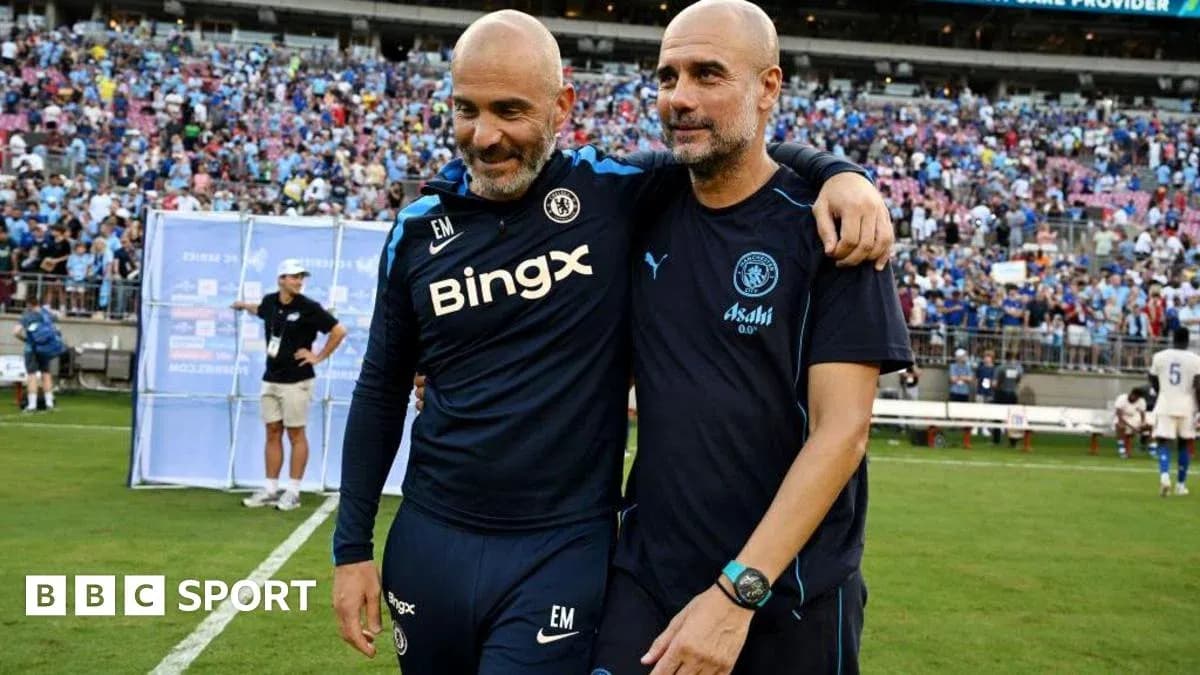
Arteta has picked up the baton at Arsenal with Jurrien Timber and Riccardo Calafiori, defenders who slide inside, step out, or drive forward depending on the phase. At Chelsea, under former Guardiola assistant Enzo Maresca, Malo Gusto and Marc Cucurella have been asked to do many of the same things: defend the flank, then flood central spaces when the ball is theirs.
This is Guardiola’s influence at its most visible. The old, tidy labels – full-back, centre-back, midfielder – have become fluid. The starting position on the team sheet tells you less and less about where a player will actually spend the game.
Owning the Ball, Owning the League
Guardiola’s deepest conviction has never changed: he wants the ball. Not just more than the opponent. Almost all the time.
At Barcelona, a Champions League tie against Inter Milan marked a turning point. With Zlatan Ibrahimovic up front, he strayed from his usual plan, accepted less possession and tried to attack more quickly. Privately, he felt he had betrayed his own football. He vowed not to repeat it.
City under Guardiola have been the purest expression of that promise. In 2017-18, they averaged 71.9% possession. Since then they have never dipped below 60% across a league season. Six Premier League titles in seven years with that approach did more than fill a trophy cabinet. It reset the expectations of what “normal” looks like at the top of English football.
The ripple effect is everywhere. Liverpool, under Arne Slot, claimed the title in his first season with a style closer to Guardiola’s controlled, positional game than Jurgen Klopp’s more chaotic, heavy-metal pressing. Arsenal, under Arteta, have married a ferocious defensive record with a clear desire to dominate the ball.
Brighton’s entire project has leaned into that same idea. From Roberto De Zerbi to Fabian Hürzeler, they have hired coaches who want to impose themselves through possession, not react to the opposition. The footballing logic flows straight back to Guardiola’s City.
Not every disciple has thrived. Scott Parker, Vincent Kompany and Russell Martin all tried to stick to a possession-first philosophy in the Premier League. They struggled, not because the idea itself was flawed, but because their squads could not execute it at the level required – and because they refused to dilute the principles. Their failures underline just how high Guardiola has set the bar for this kind of football.
From Ferguson’s England to Guardiola’s
Before Guardiola, the Premier League’s defining tactical imprint belonged to Sir Alex Ferguson. Pace, width, direct running, ferocious counter-attacks – his Manchester United sides embodied English football’s self-image.
That DNA has not vanished. Under Michael Carrick, United have leaned back into their counter-attacking heritage, looking to break quickly and strike in transition. Yet the broader picture is clear: the league’s best sides now tend to measure themselves by how well they can control games with the ball, not by how quickly they can get rid of it.
Guardiola walked into a division built in Ferguson’s image and quietly reprogrammed its elite. Not by decree, but by winning. Repeatedly.
Adaptation, Not Dogma
One myth persists: that Guardiola arrives, imposes a rigid style, and forces everyone else to follow. The reality is subtler – and more impressive.
He does cling to core principles: possession, positional structure, technical quality. Around those pillars, though, he constantly bends and reshapes. Injuries, new signings, emerging trends in the league – all of them feed into his next iteration.
He has won with false nines and with orthodox centre-forwards. With wingers hugging the touchline and with wide players drifting inside. With inverted full-backs and with old-fashioned, stay-at-home defenders. With a goalkeeper who passes like a midfielder and, later, with one who saves like a throwback.
Each time he finds an edge, the league scrambles to replicate it. Each time the imitation gathers pace, he has already shifted to something new.
That, more than any single tactical wrinkle, is Guardiola’s true legacy in the Premier League: he turned a league famous for its stubbornness into one obsessed with adaptation. The rest are still chasing his last idea. He is already working on the next one.