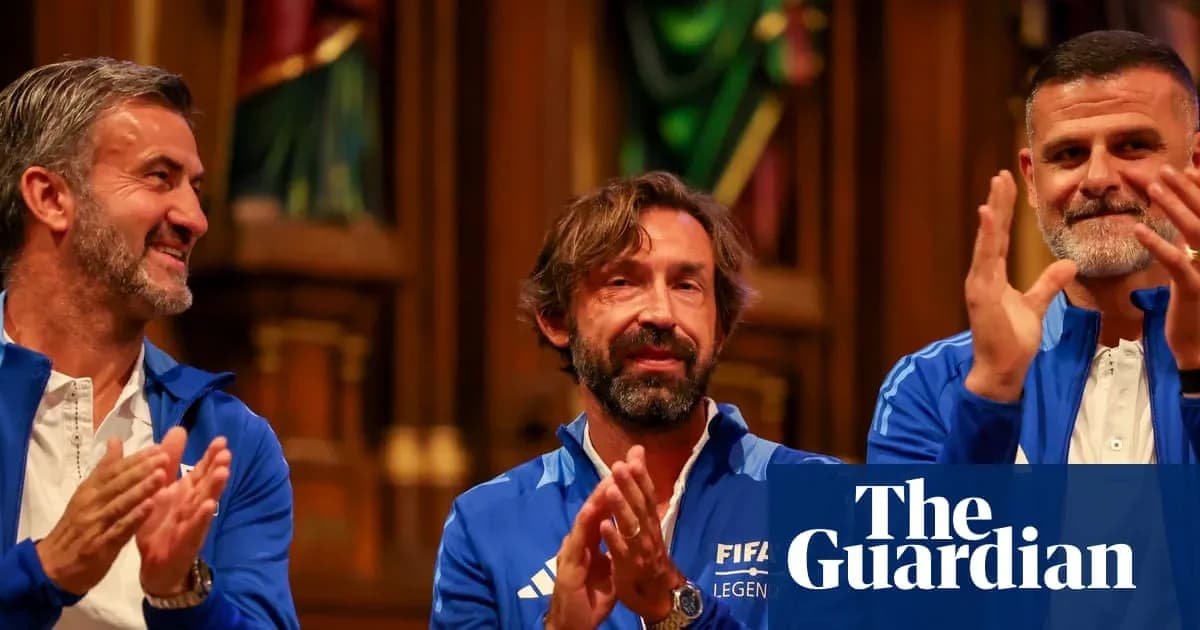
Andrea Pirlo's Italy Coaching Dream Ends Amid Political Storm
Andrea Pirlo’s Italy dream is over before it truly began. And it has not been ended by tactics, results or a dressing-room split, but by a sponsorship deal and a political storm that Italian football could see coming a mile away and still failed to avoid.
Pirlo confirmed on Monday that he is no longer in contention to become Italy’s next head coach, revealing on Instagram that he “heard last night that I’m no longer the candidate for the Italy national team job”. The decision comes after days of fierce debate over his role as an ambassador for Fonbet, a Russian betting company, and whether that sits in direct conflict with Italy’s support for Ukraine.
The 2006 World Cup winner has tried to draw a clear line between football and geopolitics. He previously stressed that the Fonbet agreement stemmed from his work in the United Arab Emirates and was, in his words, “exclusively for commercial and sports purposes”, arguing that anyone attaching political meaning to the deal was assigning him “beliefs… that I have never expressed and don’t belong to me.”
That distinction cut no ice in Rome.
Political backlash drowns out Maldini’s backing
Even with the support of Paolo Maldini, the newly appointed technical director of the Italian football federation (FIGC), Pirlo’s candidacy quickly turned toxic in the political arena. What began as a debate about his coaching credentials turned into a litmus test on Italy’s stance toward Russia.
Several Italian politicians lined up to condemn the idea of the national team being led by a man fronting a Russian brand. For them, the issue was not whether Pirlo could organise a back four, but whether he could represent a country that has taken a clear position on the war in Ukraine.
Pina Picierno, vice-president of the European Parliament, did not mince her words. Posting on social media, she argued that after “yet another defeat and another missed World Cup qualification”, Italian football needed nothing less than a “cultural, ethical and managerial revolution” — and that “the choice of Andrea Pirlo goes in the exact opposite direction.”
The criticism cut across party lines. Ignazio La Russa, president of the Senate and a leading figure in Giorgia Meloni’s party, questioned the appointment on sporting grounds as well as symbolic ones. Speaking to Ansa, he said: “God help us. Of course I am an Italy fan and Pirlo was a great champion, but as a coach, it is a leap in the dark.”
Carlo Calenda, leader of the Azione party, went straight to the heart of the political dispute. “Anyone who is or has been promoting Russia after 2022 should not hold national office,” he said. In that single line, Pirlo’s commercial contract became a disqualifying act.
Once those words were out, the momentum shifted decisively. Maldini’s endorsement, Pirlo’s pedigree, his readiness to walk away from his current role at Dubai United — all of it was drowned out by the noise from parliament.
A search already on the back foot
Pirlo’s withdrawal exposes a federation scrambling in the dark. The FIGC had already missed out on its top targets. Approaches to Pep Guardiola and Carlo Ancelotti, ambitious to the point of fantasy, came to nothing. Both remained firmly committed to their clubs, leaving the federation to pivot toward a former Azzurri icon willing to take on a monumental rebuild.
Pirlo, prepared to leave Dubai United to answer the call, looked like a pragmatic, if risky, choice for a team that has failed to qualify for three consecutive World Cups. His name brought instant prestige. His coaching record, still thin at elite level, brought doubt. His commercial ties brought uproar.
The pressure finally told.
Gattuso’s departure by mutual consent in April, after that latest World Cup failure, had already underlined the depth of Italy’s crisis. The national team, once a byword for tournament resilience, now stands as a case study in decline. The FIGC’s response has been to chase star power on the bench — Guardiola, Ancelotti, now briefly Pirlo — while the political class demands moral clarity and a break with the old ways.
Instead, Italy is back where it often ends up: looking to the past.
Old names, familiar dilemmas
With Pirlo out, the carousel swings back to two men who know the job intimately: Roberto Mancini and Antonio Conte. Both have already carried the weight of the Azzurri. Both left under very different circumstances. Both are now being discussed again.
Mancini delivered Euro 2020 glory, only to see his project unravel with that catastrophic World Cup qualifying exit. Conte brought intensity and structure during his spell, and remains one of the game’s most demanding, high-profile coaches. Either appointment would offer experience, authority and a clear identity — but neither represents the fresh cultural reset that so many politicians are now calling for.
That is the paradox facing Italian football. It craves revolution, yet keeps circling back to the same names.
Pirlo, caught between the federation’s need for a new face and the country’s insistence on an unambiguous political stance, has become collateral damage in a broader struggle over what the national team should represent in 2024 and beyond.
The FIGC must now decide whether to double down on familiarity with Mancini or Conte, or risk another leap into the unknown. With a fanbase weary of failure and a political class watching every move, how many more missteps can Italy afford?