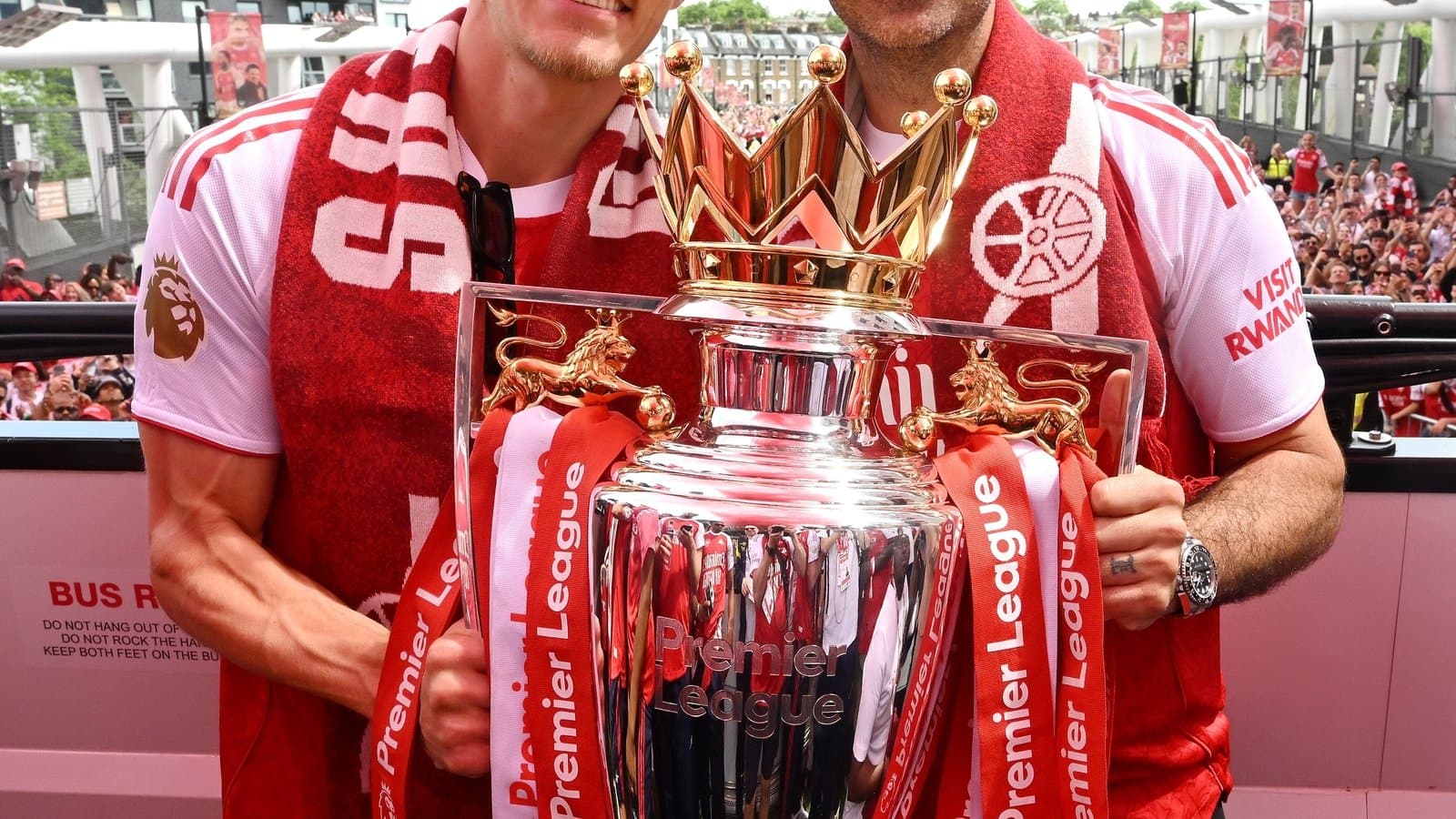
Premier League Trophy Returns After 22 Years
The Premier League trophy finally belongs to them again, 22 long years after they last finished top of the table. At Selhurst Park last month, under a sky thick with noise and colour, Martin Ødegaard gripped the handles, raised the silver crown high and let the moment wash over the away end. The title was secured. The lap of honour would come later. This was the instant it became real.
A few weeks on, the trophy sits safely in the club’s cabinet, no longer a dream or a target but a polished, weighty reminder of a season that rewrote history. Up close, it tells its own story.
A heavyweight prize
Every player wanted their photograph with it, of course. They also got a reminder of what a title race feels like in their arms.
The Premier League trophy weighs 9.5kg – about 1.4 stone – without its base. Add the engraved base that carries the roll call of champions and the figure jumps to 25.4kg, or 4 stone. No wonder some players’ celebrations turned into a brief strain and a quick readjustment of grip before the cameras flashed.
It is not some hollow prop. It’s built to feel like the end of a journey.
Built to dominate the room
Stand in front of it and it looms over the table. From the bottom of its engraved base to the tip of the crown, the trophy measures 104cm, or 3ft 5in. Across, it stretches 61cm, roughly 2ft wide, broad-shouldered and unmistakable.
There isn’t just one, either. The Premier League keeps two identical trophies, each carrying the champions’ names around the base. One lives with the holders during the season, the other is used by the league for its own duties and logistics. On presentation day, they are indistinguishable: the same shine, the same crown, the same history etched in metal.
The Three Lions in silver and stone
Look down to the base and the past stares back. Every champion from 1993 is listed there, season by season, right through to the newest engraving: 2025/26.
That base is carved from malachite, a semi-precious stone sourced in Africa. Its deep green ring around the opaque stone is no accident – it represents the field of play, the pitch on which titles are won and lost. Above it rises the main body of the trophy, cast by Asprey London, the Crown Jewellers, in solid sterling silver. The crowns at the top are fashioned from 24-carat silver gilt, catching the light in every stadium and every dressing room celebration.
The whole design leans on a single idea: “The Three Lions of English Football”. Two golden lions stand on either side of the trophy. The third appears only when the captain steps forward, wraps his hands around the handles and lifts the silver above his head. In that moment, he becomes the final lion in the crest.
At Selhurst Park, Ødegaard filled that role, framed by a wall of travelling supporters and a season’s worth of emotion.
How long does glory stay on the shelf?
For now, one of the two trophies remains in the club’s possession. It will travel, be photographed, paraded, touched by thousands of hands and millions of camera lenses. It will become part of the daily scenery at the training ground and the stadium, a constant reminder of what it took to get there.
But it is only on loan.
The Premier League requires the holders to return their trophy at least three weeks before the final round of the following season. By then, the engraving tools will be ready, the ribbons will be waiting, and another captain will be preparing to step up as the “third lion”.
The question now is simple: when that moment comes again, will this club be the one lifting it back?