PSG Completes Comeback Against Monaco in Champions League
At Stade Louis II, in a breathless UEFA Champions League Round of 32 tie, Paris Saint Germain overturned a two-goal deficit and a raucous start from Monaco to win 3–2 and consolidate their upper-mid position in the continental standings. Folarin Balogun’s quickfire brace had Sebastien Pocognoli’s side dreaming, but Enrique Luis’s visitors responded with a dominant display of control and patience, capped by a decisive second-half strike from substitute Désiré Doué. The result leaves Monaco, 21st in the overall table on 10 points and a -6 goal difference, still competitive but clearly a tier below PSG’s 11th place, 14-point platform.
First Half Analysis
The game exploded into life almost immediately. After just 1', Monaco struck: Folarin Balogun finished a move supplied by Aleksandr Golovin, giving the hosts a dream start. PSG were rattled again on 18' when Balogun doubled the lead, this time fed by Maghnes Akliouche, as Monaco maximised their early attacking efficiency.
Monaco’s defensive edge soon showed. Wout Faes went into the book for a foul on 21', signalling rising physicality at the back as they tried to contain PSG’s front line. Enrique Luis reacted early, withdrawing Ousmane Dembélé on 27' and sending on Désiré Doué in an attacking like-for-like switch on the right.
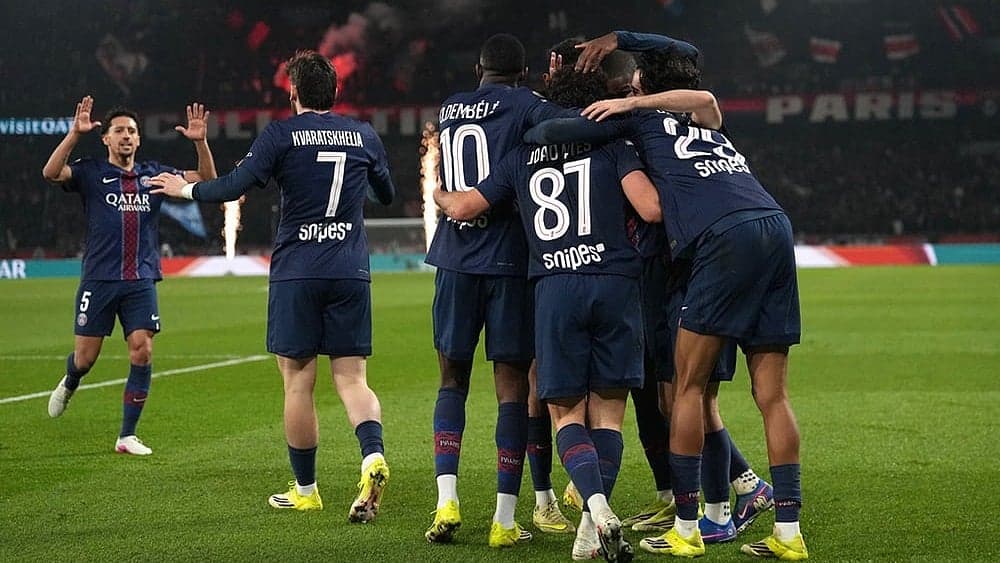
The change paid off almost instantly. On 29', Doué pulled one back, finishing after good work from Bradley Barcola. Monaco’s midfield bite then cost them again, Denis Zakaria receiving a yellow card for a foul the same minute. PSG’s pressure continued to grow and, on 41', Achraf Hakimi levelled the tie at 2–2, assisted by the lively Doué. By half-time, Monaco’s two-goal cushion had vanished, and the momentum was firmly with the visitors.
Second Half & Tactical Shifts
The second half turned on discipline and numbers. Just after the restart, VAR intervened on 47' for a “card upgrade” incident involving Golovin. One minute later, the decision proved devastating for Monaco: Golovin was shown a straight red card for a foul on 48', leaving Pocognoli’s side to play the entire second period with ten men.
Trying to rebalance his shape and inject fresh legs, Pocognoli made his first change on 58', withdrawing creator Akliouche and introducing Krépin Diatta, a winger capable of working both flanks and offering counter-attacking outlets. Yet with a man advantage, PSG were patient rather than frantic.
Their superiority told on 67'. Doué, already central to the comeback, struck again, this time finishing from a pass by Warren Zaïre-Emery to make it 3–2 to PSG. With the lead secured, Enrique Luis looked to maintain control rather than chase more goals. On 69', he replaced Khvicha Kvaratskhelia with Kang-in Lee in midfield, a move that added technical security and ball retention on the left side.
Monaco responded with a double change on 70', as Vanderson made way for Aladji Bamba and Simon Adingra was replaced by Mamadou Coulibaly. Those substitutions suggested a shift towards fresh defensive energy and midfield legs to survive waves of PSG possession, while hoping for transitions. Later, PSG introduced Gonçalo Ramos for Barcola on 81', a centre-forward swap to keep pressing Monaco’s back line. Two minutes later, Monaco removed their two-goal hero Balogun for Mika Biereth on 83', a like-for-like change up front that reflected fatigue and a final roll of the dice. Despite their effort, the ten men could not find an equaliser as PSG calmly saw out the closing stages.
Statistical Deep Dive
The numbers underline just how much of the ball PSG enjoyed. Paris controlled 80% possession to Monaco’s 20%, completing 801 passes with 92% accuracy compared to Monaco’s 198 passes at 73%. It was a textbook example of territorial and technical control from the visitors, while Monaco were forced into a compact, reactive posture for long spells.
In attack, PSG’s volume was overwhelming: 30 total shots, with 10 on target, against Monaco’s 7 efforts and 4 on goal. The expected goals figures — 2.51 for PSG versus 1.19 for Monaco — mirror both the shot count and the quality of chances, with the visitors converting roughly in line with their xG. Monaco, by contrast, were highly clinical early on, scoring twice from relatively limited opportunities, but struggled to generate further threat once down to ten men.
Discipline was a decisive fault line. Monaco committed 11 fouls to PSG’s 4, collecting two yellow cards and a crucial red for Golovin, while PSG avoided any bookings. That imbalance in fouls and cards directly influenced the numerical disadvantage and the game’s eventual outcome.
Standings & Implications
For Monaco, who sit 21st in the Champions League table with 10 points, 8 goals scored and 14 conceded, this defeat halts the positive momentum hinted at by a recent “DLWDW” form line and exposes their fragility against elite opposition despite a strong home record (unbeaten in four before this, with just two goals conceded). PSG, 11th with 14 points and a +10 goal difference (21 scored, 11 conceded), reinforce their status as a dangerous knockout-side, especially away from home where they now boast two wins from four. The result keeps Enrique Luis’s team firmly on track in the play-off picture, while Monaco must tighten discipline and defensive structure if they are to bridge the gap to Europe’s upper tier.