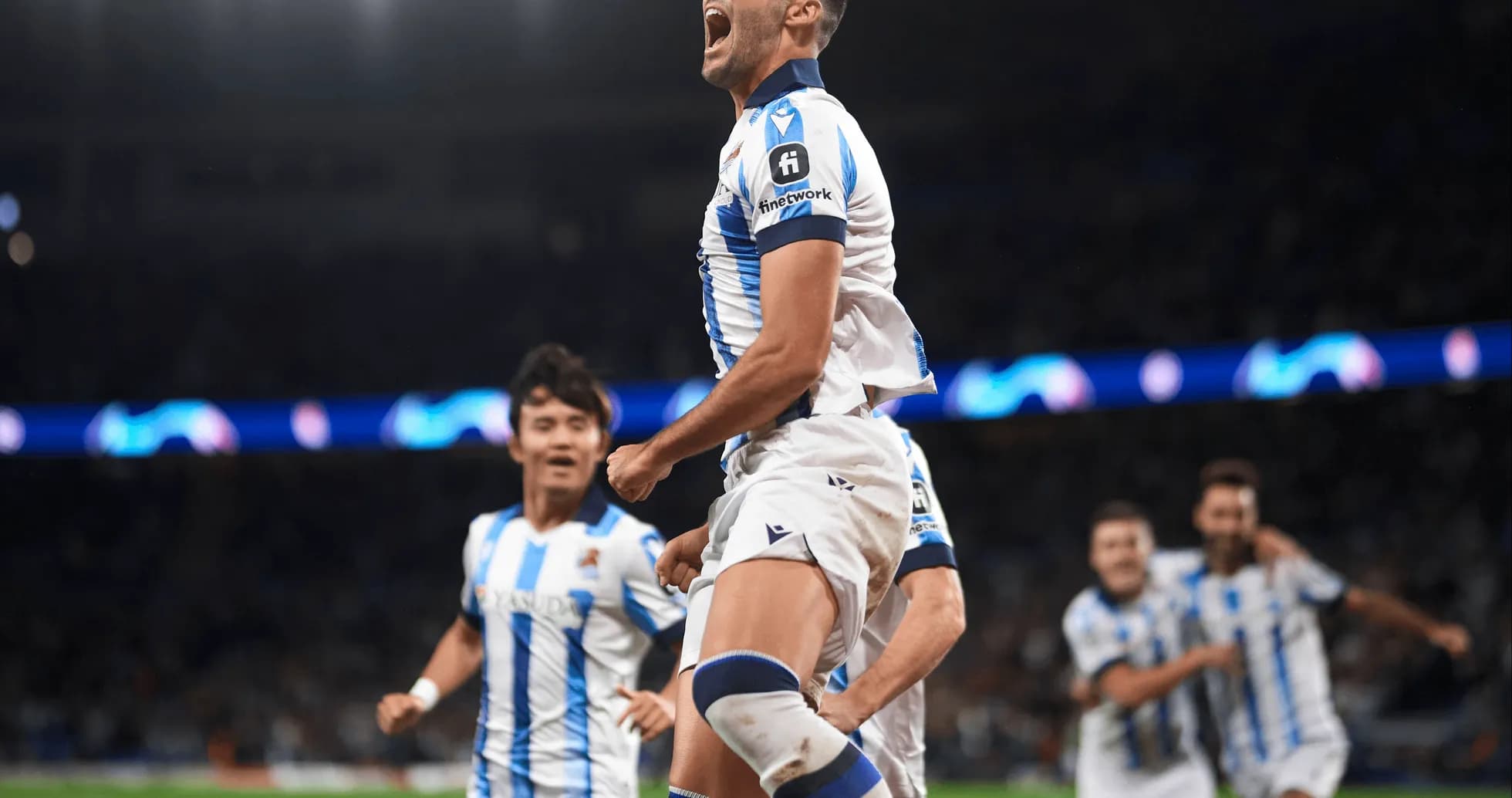
Real Sociedad vs Alaves: A Chaotic 3-3 Draw at Reale Arena
Real Sociedad and Alaves produced a volatile 3-3 draw at Reale Arena in La Liga’s Regular Season - 31, a match where structure and control repeatedly gave way to chaos. Real Sociedad, in a 4-2-3-1 under Pellegrino Matarazzo, had more of the ball and the passing rhythm, yet never translated that territorial edge into a safe game state. Quique Sanchez Flores’ Alaves, set up in a 5-3-2, absorbed pressure, attacked in direct waves, and capitalised on defensive errors and late numerical superiority after a red card. The halftime scoreline of 2-2 accurately reflected a contest where both teams’ attacking mechanisms outpaced their defensive security.
The scoring opened in the 3rd minute with a defensive calamity: Duje Ćaleta-Car, attempting to deal with early Alaves pressure, turned the ball into his own net to give the visitors a 1-0 lead. Real Sociedad responded through their positional play; in the 14th minute Luka Sučić finished a move assisted by Ander Barrenetxea, levelling at 1-1. Alaves struck back on 24 minutes when Ibrahim Diabaté found space to score, restoring the visitors’ advantage at 2-1. Just three minutes later, Real Sociedad were gifted parity again: Antonio Sivera registered an own goal in the 27th minute, leaving the score 2-2 at the 45-minute mark and into halftime.
Second Half
The second half began with Matarazzo adjusting his attacking line: at 46', Gonçalo Guedes (IN) came on for Ander Barrenetxea (OUT), seeking more direct threat from the left. On 54', Takefusa Kubo (IN) replaced Brais Méndez (OUT), injecting dribbling and verticality in the right half-space. The disciplinary phase started on 59', when Abderrahman Rebbach received a yellow card for a foul, signalling rising tension. One minute later, at 60', Quique Sanchez Flores altered his front line: Lucas Boyé (IN) came on for Ibrahim Diabaté (OUT), and in the same minute Real Sociedad took the lead for the first time, 3-2, as Orri Steinn Óskarsson scored from a Kubo assist.
The match then tilted into a stop-start rhythm. Kubo was booked for a foul in the 64th minute, followed by a yellow card for Ángel Pérez for argument in the 66th. In that same 66th minute, Alaves reshaped their midfield: Carles Aleñá (IN) came on for Jon Guridi (OUT) and Ander Guevara (IN) replaced Pablo Ibáñez (OUT), adding fresh legs and more ball circulation. Real Sociedad answered on 72', with Pablo Marín (IN) replacing goalscorer Óskarsson (OUT), a move that traded penalty-box presence for extra control. At 86', Luken Beitia (IN) came on for Luka Sučić (OUT) and Aihen Muñoz (IN) replaced Aritz Elustondo (OUT), signalling a shift towards protecting the lead. Simultaneously, Alaves brought on Denis Suárez (IN) for Ángel Pérez (OUT) at 86', adding creativity from deeper zones.
Stoppage time was defined by discipline and VAR. Sergio Gómez was initially involved in an incident reviewed at 90+2' (VAR card upgrade) and ultimately received a red card for a foul at 90+3', reducing Real Sociedad to ten men. In the midst of the emotional fallout, Guedes collected a yellow card for argument at 90+9'. One minute later, at 90+10', Denis Suárez himself was booked for argument as Alaves pushed for an equaliser. The numerical advantage and sustained pressure finally told when Lucas Boyé scored at 90' (within added time window) from a Denis Suárez assist, making it 3-3 and sealing a draw that felt like a defeat for the hosts.
Tactical Analysis
Tactically, Real Sociedad’s 4-2-3-1 was designed to dominate central zones through Beñat Turrientes and Carlos Soler as a double pivot, with Sučić as the advanced playmaker and wide creators Barrenetxea and Méndez. They achieved structural superiority in possession: 54% of the ball, 506 total passes with 83% accuracy, and nine corners. The front four consistently occupied the half-spaces, with full-backs Jon Aramburu and Sergio Gómez tasked with width. However, Real Sociedad’s attacking mechanisms produced only four shots on target from 12 total attempts and a modest xG of 0.94, underlining that much of their possession was sterile and that their three goals leaned heavily on an own goal and opportunism rather than sustained high-quality chances.
Alaves’ 5-3-2, by contrast, prioritised compactness and direct transitions. The back five of Rebbach, Victor Parada, Nahuel Tenaglia, Jonny Otto and Ángel Pérez stayed narrow, forcing Real Sociedad outside and trusting central congestion to block shooting lanes. Their three-man midfield of Pablo Ibáñez, Antonio Blanco and Guridi initially focused on screening and second-ball recovery, then evolved after the introduction of Aleñá and Guevara into a more progressive unit capable of linking to the forwards. Despite having only 46% possession and completing fewer passes (427 at 80% accuracy), Alaves matched Real Sociedad’s total shots (12) and slightly outperformed them in xG at 1.13, reflecting clearer looks at goal even with just two shots on target.
In goal, the contrast was stark. Álex Remiro did not register a single save, underlining how Alaves’ two non-own-goal strikes were either highly efficient or poorly defended, and that Real Sociedad’s defensive block was often breached before a save was required. Sivera, on the other hand, made two saves but also suffered the misfortune of an own goal, encapsulating a performance where Alaves’ last line bent but did not break, thanks largely to the structural protection of the back five.
Discipline and Defensive Behaviour
Discipline and defensive behaviour played a decisive role. Real Sociedad committed 11 fouls and collected two yellow cards (Kubo for a foul at 64', Guedes for argument at 90+9') plus the late red card for Sergio Gómez after a VAR-assisted upgrade sequence. Alaves, with 18 fouls, took on more risk in duels, drawing three yellow cards: Rebbach for a foul (59'), Ángel Pérez for argument (66') and Denis Suárez for argument (90+10'). The red card to Sergio Gómez fundamentally shifted the late-game dynamic, inviting Alaves higher and enabling the final equaliser.
Statistically, the verdict is of a match where Real Sociedad’s overall form with the ball—measured by possession share, pass volume and territorial control—was superior, but their defensive index was undermined by individual errors, an own goal and a lack of interventions from the goalkeeper. Alaves, with a lower overall form in terms of possession and passing, showed a stronger defensive index in the sense of compact shape, volume of defensive actions (18 fouls, multiple blocked shots) and the ability to keep Real Sociedad’s xG under 1. The 3-3 scoreline, when set against 0.94 xG for Real Sociedad and 1.13 xG for Alaves, highlights an encounter skewed by own goals and late-game state changes rather than a simple reflection of chance quality.