Roma's Dominance Over Lecce in Serie A Matchup
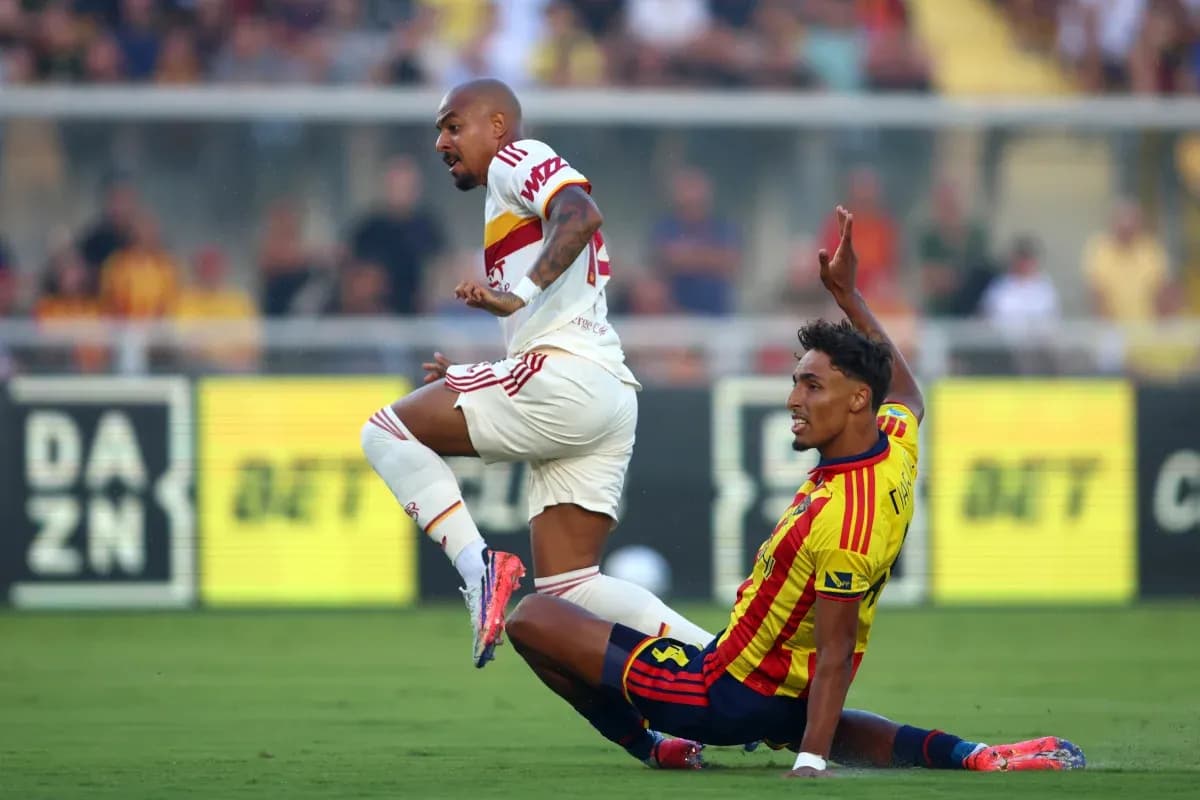
Stadio Via del Mare watched a mismatch of trajectories unfold. In Serie A’s Regular Season - 2, Lecce’s experimental 3-5-2 ran straight into the most ruthless early-season machine in Italy: AS Roma, top of the table and brimming with purpose. By full time, the scoreboard read 0-4, a reflection not only of Roma’s cutting edge but of a structural gulf between a side still learning its new shape and one already fully imprinted with its manager’s ideas.
I. The Big Picture – Two Games, Two Realities
Following this result, the standings snapshot is stark. Lecce sit 13th with 3 points from 2 matches, their overall goal difference at -2, derived from 2 goals scored and 4 conceded. The split tells the story of a split personality: on their travels they have been perfect, with 1 away win, 2 goals for and 0 against, but at home they have played 1, lost 1, scoring 0 and conceding 4. Stadio Via del Mare, traditionally a fortress of emotion, is currently a problem zone.
Roma, by contrast, leave Lecce as the early pacesetters. They are 1st with 6 points from 2 games, 8 goals scored and none conceded overall, giving them a goal difference of +8. At home they have played 1, scored 4, conceded 0; on their travels, they have again played 1, scored 4, conceded 0. The symmetry is ominous for the rest of the league: this is a side that travels with the same authority it shows in Rome.
The tactical DNA is already visible in the formations. Lecce’s shift into a 3-5-2 under Eusebio Di Francesco, after opening the season once in a 4-3-3, is a clear attempt to thicken the midfield screen and create wing-based outlets. Roma, however, are fully locked into a 3-4-2-1 that has been used in both league games, a shape that naturally overloads the half-spaces and punishes any hesitation in the back three.
II. Tactical Voids – Absences and Discipline
Roma’s dominance is even more striking given who was missing. L. Pellegrini (thigh injury), D. Rensch (muscle injury) and M. Bah (knee injury) were all ruled out of this fixture. That removes a captain-level playmaker, a dynamic full-back/defender and additional depth, yet the system held without visible strain. It underlines how Piero Gasperini Gian’s structure now outlives individual absences: the principles remain, even when the names change.
For Lecce, there are no listed absentees in the data, which makes the performance more concerning. This was close to full strength in terms of availability, and still the home side were overwhelmed.
Disciplinary patterns offer another lens. Overall this campaign, Lecce’s yellow cards are spread evenly: 25.00% in each of the 0-15, 46-60, 61-75 and 76-90 minute windows. That means their aggression – or desperation – tends to spike repeatedly rather than in one clear phase. Roma’s bookings, by contrast, are front-loaded: 33.33% of their yellows have come in 0-15, another 33.33% in 31-45, and 33.33% in 46-60. They start games on the edge, press high, and accept early fouls as the cost of control.
Individually, D. Malen and M. Kone already carry 1 yellow card each this season, anchoring Roma’s edge in the final third and midfield respectively. Yet there have been no reds, and with no penalties taken or missed by either side this campaign, discipline has not yet tipped into recklessness.
III. Key Matchups – Hunter vs Shield, Engine Room vs Screen
The “Hunter vs Shield” duel was always going to be defined by D. Malen. Heading into this game, he led the Serie A scoring charts with 5 goals from 2 appearances, firing 9 shots in total with 6 on target. His efficiency is backed by work rate: 14 duels contested, 6 won, plus 2 interceptions and 1 tackle. Malen is not just a finisher; he’s the first defender in Roma’s press.
Against him, Lecce’s defensive structure was anchored by Tiago Gabriel, one of their rare early-season bright spots. He has 1 goal this campaign and a solid defensive profile: 2 tackles, 2 interceptions and 4 duels won out of 5. In the back three with J. Siebert and K. Gaspar, Tiago Gabriel offered height and timing, but the system around him was stretched by Roma’s multi-layered attack.
Roma’s shield is not only at the back. M. Svilar has yet to concede a goal in Serie A 2026, protected by a back three of G. Mancini, M. Hermoso and D. Ghilardi that has allowed 0 goals overall, both at home and on their travels. In front of them, M. Kone’s 110 passes at 92% accuracy, 4 tackles and 14 duels (8 won) mark him out as the stabilising pivot who turns regained possession into structured attacks.
The “Engine Room” duel centred on creativity. For Roma, P. Dybala is the league’s top assist provider with 3 overall, supported by 7 key passes and 115 total passes at 84% accuracy. Operating behind Malen in the 3-4-2-1, he links the lines and decides tempo. Alongside him, Wesley Franca contributes 1 assist, 4 key passes and 6 tackles, blending playmaking with counter-pressing from midfield.
Lecce’s midfield five – D. Veiga, L. Coulibaly, O. Ngom, O. Gorter and C. Ndaba – were tasked with both screening and constructing. Yet the team’s overall numbers betray their struggle at home: they have failed to score in 1 home match and conceded 4 there, while their only clean sheet and all 2 goals have come away. The 3-5-2, as deployed here, offered bodies but not clear reference points to resist Roma’s rotations between the lines.
IV. Statistical Prognosis – Roma’s Ruthless Structure vs Lecce’s Growing Pains
Even without explicit xG values, the trends are clear. Roma’s overall average of 4.0 goals for per game, with 4.0 at home and 4.0 on their travels, combined with 0.0 goals against across all dimensions, paints the picture of a side whose chance creation and shot quality are consistently superior to their opponents. Two clean sheets in two, and no failures to score, suggest a team dominating both boxes.
Lecce’s overall averages tell a more fragile story: 1.0 goals scored per game and 2.0 conceded overall, but the split is brutal. At home, they average 0.0 goals for and 4.0 against; on their travels, they average 2.0 scored and 0.0 conceded. This is a side whose tactical identity currently travels better than it plays under pressure at Via del Mare.
Roma’s yellow-card distribution – heavy in the first 60 minutes – aligns with an aggressive, front-foot start that often buries games early, as reflected in the 0-3 half-time scoreline here. Lecce’s evenly spread bookings suggest a team that chases the game in waves, often reacting rather than dictating.
The verdict from this squad and tactical snapshot is uncompromising. Roma, even with key absentees like L. Pellegrini and D. Rensch, operate as a system-first juggernaut: a stable 3-4-2-1, a lethal spearhead in D. Malen, and dual creators in P. Dybala and Wesley Franca, all underpinned by a defence that has yet to be breached. Lecce, by contrast, are mid-transition: a promising individual like Tiago Gabriel, a flexible midfield band, but a home structure that collapses under elite pressure.
Following this result, the narrative of Serie A 2026’s early weeks is clear. Roma are not just winning; they are imposing a model. Lecce, meanwhile, must decide whether to double down on the 3-5-2 at home or recalibrate before Stadio Via del Mare becomes a recurring site of damage rather than defiance.