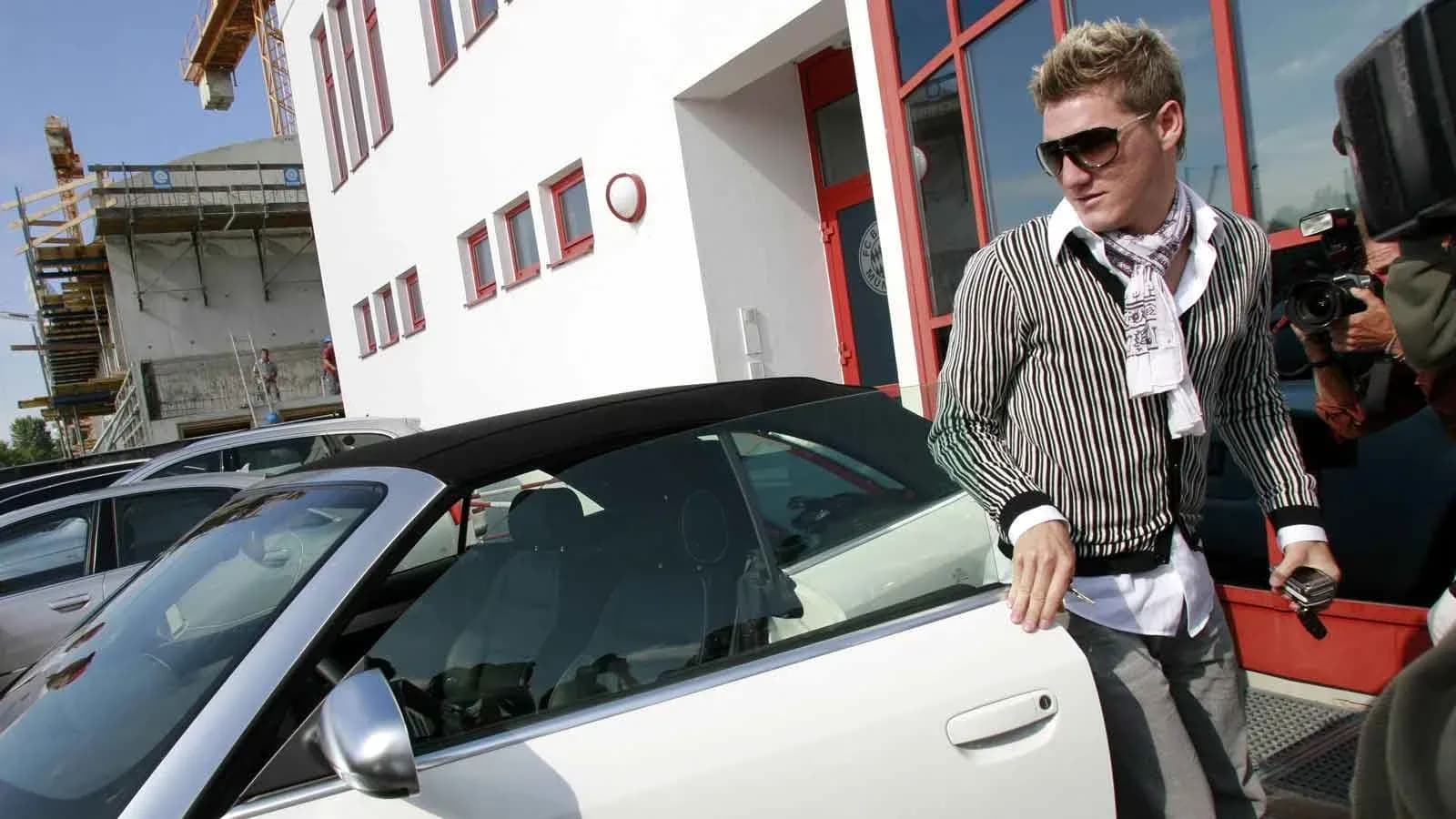
Säbener Straße: Bayern’s Training Ground Evolution
The story of Säbener Straße does not begin with glass domes, wellness pools or Buddhas. It begins with a barracks, a boiler that ran out of hot water and a bootmaker’s workshop tucked in behind wooden huts.
Today, Bayern München are preparing to spend around 100 million euros on yet another transformation of their famous training base. The plans are ambitious: a new training ground, a modernised performance centre, a complex designed to seduce the next generation of global stars. But to understand what that really means, you have to walk back through time.
From Landauer’s gamble to Europe’s throne
In 1949, Kurt Landauer did what visionary presidents do: he found a home. By securing the rights to use the Harlaching district sports ground on Säbener Straße from the City of Munich, he anchored FC Bayern in the south of the city, not far from Grünwalder Stadion and the territory of TSV 1860. A statue of him stands there now, watching over what he started.
“At first there were three training pitches,” Sepp Maier recalls. When he arrived in 1958 as a 14-year-old, Säbener Straße was a long way from the polished corporate campus it would become. A groundsman’s house with a kitchenette downstairs, living quarters upstairs. Flat wooden huts for changing and showering: pros on the left, amateurs and youth on the right. Behind them, the workshop of bootmaker Sepp Renn.
There was hot water. Briefly. “You always had to make sure you were one of the first to shower,” Maier says, because once the boiler emptied, cold water ruled until it reheated. The club office was still in the city centre; players trudged in once a month to collect wages in person. Bank transfers were a distant future.
Out of those makeshift surroundings, a dynasty grew. Maier, Franz Beckenbauer, Gerd Müller – they drove Bayern to promotion in 1965, the first Bundesliga title in 1969, and then looked beyond Germany. If they wanted to stand toe-to-toe with Europe’s giants, the shabby huts on Säbener Straße had to change.
So they built.
In 1970, the club appealed in its newsletter for donations to fund a new clubhouse. Members responded with 500,000 marks. The final bill hit 3.8 million, but Bayern had a building contractor as president in Wilhelm Neudecker and a squad on the rise. On 17 May 1971, in front of 150 guests including Munich’s Lord Mayor Hans-Jochen Vogel, the new complex opened: changing rooms, offices, a restaurant, a multi-purpose sports hall, four grass pitches and a hard court. The old barracks stayed on as tool sheds, a nod to where it all began.
The idea was clear: keep the players on site longer, strengthen focus, professionalise. Dormitory rooms with beds were built so the team could stay over on Friday nights before Saturday matches.
It failed almost instantly.
“We only did that maybe three times,” Maier admits. “Then we complained because there was no comfort at all. It looked like a youth hostel. We couldn’t stand it.” Revolutionary manager Robert Schwan listened. Neudecker relented. The players got hotels, and before the big games, even the luxury of Bachmair on Lake Tegernsee.
The training ground, though, did its job. Säbener Straße became the launchpad for three straight European Cups in 1974, 1975 and 1976.
Hierarchies in the basement
As the trophies rolled in, the building evolved. The dormitories became changing rooms for youth and amateur teams, while the first team moved into the basement. Four dressing rooms lined up side by side, each one a mirror of the club’s internal pecking order.
“The first for the coaches, the second for the stars – Beckenbauer, Maier and Müller – the third for the rest of the first-team players, and the last one for everyone else,” recalls Klaus Augenthaler, who joined in 1975 as a 17-year-old. “The team’s hierarchy was clearly reflected in the dressing room allocation.”
Hierarchy extended to the treatment table. Masseur Josip Saric, Augenthaler says, “actually only treated the big-name players who gave him tips.” On the pitch, everyone was equal. Off it, you queued.
The pitches themselves told their own story. Beautifully manicured when the players returned from summer holidays, battered and bare by autumn. “By autumn they were no longer fit for a Bundesliga club,” Augenthaler says. Yet they kept winning.
And the fans watched it all.
Every training session was open. During school holidays, the place crackled. The “Insider” restaurant, with its raised terrace beside the pitches, became a natural grandstand and social club rolled into one. Players and supporters sometimes shared a drink after training. Criticism came face-to-face, not through social media.
“When we played badly, the onlookers would have a go at us,” Maier remembers. “‘You played a right load of rubbish on Saturday,’ they’d say, ‘but never mind, we’re not angry with you anymore, let’s have a pint, come on then.’”
Hoeneß, the boutique and the glass dome
In 1983, a young general manager named Uli Hoeneß returned from the USA with ideas. One of them became the Bayern Boutique, a small shop on Säbener Straße selling fan merchandise. It was a modest start to what would later become a global commercial machine, but symbolically, it mattered: the training ground was no longer just a workplace. It was a marketplace.
By 1989, the shop expanded and Säbener Straße underwent its second major refurbishment. The now-iconic glass dome rose above the complex, a futuristic crown for a club that had outgrown its provincial shell. A separate building for the professional squad underlined the growing distance between first team and the rest.
Yet for all the modernisation, Säbener Straße remained a place where stories happened in the shadows.
In 2000, a fire in the basement sauna forced Mehmet Scholl and Giovane Elber to escape through first-floor windows using ropes. Damage ran to around two million marks. The building survived; the legend of that night still circulates.
Three years later, an 18-year-old Bastian Schweinsteiger found a different use for the facilities. Security guards, alerted by an alarm at 2 am, discovered him in the hot tub with a young woman. He introduced her as his cousin. Säbener Straße had become comfortable enough that players came back after hours.
Klinsmann’s Buddhas and the American dream
By early 2008, Bayern wanted more. Or, more precisely, Jürgen Klinsmann did. The designated coach arrived with grand ideas shaped by his time in the USA and by the NBA and NFL franchises he admired. Säbener Straße, in his view, needed to leap into a new era.
The club turned to Arnold / Werner, a Munich-based architectural firm. “A few architects were invited to a pitch at the Hotel Palace in Bogenhausen,” recalls Sascha Arnold. He and his team presented a vision: a campus with restaurant, wellness area, changing rooms, an auditorium and more. The audience was heavyweight – Klinsmann, Uli Hoeneß, Karl-Heinz Rummenigge.
Arnold’s firm won the job. One reason, he believes, was their connection to the city’s nightlife. They ran bars like Edmoses, popular with Bayern players. The bosses liked the idea that these architects “had a connection with the younger generation and understood their needs.”
What followed was a sprint. “All in all, that was definitely the most ambitious project we’ve ever undertaken,” Arnold says. Over seven weeks, more than 2,000 square metres were stripped back to the shell and completely rebuilt. Work ran 24 hours a day in three eight-hour shifts. The cost: around 15 million euros. The result: a training centre that looked more Silicon Valley than 1970s Bavaria.
Klinsmann’s Bayern now had an auditorium with booths for simultaneous interpreters, a library, language courses, common rooms with table tennis and pool tables, a PlayStation and a DJ booth. “This is unique in the world; neither Real Madrid nor FC Barcelona have anything like it,” he enthused. Captain Mark van Bommel, who had worn Barça’s colours himself, backed him up: “You don’t see anything like this anywhere in Europe. Perhaps in hotels in Dubai, but not at a football club.”
Klinsmann’s plan was strict. Players had to spend eight hours a day at the facility. He wanted to tighten team cohesion, monitor health, nutrition and everything in between. Bayern would become a campus, not just a training ground.
He even added a spiritual layer. His personal interior designer, Jürgen Meißner, installed Buddhas around the complex. They quickly turned into visual shorthand for his failure. After just ten months, without a single title, Klinsmann was sacked. The Buddhas stayed, as mute witnesses to a bold idea that never translated into trophies.
Yet in terms of infrastructure, he had dragged Germany’s biggest club decisively into the modern age.
When modernisation shuts the gates
Not everyone benefited.
The new, closed world of Säbener Straße pushed out some of its oldest characters. Landlady Erika Niemeyer, whose pub had long been part of the training ground’s social fabric, had to shut her doors. “I am appalled and extremely sad,” she said at the time. “They are tearing my heart out. Everyone here, including the fans, is losing a piece of home.”
Years later, the “Paulaner Treff” opened as a successor. But it only opens during public training sessions, which themselves have become rare. The place that once welcomed fans every day now admits them only on a handful of dates each year.
High curtains went up along the fences to shield “secret” sessions. In 2024, Bild reported that even fans trying to listen from behind those curtains were being chased away. Since 2017, the club’s own youth players have not been allowed to watch first-team training. Space constraints played their part: the entire academy, including the boarding school, moved to a new €70 million campus in the north of the city near the Allianz Arena.
The divide between base and pinnacle widened. Säbener Straße became the exclusive domain of the professionals and the club’s leadership.
Guardiola’s desk and the quiet luxury
The 2010s brought another layer of refinement. A modern multi-purpose hall, an additional office building, new outdoor areas with a sandpit and a football tennis court. Arnold / Werner returned to install a swimming pool with a counter-current system for aqua jogging and a new medical area on the top floor.
In 2013, they redesigned the office of the new coach, Pep Guardiola. Even his desk became a statement.
“For the desk, I gave him a choice between a standard model by Norman Foster and a unique, asymmetrical, sculptural piece I had designed myself,” Arnold says. Guardiola chose the bespoke option. The chair, too, had a story. Arnold recommended a grey Eames aluminium chair with a soft pad. Delivery took time, so Guardiola initially received the same model in black. “When the grey chair finally arrived, I took the black one,” Arnold says. “I still use it today. Pep’s chair is still comfortable to sit on.”
The details matter. They show how Säbener Straße turned into something resembling a high-end hotel, tailored to the whims and working habits of elite coaches and players.
The next leap: 100 million reasons
Time, though, does not stop. “Hotels generally need to renovate every ten to twelve years,” Arnold points out. “So it’s no surprise that Bayern are now planning a refurbishment after 18 years.”
Former CEO Oliver Kahn had already hinted at a new phase. His successor, Jan-Christian Dreesen, made it explicit in a 2024 press release: “A new training centre is a key component in ensuring that FC Bayern can continue to attract international players and remain competitive at the very highest level.”
Local paper Münchner Merkur reported in December that preliminary planning permission had been obtained. On Tuesday, new reports suggested that construction on a fresh training ground could begin soon. The project is expected to last around three years and cost roughly 100 million euros, with work potentially starting as early as 2026.
First barracks. Then youth hostel. Then something resembling a Dubai hotel, as van Bommel once quipped.
What comes next on Säbener Straße – and who, in the end, will still get to see it up close?