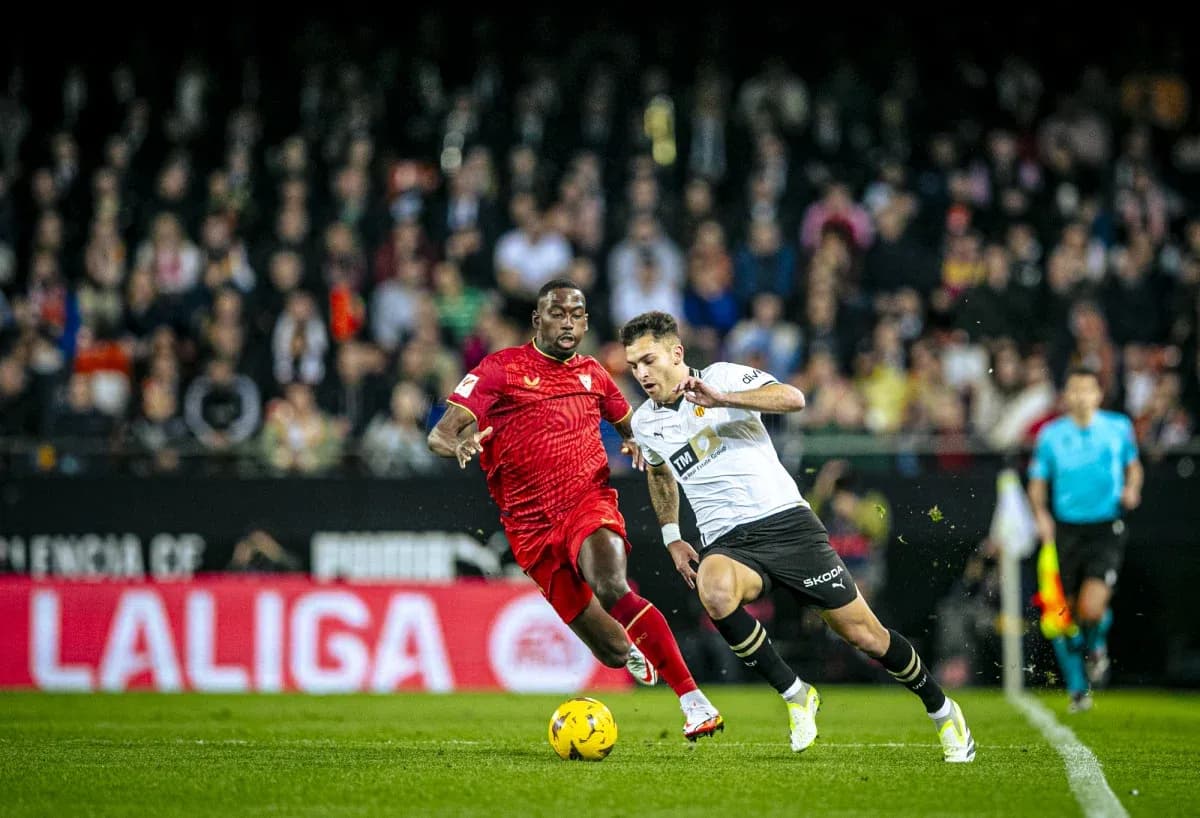
Sevilla vs Valencia: A Clash of Contrasting Identities in La Liga
On a cool March night at Estadio Ramón Sánchez Pizjuán, this La Liga meeting between Sevilla and Valencia felt less like a mid-table skirmish and more like a referendum on two conflicting identities. By full time, Valencia’s 2-0 win underlined a simple truth: one side is learning to suffer and strike with control, the other still oscillates between intent and fragility.
Sevilla entered the fixture as a team trapped between metrics and reality. Fifteenth in La Liga with 31 points from 29 games, they actually carry a respectable offensive volume: 37 goals on the season, 1.3 per game, almost identical home and away. Yet that production is undermined by a leaky structure conceding 49 times (1.7 per match), with a Sánchez Pizjuán record of 19 scored and 22 conceded across 15 home dates. Matias Almeyda’s choice of a 4-3-3 here — a shape Sevilla had only used once before this season — was an aggressive attempt to tilt the balance toward their forwards and away from their defensive scars.
Valencia, 12th with 35 points, arrived with a different problem set. Carlos Corberan’s side is more compact by instinct: 32 goals for, 42 against, a narrower goal difference than Sevilla despite similar defensive numbers. At Mestalla they are solid; away from home they have lost 9 of 15, scoring just 13 and conceding 27. This was, on paper, the kind of away assignment where Valencia usually retreat into a low block and hope. Instead, they imposed a controlled 4-3-3 of their own, and for once their away fragility gave way to a ruthless, structured performance.
Sevilla's Tactical Setup
Almeyda’s 4-3-3 re-centred Sevilla around a midfield triangle of J. Sanchez, L. Agoume and D. Sow, with R. Vargas and A. Sanchez flanking N. Maupay. It was a clear attempt to increase central pressing and shorten the distance to goal for a side that has already failed to score six times in the league. But the tactical void created by Marcao’s absence at centre-back loomed large. Without the Brazilian’s aggression and aerial presence, the back four of C. Azpilicueta, N. Gudelj, K. Salas and G. Suazo looked more like a collection of profiles than a cohesive unit.
Valencia’s absences were numerically heavier but structurally clearer. J. Agirrezabala, J. Copete, M. Diakhaby, D. Foulquier, T. Rendall and F. Ugrinic were all out, stripping Corberan of depth in defence and midfield. Yet the starting XI still carried a strong spine: S. Dimitrievski in goal, E. Comert and C. Tarrega at centre-back, G. Rodriguez anchoring midfield, and a front three of L. Rioja, Hugo Duro and L. Ramazani. The injuries effectively forced Valencia into clarity: fewer rotation options, more trust in the established hierarchy.
Discipline and Risk Management
Discipline framed the risk calculus for both coaches. Sevilla are one of La Liga’s most combustible sides in terms of cautions, with yellow cards heavily clustered from 46’ onwards and three red cards spread across the season. The presence of serial offenders like José Ángel Carmona (9 yellows) and Agoume (9 yellows) on the team sheet — even with Carmona starting on the bench — underlined how close this squad lives to the disciplinary edge. Valencia, by contrast, distribute their bookings more evenly but carry a different threat: Gayà’s red card this season is a reminder that their captain can cross the line in high-stress moments. That tension forced both teams to manage the middle third of the game carefully, where Valencia’s yellow-card spike between 46’ and 75’ usually coincides with Sevilla’s own tendency to collect bookings.
Key Matchups
The headline duel was always going to be “The Hunter vs. The Shield”: Hugo Duro against a Sevilla defence conceding at a bottom-half rate. With 9 league goals from just 24 shots, Duro is among La Liga’s more clinical strikers — scoring roughly once every 2.7 attempts. Against a Sevilla side that concedes 1.5 goals per game at home and has already suffered a 0-3 home defeat as its worst Sánchez Pizjuán result, the margin for error was minimal. Duro’s movement between Gudelj and Salas constantly threatened to dismantle Sevilla’s high line, and Valencia’s 4-3-3 gave him both width and service.
Behind him, “The Engine Room Duel” revolved around Agoume and Sow trying to dictate tempo against the passing and pressing intelligence of Javi Guerra and G. Rodriguez. Agoume, with over 1,000 successful passes and 34 interceptions this season, is Sevilla’s metronome and first presser. Yet Valencia’s midfield trio is built to withstand that pressure: Guerra’s verticality, Almeida’s creativity and Rodriguez’s screening combined to neutralize Sevilla’s attempts to transition quickly. On the other side, Rioja — one of La Liga’s most productive creators with 5 assists and 29 key passes — repeatedly found pockets behind Azpilicueta and Suazo, stretching Sevilla’s shape and forcing their midfield to turn and chase rather than dictate.
Substitutions and Depth
Depth was a subtle but decisive subplot. Sevilla’s bench offered chaos and variance: the direct running of C. Ejuke, the creativity of A. Januzaj, the penalty-box instincts of Isaac Romero, and Carmona’s ability to step in either as a full-back or a third centre-back. In theory, Almeyda could change not just personnel but system mid-game, flipping into a back three or a more conservative 4-2-3-1 that has been his most-used formation this season. Valencia’s bench, by contrast, was more role-specific than game-breaking: U. Sadiq and A. Danjuma as vertical threats, Pepelu and L. Beltran to lock down midfield, Renzo Saravia and J. Vazquez for defensive reinforcement. Their substitutions were always likely to be about preserving structure rather than flipping the script.
Conclusion
Ultimately, the statistical prognosis favoured a tight contest decided by whoever could better exploit the opponent’s structural weakness: Sevilla’s defensive looseness or Valencia’s away inconsistency. Over 29 games, Sevilla’s higher scoring rate (1.3 vs Valencia’s 1.1) is almost exactly offset by their worse defensive record (1.7 conceded vs 1.4). The decisive factor on this night was Valencia’s ability to export their home defensive personality into a hostile away venue, while Sevilla once again failed to translate offensive volume into goals.
In a season defined by fine margins, this fixture underlined a broader pattern. Valencia are evolving into a side that can suffer and strike on the road when their first-choice spine is intact. Sevilla, despite flashes of attacking promise and a deep bench of potential game-changers, still lack the defensive solidity and emotional control to withstand setbacks. Until Almeyda finds a way to anchor that back line — and reduce the disciplinary volatility that so often drags his team into chaos — Sevilla will remain a team whose numbers hint at mid-table comfort but whose performances flirt uncomfortably with the relegation conversation.