South Africa's Women’s Africa Cup of Nations Hopes Revived After Draw
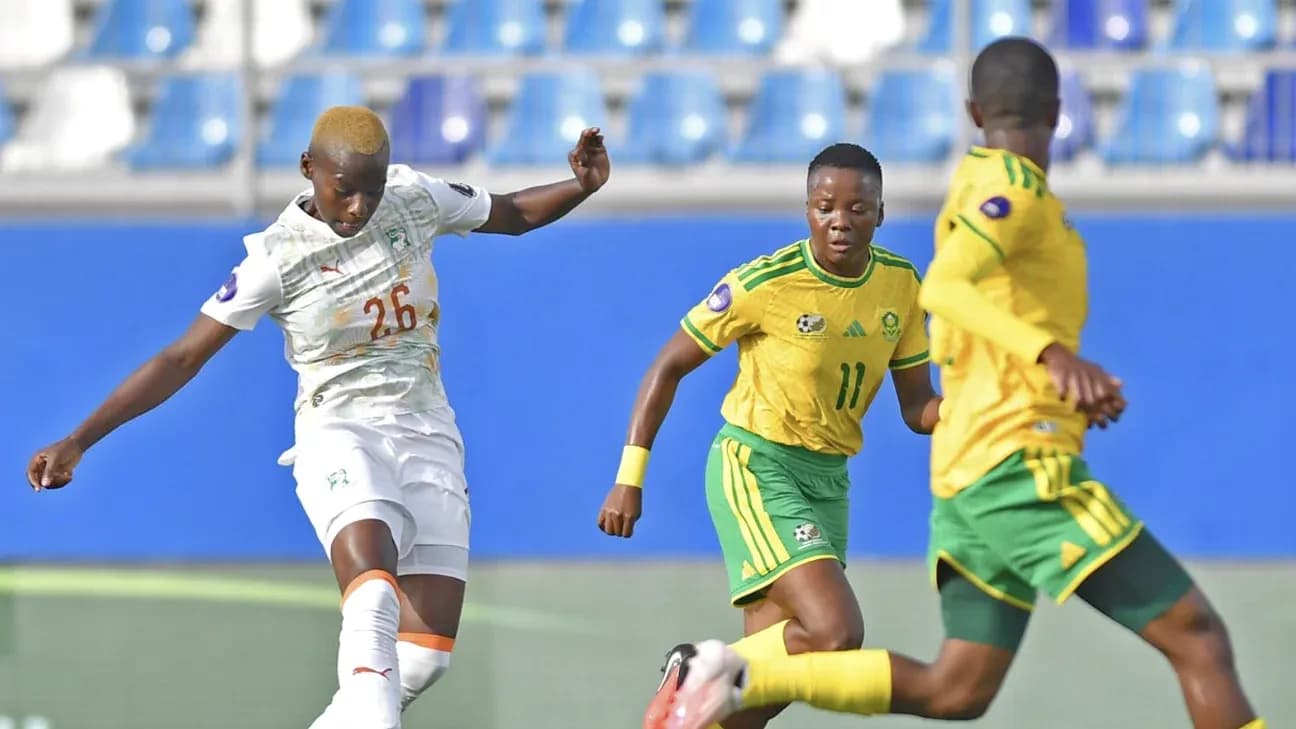
South Africa clung to their Women’s Africa Cup of Nations hopes in Casablanca, dragged back from the brink by two strikers who have spent the past year listening to doubts about whether they still belong on this stage.
A 2-2 draw with Ivory Coast keeps Banyana Banyana alive in Group B. Barely. But alive all the same.
Torn Apart, Then Switched On
For 45 minutes, South Africa looked like a side drifting towards the exit.
Ivory Coast waited, absorbed, then sliced through them with ruthless counter-attacks. Grace Sery finished both, on 18 and 36 minutes, each goal a near carbon copy of the other: South Africa overcommitted, the Elephants sprang forward, and Banyana’s defensive shape simply fell apart.
There was almost nothing in response.
Only once did South Africa threaten before the break, when Linda Motlhalo threaded a superb ball into Thembi Kgatlana’s path. Aramatou Diakité raced out, smothered the chance, and with it, much of Banyana’s early belief. Kgatlana, isolated and starved of service, barely had a touch of note. For a player whose name once meant constant danger, it was a worrying sight.
At half-time, the questions around her only grew louder. Were her best days in Banyana colours already behind her?
Kgatlana Bites Back
The second half gave a very different answer.
With more support around her and better structure behind her, Kgatlana suddenly looked like herself again: sharp, direct, impatient with the idea of defeat. The movement returned. So did the menace.
The turning point came with just under 20 minutes plus stoppage time remaining. Ronnel Donnelly, introduced off the bench and already busy, spun away from pressure and carved out space but couldn’t get a clean shot away. The ball stayed alive, recycled back into danger. Kgatlana picked it up, cut inside, and drilled South Africa back into the contest.
One touch to set, one to finish. Clinical. Familiar.
It was the kind of moment that silences critics, if only for a while. More importantly, it changed the entire mood of the game.
Donnelly Answers Back
Donnelly’s role in the comeback went far beyond that recycled move.
For months, the 22-year-old Mamelodi Sundowns striker has worn the brunt of heavy criticism. She is not Jermaine Seoposenwe, and that comparison has followed her everywhere. Seoposenwe’s retirement last year left a gaping hole in Banyana’s attack, especially in the link-up play that allowed Kgatlana to thrive. Nobody has convincingly filled that role.
On Friday, Donnelly made a compelling case.
She occupied defenders. She won headers. She created space for others. She gave South Africa a focal point they had badly lacked in the first half. It was not flashy, but it was exactly what the system needed.
Deep into stoppage time, the pressure finally told.
A hopeful ball forward became something more when Donnelly rose and flicked on a deft header. Hildah Magaia, alive to the moment, surged onto it and thumped home the equaliser. From 2-0 down and drifting out of the tournament, Banyana had clawed back a point.
The final whistle felt less like relief and more like a reprieve.
Group on a Knife-Edge
The draw reshapes, but does not rescue, South Africa’s position in Group B.
Ivory Coast sit on four points from two games, with a +3 goal difference after their 4-1 win over Burkina Faso and this draw. Tanzania, who beat Banyana 2-1 in their opener, went into their Friday night clash with Burkina Faso on three points and a +1 goal difference.
South Africa now have a single point and a -1 goal difference. Burkina Faso remain pointless.
The equation for Banyana is brutally simple: they must beat Burkina Faso on August 4 to have any chance of reaching the quarter-finals. Head-to-head results, not goal difference, will be the first tiebreaker for teams level on points, but a convincing win would still ease nerves and strengthen their case in any three-way scenario.
Beyond WAFCON, the stakes rise even higher. The four semi-finalists will book direct tickets to the 2027 FIFA Women’s World Cup in Brazil. Two of the losing quarter-finalists will still have a route through internal African playoffs and then the Inter-Confederation Playoff. The path is narrow, but it exists.
Selection Questions and a Possible Front Four
Desiree Ellis now faces a defining selection call.
If she wants to start on the front foot against Burkina Faso and chase goals rather than control, Friday’s final 20 minutes in Casablanca offered a clear template. A front four of Donnelly, Kgatlana, Lebohang Ramalepe and Magaia stretched Ivory Coast, unsettled their defence and finally gave South Africa bite in the final third.
Donnelly’s aerial presence and graft, Kgatlana’s pace and directness, Magaia’s finishing, Ramalepe’s energy from wide areas – together, they looked like a unit that could trouble anyone on the continent when the supply lines work.
South Africa still have their backs to the wall. There is no disguising that. But if Ellis leans into the aggression and belief her side showed at the death in Casablanca, the final group game will not be about damage limitation.
It will be about whether this team still has one big performance left in them when everything is on the line.