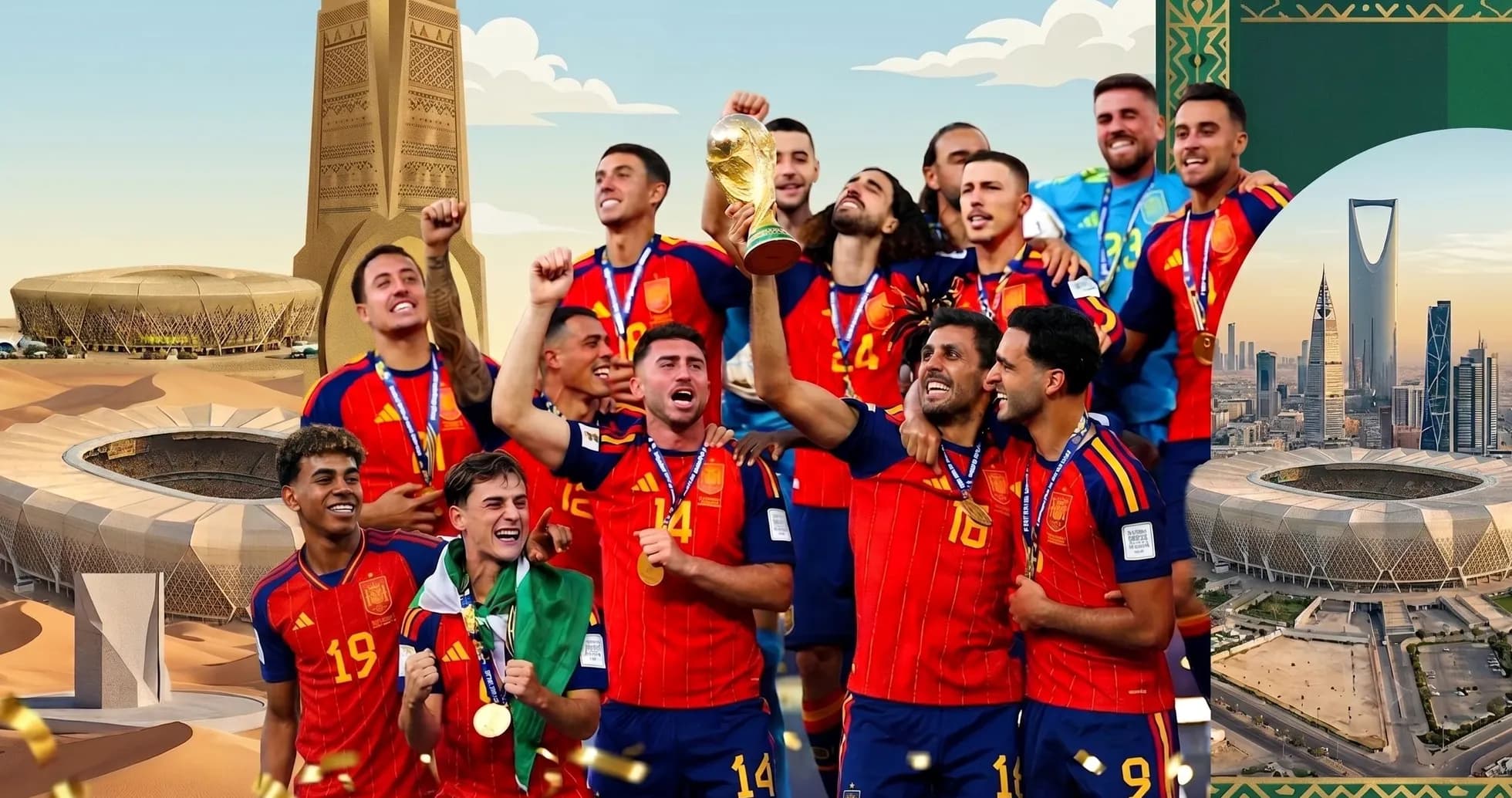
Spain's World Cup Triumph and the Roshn League's Near-Misses
Two summers ago, the Saudi Roshn League could point to the very top of European football and say: those are our players.
Nacho Fernandez and Aymeric Laporte, then of Al-Qadisiyah and Al-Nassr, stood on the podium as Spain finally reclaimed the European crown at Euro 2024. It was a validation of the project, a neat line in the narrative: Saudi clubs feeding into the champions of Europe.
Fast forward to 2026 and Spain have climbed an even higher peak, lifting the World Cup after outmanoeuvring Argentina in a tense final settled by a single goal. The Roshn League again has a strong Spanish flavour. This time, though, none of those players are part of the story.
Spain’s title, Saudi’s near-misses
Luis de la Fuente built a ruthless machine in this Spain side. Tactical control, defensive discipline, and just enough incision in the key moments. They strangled games, squeezed opponents, and when it mattered most against Argentina, they shut the door with a back line that barely flinched.
At the heart of that defensive wall: Aymeric Laporte, reborn alongside Pau Cubarsi.
For the Roshn League, Laporte is the great “what if”. The one that got away twice.
He arrived at Al-Nassr as a marquee name, a defender of global repute joining Cristiano Ronaldo and a cast of stars. It should have been a long-term cornerstone signing. Instead, it unravelled. Under Italian coach Stefano Pioli, Laporte found himself sanctioned, training alone, cut out of the decisive matches as the season reached its climax. He later described the atmosphere at Al-Nassr as “difficult”, a club in constant flux with changing management and coaching staff.
Within a year he was gone, back to Athletic Bilbao. One season later, he is a world champion with Spain.
Had a few other transfer sagas broken differently, Saudi clubs might now be basking in reflected glory, boasting active world champions in their squads. Roshn League sides tracked several members of De la Fuente’s group, tested the water, held talks, saw their names splashed across rumour columns. None of those moves reached the finish line.
The result is a strange split-screen. Spain’s dressing room in 2026 is full of players once linked to Saudi Arabia, but no Roshn League badge made it into the world champions’ squad list.
No champions, but plenty of presence
That does not mean the Roshn League drifted through this World Cup as a spectator.
Forty-nine players from Saudi clubs took part in the tournament. That is a significant footprint in itself, a clear sign of how deeply the league has embedded itself into the global game. The missing piece is symbolic rather than structural: no current Roshn League player climbed the steps to collect a winner’s medal.
There is another side to this, a more tangible one. FIFA’s club benefits programme turned those call-ups into hard numbers.
According to French newspaper L’Equipe, the scheme paid out 4,300 euros per day for each player involved in the World Cup, covering the period from 1 June to 19 July 2026. The total pot: 305.3 million euros. For clubs, that is not a footnote. It is a line on the balance sheet and, in some cases, the difference between talking about ambition and paying for it.
No Saudi club capitalised more than Al-Hilal.
Al-Hilal lead the way
Al-Hilal sent 12 players to the World Cup, more than any other club in the Kingdom. That figure alone underlines their status as the league’s flagship institution, a squad built not just to dominate domestically but to populate international tournaments.
Among that dozen, one name stood out: Theo Hernandez. The full-back stayed with France all the way to the third-place match, driving down the flank as the French chased a bronze medal that ultimately slipped away. Even without the podium finish, his extended stay meant more visibility, more minutes on the biggest stage, and more days ticking on FIFA’s compensation clock for Al-Hilal.
Behind them, the chasing pack was led by two familiar heavyweights.
Al-Ahli and Al-Nassr ride the wave
Al-Ahli matched Al-Nassr with nine World Cup representatives, a joint second-best tally among Saudi clubs. Both sides saw their squads stretched across continents and time zones, their shirts appearing in group-stage battles and knockout dramas.
For Al-Ahli, the standout story belonged to Ivan Toney. The striker helped England secure the bronze medal, a piece of history for a nation that has often stumbled at the final hurdles of major tournaments. Toney did not just make up the numbers; he contributed to a run that ended with England on the podium, medal ribbons around their necks, and Al-Ahli’s investment validated on the global stage.
Al-Nassr, for their part, could not point to a current world champion, but their World Cup contingent underlined the club’s pulling power and the depth of their squad. The irony, of course, is that their most successful alumnus of this cycle, Laporte, was lifting the trophy in Spain’s colours after leaving Riyadh behind.
Al-Qadsiah’s Mexican spark
If Al-Hilal and Al-Ahli dominated the headlines with numbers and medals, Al-Qadsiah found their own star in Julian Quinones.
The Mexican forward arrived at the World Cup and caught fire. Six appearances. Four goals. One decisive assist. Quinones carried his club’s badge into the spotlight with a series of sharp, confident performances that showcased his range: penalty-box instinct, movement off the ball, and the nerve to deliver when it mattered.
For Al-Qadsiah, sending six players to the tournament was already a statement. Watching Quinones turn that opportunity into end product transformed it into something more powerful. This was not just participation; it was influence.
The next step
So the ledger reads like this: no Roshn League player stands today as a 2026 World Cup winner. The dream of pointing at Spain’s champions and claiming one of them as a current Saudi-based star will have to wait.
Yet 49 players from the league walked out under World Cup lights. Clubs banked millions in FIFA compensation. Al-Hilal, Al-Ahli, Al-Nassr and Al-Qadsiah all saw key men return with enhanced reputations and hardened competitive edges.
The “final step” – landing and keeping a world champion in their prime – remains elusive. The question now is simple: after a World Cup that showcased their reach, how long will Saudi clubs accept watching the trophy lift from a distance rather than from inside the winners’ circle?