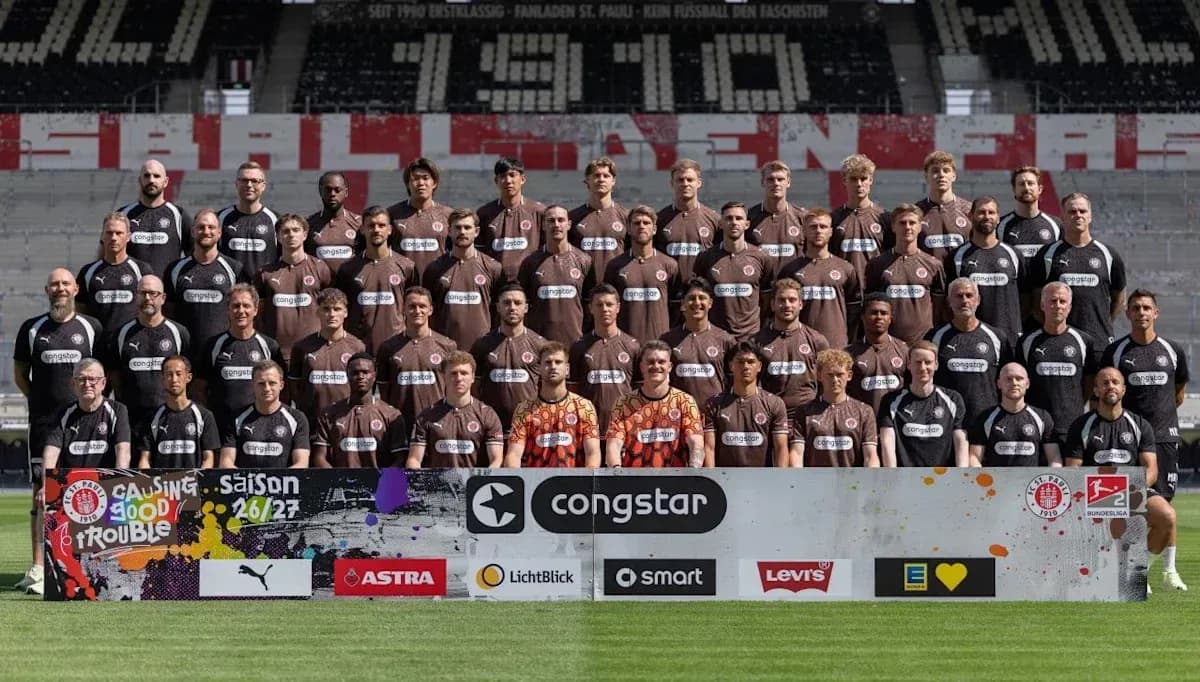
St. Pauli's Rebuild: From Relegation to Redemption
The party didn’t last long on the Kiez.
After the emotional high of surviving in the Bundesliga in 2024/25 – something the club hadn’t managed since 1995/96 – St. Pauli crashed out a year later with a thud. Six wins, eight draws, twenty defeats. Bottom of the table. Relegated, and with it the sense that a hard-won dream had slipped straight through their fingers.
The fallout was swift. Head coach Alexander Blessin was dismissed in the weeks after the season ended, and the squad that had dragged the club back into the top flight was suddenly stripped for parts. Yet, as the dust settles over the Millerntor, there’s a familiar stubbornness in the air. Relegation hurts, but it rarely kills this club.
The question now: what does the reset look like in 2026/27?
A captain gone, a core under strain
Nothing symbolises the summer exodus more than the departure of Jackson Irvine.
The Australian, captain and heartbeat, leaves behind 153 appearances, 15 goals, 21 assists and a bond with the fanbase few foreign players ever achieve at St. Pauli. He led the side to promotion in 2023/24, embedded himself in the community, and looked like the kind of figure you build an era around.
Instead, he asked to go. His move to Cerezo Osaka, announced less than a week before the first league fixture, stunned many around the club. Not because he wasn’t good enough for a new challenge, but because of the timing. The dressing room lost its leader just as the club needed stability most.
He wasn’t alone on the way out.
Goalkeeper Nikola Vasilj, with 167 appearances and 43 clean sheets, left for Al-Diriyah on a free. Karol Mets joined Bochum, also on a free, after 91 games in brown and white. Manolis Saliakas went to Olympiacos for €1.3 million, Hauke Wahl to Wolfsburg for €2 million, and Daniel Sinani to Sampdoria on a free. Between them, they represented hundreds of games of experience and a spine that had carried St. Pauli through promotion and survival.
Those are not just names on a departures list. Those are holes in a team sheet that used to pick itself.
Hrgota’s goals and Rapp’s promotion pedigree
St. Pauli’s response has not been to throw money at the problem, but to look for value and leadership.
The headline arrival is Branimir Hrgota from Fürth on a free transfer. At 31, he brings something this new-look side badly needs: proven goals at this level and above. Hrgota is Fürth’s all-time leading scorer across the top two tiers of German football, with 69 goals and 41 assists in 238 appearances. He dragged them back into the Bundesliga in 2020/21 with 16 goals and 7 assists, becoming the face of their promotion run.
Now, he is being asked to do something similar on the Kiez. Different club, same task: be the man who finishes chances and calms nerves.
Behind him, another key piece: centre-back Marcus Mathisen, signed from Magdeburg on a free. With Mets and Wahl gone, the back three needed an anchor, someone who knows the league and won’t blink when the pressure hits. Mathisen fits that brief, and his arrival feels less flashy but just as vital.
On the touchline, the new figure is Marcel Rapp. The 47-year-old arrives from Holstein Kiel with a recent, relevant line on his CV: he coached Kiel to their first-ever Bundesliga promotion in 2023/24. The irony is hard to miss – the same season St. Pauli won the league, Rapp was writing his own promotion story in the north.
Now those paths cross. St. Pauli turn to a coach who has just shown he can navigate the chaos of the 2. Bundesliga and come out the other side smiling.
Pre-season hints: goals, gaps, and a costly injury
If pre-season friendlies are a sketch rather than a finished painting, Rapp’s early drafts still tell us something about where this team is heading.
The tour started in familiar fashion with a local clash against Altona 93. St. Pauli tore through their neighbours 6-2, the kind of open, attacking display that always plays well with the away end, no matter the stakes. They followed that with a 3-1 win over Regionalliga Nord side Kickers Emden – less spectacular, but businesslike.
Momentum built in the third match, a 4-1 win over Babelsberg. The relationship between the two sets of supporters is well known, and the atmosphere matched the friendship. On the pitch, Abdoulie Ceesay stole the show with a first-half hat-trick, a performance that hinted at a breakout season.
Then came the first setback.
Against Croatian side Gorica, St. Pauli won 2-1 thanks to goals from Louis Oppie and Ricky-Jade Jones, but Ceesay suffered a capsule-ligament injury in his right ankle. Fresh off his hat-trick, he suddenly joined the absentees list, and Rapp lost a dynamic option in attack just as he was catching fire.
The penultimate test was the harshest. Facing Premier League and Europa League side Bournemouth in Austria, St. Pauli actually struck first through Kaars in the 22nd minute. What followed was a brutal reminder of the step up in quality: four goals conceded in 27 minutes, a 4-1 defeat, and a lesson in defensive organisation.
The Millerntor finally got its first glimpse of the new-look side against newly promoted LaLiga outfit Deportivo de La Coruña. St. Pauli led twice, first through Taichi Hara and then again via Kaars, but an 84th-minute equaliser from the Spaniards sealed a 2-2 draw. Encouraging attacking play, frustrating lapses at the back – a theme that might yet define the early weeks of the season.
Across the friendlies, one pattern emerged: Rapp’s St. Pauli will not be shy going forward. Whether they can keep the door shut behind them is another matter.
Shape and selection: a familiar back three, a new focal point
Tactically, Rapp is expected to stick with a three-at-the-back system. That continuity should help a squad already dealing with major turnover.
With Eric Smith’s fitness still in doubt ahead of the opener against Fürth, the back line will likely see Mathisen flanked by Nemeth and either Tomoya Ando or Adam Dzwigala. It’s a unit that blends familiarity with new blood, but it will be tested immediately in a league where defensive errors are punished ruthlessly.
In midfield, Fujita looks set to run the centre, partnered by either Rasmussen or Metcalfe. Out wide, Pyrka and Oppie are poised to operate as wing-backs, expected to provide both width in attack and cover in transition. Behind them, Lars Ritzka and Erik Ahlstrand offer depth and flexibility, important given the physical grind of a 2. Bundesliga campaign.
Up front, the structure is clear.
Hrgota will be one of the two players operating behind the central striker, paired with either Jones, Hara or, once fit again, Ceesay. Kaars is projected to lead the line as the No. 9, the reference point for the attack. On paper, it’s a front three with variety: Hrgota’s craft, Jones’ and Hara’s movement, Ceesay’s directness, Kaars’ presence.
The predicted XI, in a 3-4-2-1: Voll – Nemeth, Mathisen, Ando – Pyrka, Rasmussen, Fujita, Oppie – Hrgota, Jones – Kaars.
Given the exits and the injuries, that St. Pauli can still field a side with this much structure and depth says something about the work done behind the scenes.
Can St. Pauli bounce back faster this time?
History is a nagging voice at this club.
The last time St. Pauli were relegated before this drop – back in 2010/11 – it took them 13 years to return to the Bundesliga. The quickest they’ve ever bounced back is four seasons, a mark they’ve hit twice in the 1990s and early 2000s. This is not a club accustomed to instant returns.
Yet there are reasons to believe this relegation might not follow the old script.
Despite losing key figures across the pitch, St. Pauli still boast one of the strongest cores in the division. The pre-season showed a team capable of scoring freely and competing with a range of opponents. On top of that, the squad is officially the second most valuable in the 2. Bundesliga, behind only VfL Wolfsburg – even if the gap to Wolfsburg is almost €200 million.
The path back up will be brutal. Wolfsburg look like the clear favourites for the title, and the fight for second and third is already shaping up as a street fight, with Hannover and fellow relegated side Heidenheim circling the same prize.
For St. Pauli, the expectation is not blind optimism but measured ambition. A finish outside the top six would be a disappointment with this squad. A place in the top three is a realistic target if Rapp’s ideas land quickly and the new signings settle.
The Millerntor has seen enough false dawns to be wary. But with a proven goalscorer in Hrgota, a promotion-winning coach in Rapp, and a squad that still looks built to compete at the sharp end of the league, the stage is set for something more than a long, grey slog in the second tier.
The only unknown now is whether St. Pauli will seize this chance to rewrite their usual relegation story – or be forced to live it all over again.