Strasbourg's Journey: From Liquidation to European Final Dreams
On the banks of the Rhine, with Europe watching, Strasbourg stand on the edge of a night they never truly expected.
Gary O'Neil’s side host Rayo Vallecano at a revamped, restless Stade de la Meinau on Thursday, chasing down a 1-0 deficit in the second leg of their Conference League semi-final. Win, and they stride into a first European final, in Leipzig on May 27, against Crystal Palace or Shakhtar Donetsk. Lose, and the greatest adventure in the club’s modern history stops one step short.
For a club that once vanished into the regional wilderness, the very idea feels surreal.
From liquidation to Leipzig dreams
Strasbourg, from a city better known in Brussels and Strasbourg corridors of power than on European football maps, have only one French league title to their name, back in 1979. Their continental pedigree is thin: a European Cup quarter-final defeat to Ajax in 1980, a famous UEFA Cup win over Liverpool in 1997, and not much else.
Fifteen years ago, they were not just out of the limelight; they were out of the system. Financial collapse had dumped them into the amateur fourth and fifth tiers. The professional game felt a long way away.
They clawed their way back. Promotion after promotion, season after season, until Ligue 1 finally welcomed them back in 2017. They stabilised, became awkward opponents, a noisy presence with a fierce home crowd. But contenders in Europe? That still looked a stretch.
Then came BlueCo.
The consortium that bought Chelsea moved into Alsace in June 2023. Money followed. So did a new level of expectation, and a new level of unease.
Club president Marc Keller, a former Strasbourg midfielder who has lived every stage of this story, made no secret of why he opened the door.
"We needed someone to accompany us to get to this step," he told RMC radio after Strasbourg knocked out Mainz in the previous round. He also reminded everyone just how far the club had climbed since those amateur days, and how far they had already taken the old model.
"We were conscious that we had gone as far as we could with our existing model," he said.
The investment has been clear enough. A refreshed squad. A thrilling domestic campaign under English coach Liam Rosenior last season that secured a Conference League place. Young talent arriving from Chelsea, mostly on loan, adding quality and depth.
But every new arrival has carried a question: at what cost?
A club reborn, a fanbase conflicted
For many Strasbourg fans, the price is not just financial. It is identity.
The fear is simple and raw. With BlueCo in charge, Strasbourg risk becoming a satellite, a proving ground, a feeder team in all but name. When a player or coach shines in Alsace, the suspicion is that the call from Stamford Bridge will not be far behind.
Evidence has not been hard to find. In September, captain Emmanuel Emegha, the Dutch striker and a symbol of the team’s resurgence, announced he would join Chelsea next season. The timing and the message cut deep.
Then came January. Chelsea moved again, this time for Rosenior. His departure was expected; the reaction was not softened by his attempt to reframe the move as a badge of honour for Strasbourg.
"I hope the fans are proud in a way that somebody who's worked here has been identified to be the manager of a Champions League-winning club and current club world champions," he said.
The words landed badly. Pride was not the overriding emotion.
O'Neil stepped in and steadied the ship, but not without scars. Strasbourg have already fallen in the French Cup semi-finals under his watch. Now he leads them into what he freely calls uncharted territory.
"Thursday's game is the biggest in the club's history. We will need the same support and energy that we got against Mainz," he said.
And there lies the tension. Because that support, at least at kick-off, is no longer guaranteed to sound like it once did.
Silent stands, loud message
Strasbourg’s most passionate supporters have chosen a striking form of protest. Since last season, the leading ultra groups have stayed silent for the first 15 minutes of matches, turning what used to be one of France’s most intimidating atmospheres into something eerie and pointed.
It is not apathy. It is anger, organised and deliberate.
Ultra Boys 90, one of the main groups, set out their fears in an open letter earlier this year. What is happening in Strasbourg, they argued, is not an isolated case but a glimpse of where the game is heading.
"What is happening at Strasbourg is what the future could look like for the vast majority of clubs," they warned. "They will be relegated to the role of feeder teams, without their own resources, with no soul and no link to where they come from."
Those words will echo around the stadium again on Thursday, even if the voices do not – at least at first.
The plan remains the same: a silent protest for the opening quarter of an hour, despite the magnitude of the occasion. Ultra Boys 90 have urged fans to gather early and welcome the team bus, to show the players that the city is behind them, even as the ownership model is not.
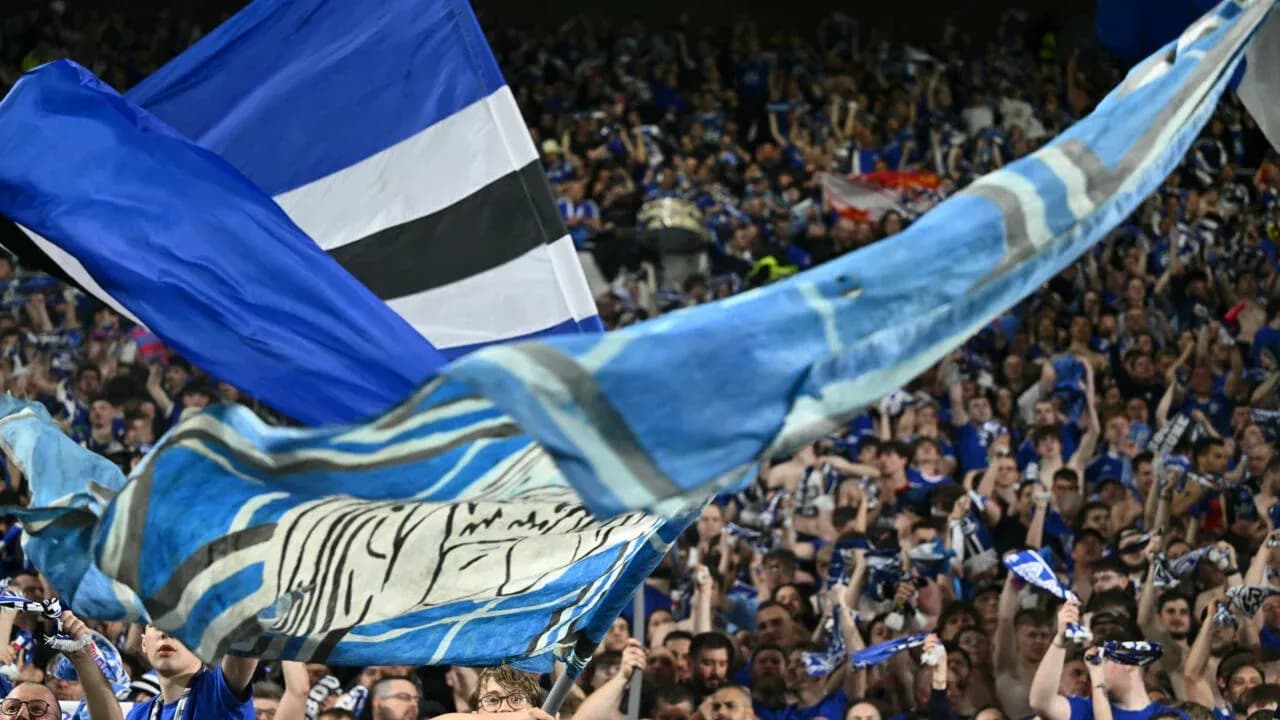
So Strasbourg will emerge into a stadium transformed but muted. The new main stand, part of a renovation that has pushed capacity to around 32,000, will be packed. Tickets rarely go spare these days. The club has never been more popular, never more visible.
Yet beneath the sea of blue and white, there is a knot of doubt. Many of those in their seats feel pulled in two directions: thrilled by the footballing rise, uneasy about the corporate ladder that has made it possible.
A night that could define a generation
On the pitch, the equation is simple. Strasbourg must overturn Rayo’s 1-0 advantage to reach a first European final. They have never been this close. Neither have Rayo.
The stakes stretch far beyond the scoreboard. A place in Leipzig would place Strasbourg on a stage they have never occupied. It would also sharpen every question about what they are becoming.
Because the irony is impossible to ignore. The trophy they are chasing is the very one Chelsea lifted last season. BlueCo’s flagship club won it first. Their French outpost now has a chance to follow.
If Strasbourg do make it to Germany and lift that silverware, the city will explode in celebration. The long, painful climb from liquidation to European glory would be complete.
But when the confetti settles, what will this club be? A European force in its own right, or proof that the future really does belong to multi-club empires?
The answer may start to take shape under the floodlights of Stade de la Meinau on Thursday night, in a stadium full, conflicted, and – for 15 long minutes – defiantly quiet.