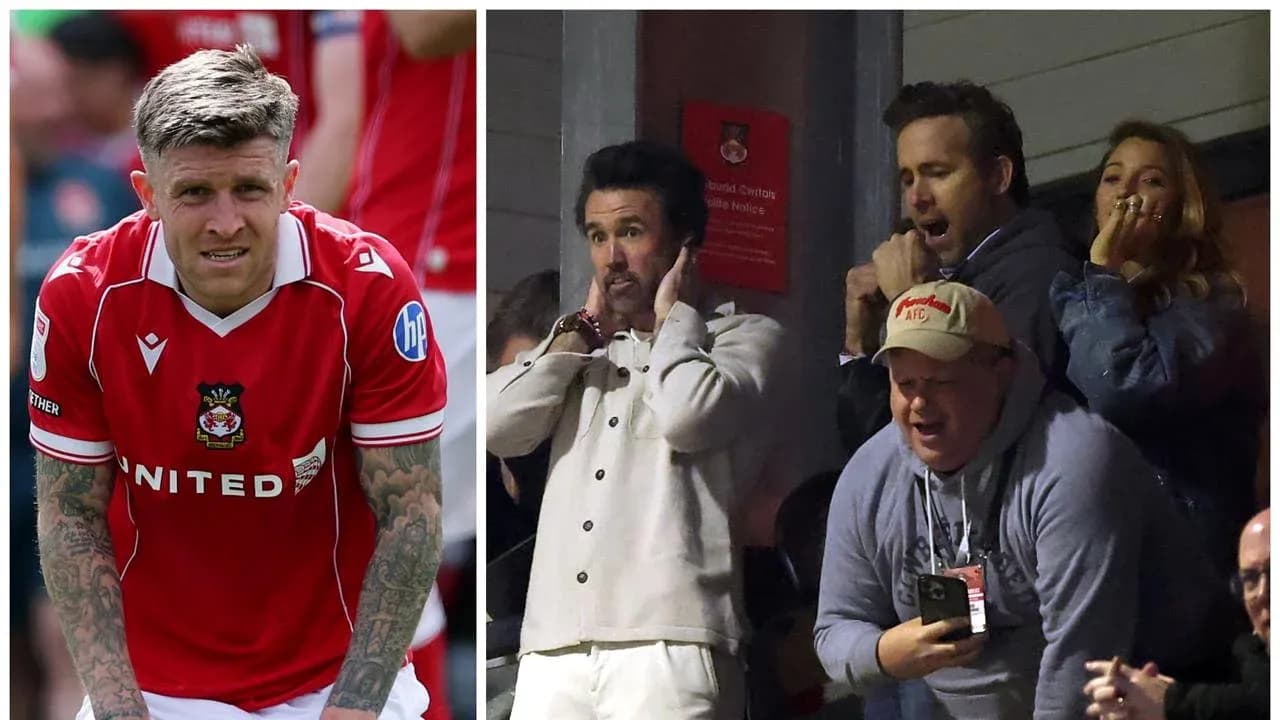
Wrexham's Championship Challenge: A Hollywood Dream Stalls
The tears at the Racecourse Ground told their own story.
Wrexham, the club that has turned a Hollywood script into a footballing reality, hit its first serious plot twist on the final day of the Championship season. A 2-2 draw at home to playoff-bound Middlesbrough wasn’t enough. As the Welsh side staggered, Hull City surged past them with a 2-1 win over Norwich City to snatch sixth place and the final playoff spot.
For Ryan Reynolds and Rob McElhenney, this is the first time the fairy tale has truly stalled.
From non-league to the brink
In five years, Wrexham have gone from a non-league afterthought to a serious contender in England’s second tier. Three straight promotions dragged the club out of the wilderness and back to a level they had not reached for 43 years. The rise has been dizzying, almost surreal.
It felt, for a while, like the momentum might carry them all the way to the Premier League.
An Australian almost kept that dream alive. Mohamed Toure struck first for Norwich at Hull, a goal that briefly seemed to tilt the day in Wrexham’s favour. But Hull turned it around, while at the Racecourse, Middlesbrough – anchored by Australian midfielder Riley McGree – refused to buckle.
The pressure grew, the clock ticked, and Wrexham could not find the winner that would have dragged them into the playoffs.
When the final whistle went, the stadium that has become a global stage dissolved into raw, local heartbreak.
Reynolds’ reality check
Reynolds, who has embraced the club’s emotional swings as fiercely as any lifelong supporter, took to social media in the aftermath.
“I am completely gutted by today’s result but incredibly proud of our season,” he wrote, calling this the best campaign in Wrexham’s 150-plus-year history. “More to do. But for now, we have so much to be proud of, Reds.”
He’s right on both counts. This is uncharted territory for Wrexham. It is also the point where ambition collides with the ruthless economics and fine margins of elite football.
Reaching the Premier League is brutally hard. Staying on course after a first major setback is harder still.
The real test of Hollywood ownership
Former Watford striker Troy Deeney, who has lived both promotion and relegation in this division, believes the real examination of Reynolds and McElhenney starts now.
“I actually think this is going to be the real making to see how they are as owners,” Deeney said on Paramount+. “Because everything has been, not smooth, but simple. Throw a load of money at it, buy players from the league above, go up, get promoted.”
That approach has worked so far. Off the pitch, Wrexham is a case study in modern football branding. The new grandstand at the Racecourse is due to open next season, boosting matchday income. The documentary “Welcome to Wrexham” has turned a local club into a global curiosity, and its run has been extended for another three seasons.
The numbers are staggering. The owners recently sold shares at a valuation of US$475m, having bought the club for around US$2m in 2021. That kind of leap is almost unheard of in the lower leagues.
But such success comes with a cost. Once you sell the dream of the Premier League, you have to keep walking towards it.
‘If you can’t beat Middlesbrough at home…’
For Martin Samuel, chief football correspondent at The Times, Wrexham’s trajectory still points one way.
He argued on Sky Sports that promotion feels “inevitable”, but also that this season’s near miss exposed how far they still have to go. Samuel pointed out that had Wrexham reached the playoffs from sixth, they would have been the first side to do so from that position since Blackpool in 2009/10.
“All they needed to do was beat Middlesborough at home. I know Middlesborough are a good team, but if they beat Middlesborough, they’re up,” he said. “If you can’t beat Middlesborough at home for your life, you’re probably not ready for the Premier League.
“So, maybe another year in the Championship is what Wrexham need. They’re gonna be contenders next year again. I’m absolutely certain of that.”
His warning was clear: whoever drops from the Premier League next season will have to deal with a “super ambitious” Wrexham, backed by a country and a swelling fanbase in America.
The belief outside the club is that Wrexham will get there. The question is how quickly – and at what price.
Big calls in a bigger league
The Championship will expand its playoffs from four to six teams next season, bringing those who finish from third to eighth into the mix. On paper, that gives Wrexham more room for error.
It doesn’t change the fundamental truth: only three clubs go up.
Deeney believes this summer demands a ruthless audit. Nothing is off the table.
Is Phil Parkinson, the manager who has guided Wrexham from the fifth tier, still the right man to take them into the Premier League? Are they spending wisely enough in the transfer market? Is their open, attacking style sustainable in a league where one bad month can destroy a season?
They have already shown their financial muscle. Callum Doyle arrived from Manchester City on a four-year deal and made the Championship team of the season. Even so, Deeney argued that the defensive issues remained.
“They’ve got into so many shootouts this year because they’ve been coming from behind,” he said. “They’ve spent £50 million. They spent £10 million on Doyle, centre back. I wouldn’t say there’s a £10 million player there that’s organising that backline.”
The questions came thick and fast: is this the right manager, the right style, the right squad balance?
Former West Ham and Aston Villa midfielder Nigel Reo-Coker agreed that a full “re-evaluation” is inevitable. The target has never been vague. “They have ambition of getting to the Premier League. That is the main goal, whatsoever,” he told BBC Radio Wales Sport.
And if that means looking at managers with a track record of promotion, names like Scott Parker – recently out of work after leaving Burnley and known for taking clubs up – will hover in the background.
Transfer pressure and a looming risk
On the pitch, Wrexham will go hard again in the market. They may have to.
Doyle’s future is already in doubt. Manchester City inserted a buy-back clause when they sold the 22-year-old, and with John Stones leaving and Nathan Ake linked with a move away, City could easily recall him for depth.
“He’s a really quality player. I think he’s got everything,” said Dom Hyam, his defensive partner and a Scotland international. “He’s technically so calm. He’s a beast as well, and he’s young. I think that’ll unfortunately attract some big clubs.”
Up front, Josh Windass carried much of the burden. Signed on a free from Sheffield Wednesday, he finished as Wrexham’s top scorer with 17 goals in all competitions, including seven in the final eight league games. He won the club’s player of the season award almost by acclamation.
But Brian Flynn, the former Wrexham player and manager, believes Windass needs more help.
“I think they need at least three or four players. Is that a major overhaul? I don’t think so,” he told BBC Radio Wales Sport, praising Hyam and others such as Ollie Rathbone, who chipped in with crucial goals. In Flynn’s view, the core is strong, the gaps are obvious, and Wrexham “will definitely come back stronger and better next season, without a shadow of a doubt.”
They will also want a harder edge. Too many points slipped away against teams they should have beaten. This is a side that pushed Nottingham Forest and took Chelsea to extra time in the FA Cup, that beat champions Coventry and fellow promoted side Ipswich Town at home. Yet they dropped points at home to relegated Sheffield Wednesday – who won just two of 46 league games – and Leicester City, conceding a 90th-minute equaliser against the latter.
That kind of softness is fatal in a division as unforgiving as this.
Leicester’s warning – and Wrexham’s numbers
Leicester are more than a cautionary tale; they are a flashing red light. A decade ago, they were Premier League champions, the 5000-1 miracle under Claudio Ranieri. Next season, they will play in League One after a second straight relegation, victims of financial mismanagement and spiralling costs.
Sports finance expert Dr Rob Wilson believes Wrexham are already walking a tightrope.
He told goal.com that missing the playoffs can cost a club around £15m in lost ticket and commercial revenue from those extra high-stakes matches. Fail to reach the Premier League and the opportunity cost can hit £120m.
“That’s particularly true for Wrexham given the amount of money they are spending and the spending that they have undertaken over the last couple of years,” Wilson said. The club also has a new training ground and stadium expansion in the pipeline. The room for error shrinks with every project.
The last published accounts showed turnover at around £33m in League One, with wages over £20m and losses of about £15m – up sharply from £2.7m the previous year. Wrexham are already spending well beyond what they earn, a strategy that only makes sense if they climb higher, quickly.
In the Championship, their revenues could edge towards £50m thanks to their global profile and commercial pull. But they have also added more players on significant wages. The stakes keep rising.
No Old Trafford yet – but no end to the story
There will be no league trips to Old Trafford, Anfield, the Emirates or the Etihad for Wrexham fans next season, unless the FA Cup throws up something spectacular. A visit to Tottenham is possible, depending on the draw, but the weekly glamour will remain out of reach for at least another year.
What remains is something more complex than the tidy Hollywood narrative that has framed the club’s rebirth.
Under Reynolds and McElhenney, Wrexham’s story has been one of triumph, charm and improbable acceleration. Now it edges into a different genre: one where near-misses, financial jeopardy and hard decisions shape the plot as much as last-minute winners.
The Championship is often called the toughest league in the world for a reason. It drags clubs into cycles of almost, of not quite, of “maybe next year”. It can swallow ambition whole.
Wrexham insist they will break through that ceiling. The cameras will be rolling for at least three more seasons. The money is on the table. The country is watching.
The question now is simple, and brutal: can a Hollywood project handle the grind of a league that doesn’t care for scripts?