Sunderland's Last Match Before War: A Defeat to Huddersfield
On the eve of war, Sunderland were worrying about something far more ordinary: a leaky defence, a limping captain and a sobering home defeat.
Bill Murray had only just stepped into the manager’s office at Roker Park, replacing Johnny Cochrane in March 1939. He knew the place inside out, having played under Cochrane during Sunderland’s glittering spell as 1936 league champions and 1937 FA Cup winners. His task was clear: drag a fading giant back towards those standards after a dismal final season under his old boss.
An opening-day win over Derby County in the 1939-40 campaign hinted that the revival might come quickly. Hopes rose. The old ground stirred. Then Huddersfield Town arrived.
Huddersfield expose Sunderland’s frailties
On this day in 1939, the visitors left with both points and most of the praise. Huddersfield were sharper, more organised and far more convincing as a team. Sunderland, by contrast, looked every inch a side in transition.
At the back they dithered. Marking was loose, challenges half-hearted. Going forward, the attack rarely clicked, the moves breaking down before they could threaten to turn the game.
Newspaper reports the next morning pointed a finger at the officials, accusing them of failing to stamp out a stream of borderline fouls from Clem Stephenson’s Huddersfield side. But the real problem lay closer to home. Raich Carter, the captain and creative heartbeat, took a knock and never moved with his usual glide. Once he was hampered, nobody else seized control.
The criticism was blunt. Carter’s team-mates did not step into the gap. They drifted through the contest while their captain laboured. Only goalkeeper Johnny Mapson emerged with any real credit, with most observers agreeing he could hardly be blamed for either of the goals that beat him.
A disputed opener, a late winner
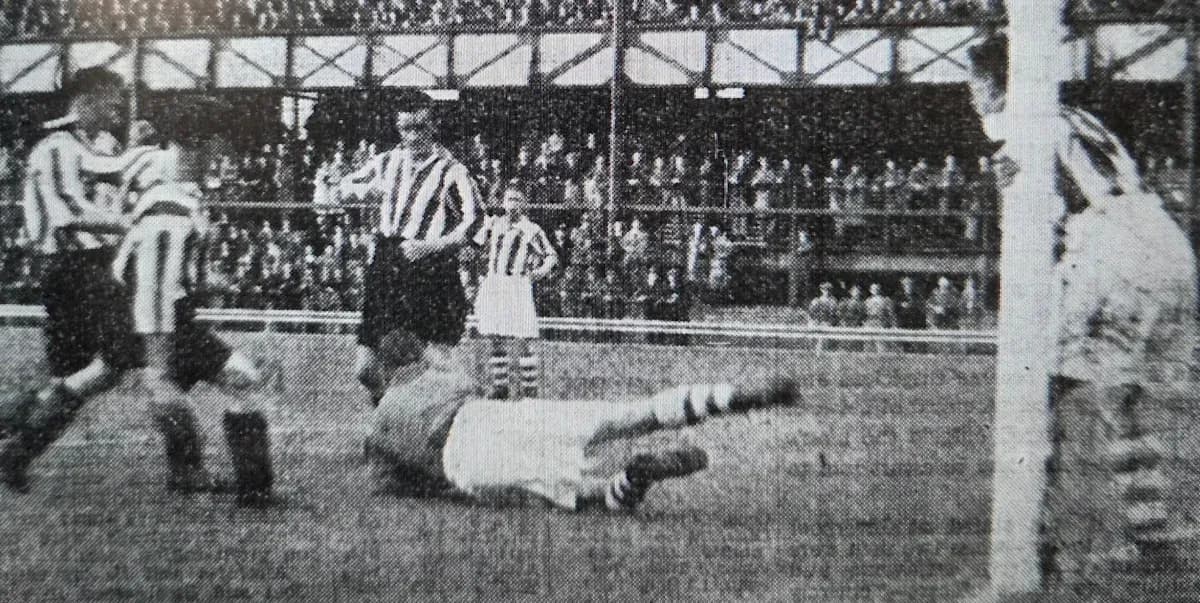
The game’s first flashpoint came almost immediately. Huddersfield forced an early attack, and Billy Price met a cross with a header that flew goalwards. Some in the crowd were adamant it went straight in. The referee saw it differently, recording the goal as an own goal off Jimmy Gorman, who had challenged Price in the air and was adjudged to have diverted the ball past Mapson. Either way, Sunderland were behind inside four minutes.
The home crowd needed something, and Carter briefly gave it to them. Around the 33-minute mark, the captain levelled the scores, reminding everyone of his class even on one good leg. For a while, Roker Park believed again. The match opened up, tension rising with every attack.
But Huddersfield’s structure held firm. Sunderland’s did not. As the game wore on, the visitors’ superior organisation began to tell. With ten minutes to go, Price struck what proved to be the winner, finishing off the contest and, with it, any lingering sense of injustice about the officiating.
When the final whistle went, there was little argument in the stands. Huddersfield deserved their 2-1 win. Sunderland’s fans drifted away, worried about their team’s direction but, increasingly, about something far larger.
Football under a darkening sky
Anyone who had picked up a newspaper before heading to Roker Park that day would have struggled to treat the match as pure escapism. The front pages were dominated by Europe’s slide towards catastrophe and the looming prospect of a second world war.
The Sunderland Echo and Shipping Gazette carried reports of French radio being handed over to military authorities and tense negotiations between European powers. There was a stark photograph of workmen stacking sandbags in front of the Royal Infirmary, a physical reminder that the town itself was preparing for danger.
Alongside it ran a chillingly practical notice: details of helmet and respirator arrangements for parents in Sunderland. Demonstration and collection points were listed at schools across the area – Redby, Hudson Road, Cowan Terrace, Thomas Street, Commercial Road, Hylton Road, Diamond Hall, High Southwick, James William Street and Barnes – where children could be fitted with gas masks, with specially adapted versions for infants.
These were not the usual pre-season concerns. They seeped into everything, even a routine league fixture.
At Roker Park that afternoon, soldiers and sailors in uniform dotted the crowd, already called up under the emergency measures. They were allowed in for half price, provided they entered through what was usually the “boys gate”. It was a small concession, a nod to the times. The football on show, though, did little to lift spirits in a town bracing for something far worse than a home defeat.
Some in that 16,315 crowd must have suspected this might be their last match for a while. The sense of unease was hard to ignore.
From Highbury to hiatus
Within a week, the world changed. By the time Sunderland travelled to Arsenal for their next fixture, German forces had invaded Poland and a wider war was all but certain.
The Highbury game went ahead, but even that carried the mark of crisis. Kick-off was pushed back to 17:00, later than originally scheduled, to ease pressure on public transport running on emergency timetables and to allow a hastily organised evacuation of local children to be completed. Football shrank in importance. It was no longer the main event; it was a sideshow.
Soon, those early-season results against Derby, Huddersfield and Arsenal were wiped from the official records. The 1939-40 Football League campaign, barely begun, was effectively erased.
Murray’s rebuilding plans were shelved. Instead of shaping a side to challenge at the top of Division One, he found himself overseeing fitness work for troops stationed in County Durham. Roker Park, designated an evacuation zone, fell largely silent for the next two years, its terraces empty, its noise gone.
On 30 August 1939, Sunderland lost 2-1 to Huddersfield Town. It felt, at the time, like another frustrating afternoon for a club trying to rediscover its past glories. Within days, it became something else entirely – the last flicker of normality before the game, and the country, were overtaken by war.
Saturday 30 August 1939
Football League Division One
Sunderland 1 (Carter 33')
Huddersfield Town 2 (Gorman o.g. 4', Price 80')
Sunderland: Mapson; Gorman, Hall; Housam, Lockie, Hastings; Duns, Carter, Robinson, Smeaton, Burbanks.
Roker Park, attendance 16,315