Serie A Opener: Torino vs AC Milan Tactical Analysis
Under the warm Turin evening lights at Stadio Olimpico Grande Torino, Serie A’s new season opened with a tactical mirror match: Torino and AC Milan both stepping into a 3-4-2-1, both trying to define their identity for 2026–27. By full time, the scoreboard read 1–2, and the early narrative of these two campaigns had taken shape.
I. The Big Picture – Two 3-4-2-1s, Two Very Different Stories
Following this result, Torino sit 13th with 0 points from 1 match, their overall record 1 goal for and 2 against, a goal difference of -1 (1 − 2). At home they mirror that exactly: 1 home game, 1 home defeat, 1 home goal scored, 2 home goals conceded. AC Milan, by contrast, leave Turin already in fifth, on 3 points from their single outing, with an overall goal difference of +1 (2 − 1). On their travels, they are perfect so far: 1 away match, 1 away win, 2 away goals scored and 1 away goal conceded.
The symmetry of the formations on the teamsheet belied the asymmetry in maturity. Torino, under Ignazio Abate, are at the very beginning of a project, trusting youth and new connections. Ruben Amorim’s Milan, though also modern and aggressive, already carry the composure of a side expected to challenge at the top and have the individual quality to decide tight games.
Torino’s shape was clear: D. Mascardi in goal behind a back three of S. Coco, A. Ismajli and P. Comuzzo, with a mobile midfield four of M. Pedersen, G. Gineitis, K. Fitz-Jim and A. Cacciamani. Ahead of them, N. Vlasic and C. Casadei floated behind G. Simeone. Milan mirrored it: M. Maignan behind M. Gila, K. De Winter and S. Pavlovic; a wide, energetic band of four with S. Chukwueze and P. Estupinan flanking Y. Musah and A. Jashari; then R. Loftus-Cheek and A. Cisse supporting central striker G. Ramos.
II. Tactical Voids – Absences and the Edges of Control
Both squads came into this opener with notable absentees that shaped their tactical ceilings. Torino were without F. Anjorin (hip injury), F. Israel (shoulder injury), P. Pellegri (knee injury) and E. Comert, suspended after a red card. The missing Comert mattered most structurally: Abate had to trust a relatively green back line, with Comuzzo and Coco asked to hold their nerve against Milan’s intelligent movement between the lines.
On the Milan side, the list of missing names underlined the depth of this squad. Y. Fofana and C. Nkunku were inactive, while S. Gimenez (ankle injury), R. Leao (muscle injury) and F. Tomori (inactive) all sat out. That stripped Milan of some of their most explosive vertical threats and a key defensive leader, yet the visitors still fielded a side rich in ball-carrying and creativity.
Discipline played its own quiet role. Across the league data, Milan’s only recorded yellow card so far belongs to R. Loftus-Cheek, who has 1 yellow in his first appearance, and the team’s seasonal card distribution shows a single yellow arriving between 46–60 minutes, a 100.00% share of their cautions in that window. It fits the profile of a side that can occasionally lose control in the early stages of the second half, as intensity spikes and duels become more desperate. Torino, by contrast, have no recorded yellow or red cards in this early snapshot, suggesting a team that stayed within the lines but perhaps lacked the edge to disrupt Milan’s rhythm when it mattered.
III. Key Matchups – Hunter vs Shield, and the Engine Room
The “Hunter vs Shield” narrative for Milan is already being written by two names: A. Cisse and A. Rabiot. Cisse, starting as one of the two attacking midfielders behind Ramos, delivered a statement performance. In his 66 minutes he scored 1 goal from 3 shots, added 1 key pass and won 6 of 10 duels. His 7.9 rating reflects a player who not only finished but also pressed, linked and drove at Torino’s back three. For a Torino defence that, overall this campaign, has conceded 2 goals in 1 match, Cisse was the embodiment of the threat they struggled to contain: late arrivals into pockets just outside the box, and the willingness to turn and shoot quickly.
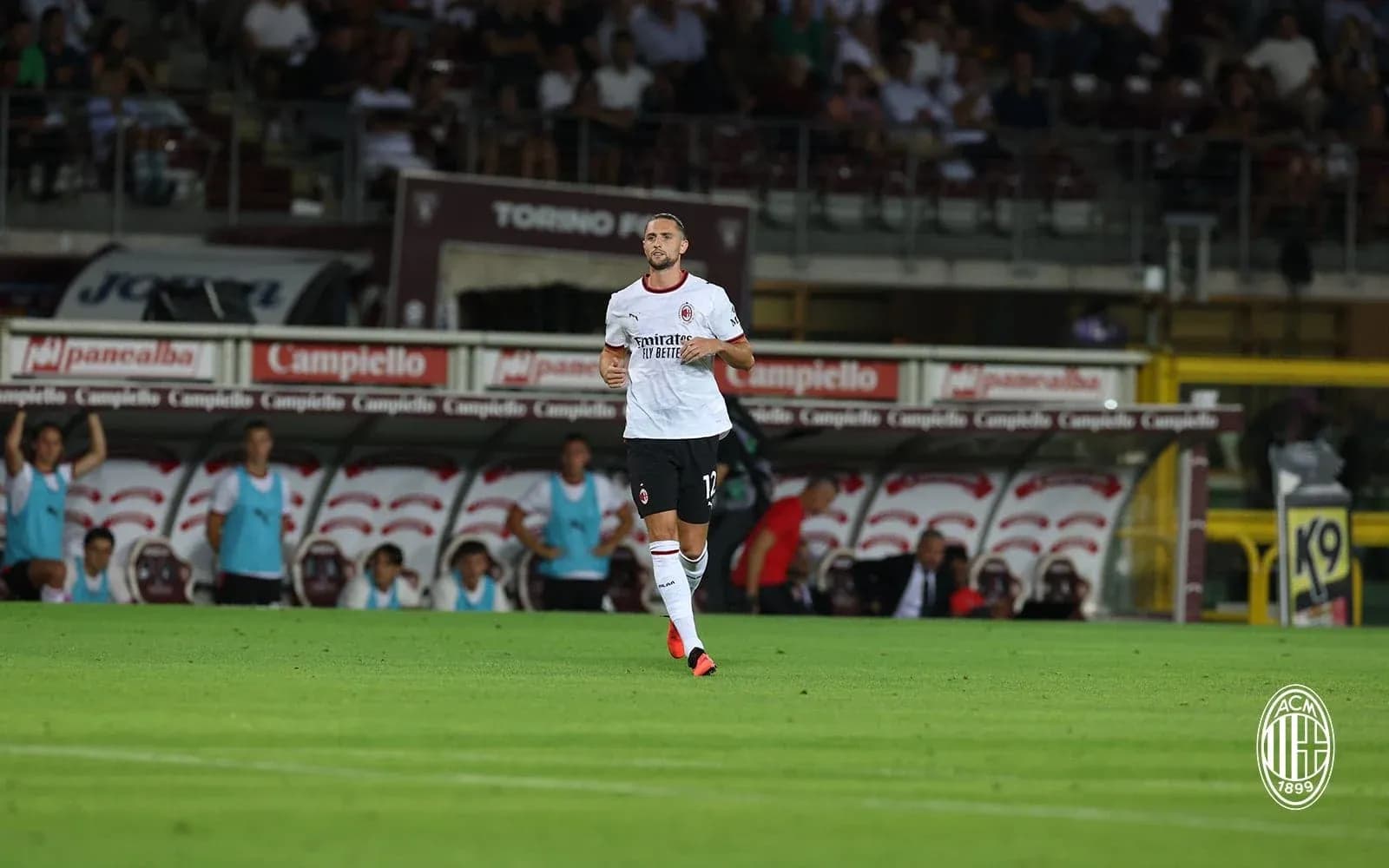
Then there is R. Rabiot, the rare midfielder who simultaneously tops Milan’s early scoring and assist charts. In just 34 minutes off the bench he produced 1 goal, 1 assist, 1 shot on target and 12 passes, with 1 key pass and a 7.5 rating. His presence hints at a terrifying late-game scenario for future opponents: when legs tire, Milan can introduce a player who immediately raises their technical level and adds penalty-box presence from deep. Torino experienced that punch of quality when their structure had already been stretched.
For Torino, the attacking “hunter” is emerging in C. Adams. Used from the bench, he needed only 20 minutes to score 1 goal from 1 shot on target, complete 11 passes at 72% accuracy and win 1 of his 3 duels. He appears twice in the early leaderboards: among the top scorers with 1 goal, and in the assists chart (though without an assist, his inclusion there underlines his overall impact rating). Adams offers something different from Simeone: sharp, direct movements across the line and the instinct to attack the near post. In a season where Torino have, overall, scored 1 goal in 1 match with an overall scoring average of 1.0, his efficiency stands out as a path forward.
Behind him, the “engine room” duel was defined by G. Gineitis versus Milan’s midfield triangle. Gineitis played the full 90 minutes, completing 30 passes at 86% accuracy, adding 1 key pass, 1 tackle and 1 successful block. He also drew 2 fouls, evidence of his willingness to carry the ball through pressure. In a game where Torino’s overall goals against average at home currently stands at 2.0, his work without the ball was vital in preventing Milan from running away with the contest.
On the opposite side, S. Chukwueze was Milan’s creative metronome between wing and half-space. Across his 90 minutes he delivered 45 passes at 77% accuracy, 4 key passes, 2 shots (1 on target), 1 successful dribble from 2 attempts, and 1 tackle. He also drew 1 foul, constantly asking questions of Pedersen and Coco on Torino’s right side. Chukwueze’s presence, combined with Cisse’s penetration, meant Torino’s back three were repeatedly forced into lateral shifts that opened gaps for late midfield runs.
The other key figure in Milan’s engine was Loftus-Cheek. His numbers tell a nuanced story: 3 shots, 3 key passes, 20 completed passes at 100% accuracy, 3 dribble attempts with 1 success, and 6 duels contested, of which he won 2. He also committed 1 foul and received 1 yellow card, underlining his dual role as both ball-carrier and physical disruptor. His ability to drive through the right half-space pinned Gineitis and Fitz-Jim deeper than Abate would have liked, reducing Torino’s capacity to spring quick transitions.
IV. Statistical Prognosis – Trajectories from a Tight Opener
From a macro view, both sides emerge from this opener with clear statistical signatures. Torino’s overall record shows 1 match played, 0 wins, 0 draws, 1 loss, 1 goal scored and 2 conceded. At home, those numbers are identical. Their overall scoring average of 1.0 and overall goals against average of 2.0 suggest a side currently more porous than prolific, but the fact they have not yet failed to score (0 matches overall without a goal) is a quiet positive. There are no penalties taken or missed so far, and no card timing spikes to indicate structural indiscipline.
Milan, meanwhile, have started with clinical efficiency. Overall, they have played 1 match, won 1, drawn 0, lost 0, scoring 2 and conceding 1. On their travels, they mirror that exactly: 1 away win, 2 away goals scored, 1 away goal conceded. Their overall attacking average sits at 2.0 goals per match, with an overall defensive average of 1.0 goal conceded. They have yet to keep a clean sheet, but the balance of their numbers, combined with the depth on the bench – from Rabiot to C. Pulisic and F. Camarda – hints at a side built to outscore rather than simply contain.
In the absence of explicit xG data, the best proxy lies in chance creation and shot volume. Milan’s primary creators – Chukwueze and Loftus-Cheek – combined for 7 shots and 7 key passes, while Cisse added 3 shots and 1 key pass of his own. That density of final-third actions, allied to Rabiot’s late surge from the bench, strongly suggests that Milan’s underlying chance quality matched or exceeded their 2-goal return. Their early-season offensive ceiling appears high, even without Leao and Nkunku.
Torino, by contrast, fashioned their clearest threat from the bench through Adams and from Gineitis’ measured distribution. The fact that Adams turned his only shot into a goal indicates finishing efficiency rather than sustained pressure. For Abate, the challenge will be to convert that brief attacking spark into a 90-minute pattern, especially given that his side’s overall defensive record already shows a tendency to concede twice at home.
Following this result, the tactical verdict is clear: Milan’s 3-4-2-1 is already a weapon, powered by layered attacking options and a midfield that can both create and arrive to score. Torino’s mirror shape is promising but still raw, reliant on emerging figures like Gineitis and Adams to grow into leading roles. If the numbers hold, Milan’s blend of offensive volume and late-game quality should keep them near the top, while Torino will need to tighten their home defensive average and lean into their new “hunter” up front if they are to climb from mid-table towards something more ambitious.