Tottenham's Financial Surge: The New Arms Race in English Football
Tottenham fans would happily erase last season from memory.
Another manager gone. Key players in the treatment room. A final day spent staring over the cliff edge as the ninth-richest club in world football flirted with relegation before scrambling to safety. Seventeenth place. Again.
On the pitch, this is a club stuck in reverse. Off it, they are racing away from most of the league.
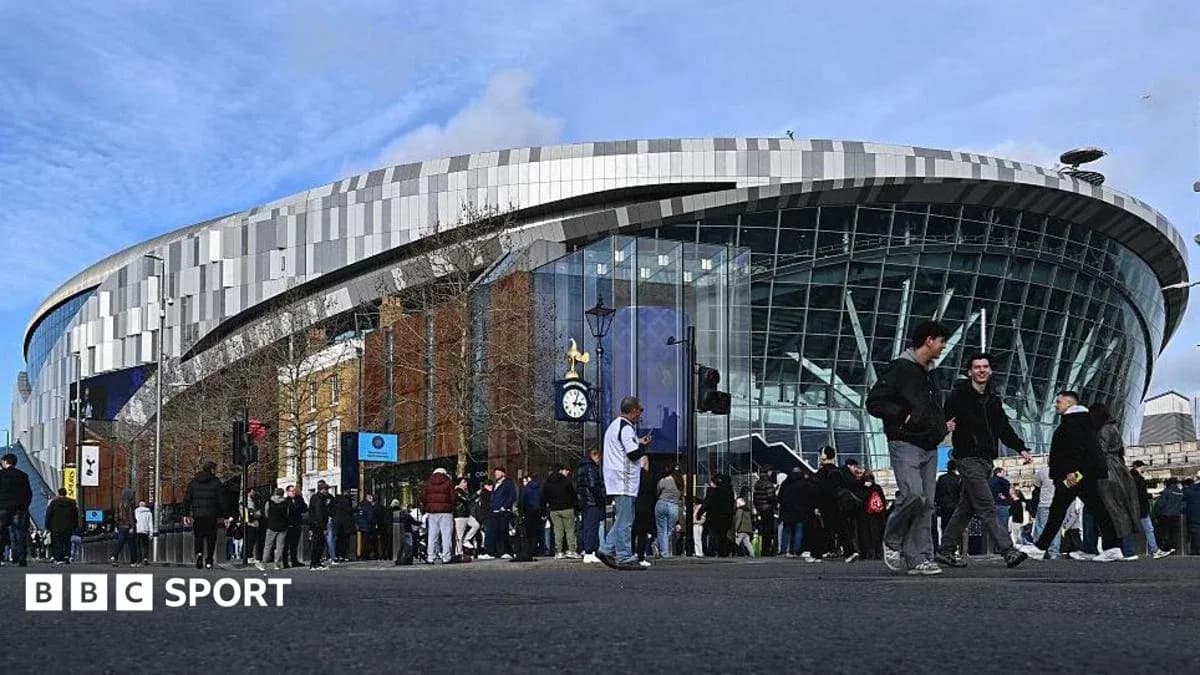
The Tottenham Hotspur Stadium has turned a troubled team into a financial powerhouse. While results have sagged, the balance sheet has swelled. And every club with ambitions of joining the elite is watching closely.
Spurs’ Golden Turnstiles
To understand the scale of Tottenham’s leap, start with matchdays.
“Spurs' matchday income has increased from £45m in 2016-17, the season they left White Hart Lane, to £126m in 2024-25,” says football finance expert Kieran Maguire.
Less than double the capacity. Two and a half times the revenue.
That doesn’t happen by accident. “What Spurs have done is they've created a welcoming environment,” Maguire explains. “So if people are spending an extra 40 to 50 minutes in the stadium itself they're not just spending time - more importantly they're spending money.”
The club has built a venue designed not just for 90 minutes of football, but for an entire day out. Fans arrive earlier, stay later, and pay for the privilege. Food, drink, hospitality, retail – the margins stack up.
And that’s before you even get to the events where Tottenham aren’t playing at all.
The Stadium That Never Sleeps
Spurs can host up to 30 non-football events a year at full capacity. That clause in the business plan is proving as valuable as any player on the pitch.
The stadium has staged major concerts, NFL games, and boxing world title fights, including Anthony Joshua’s heavyweight showdown with Oleksandr Usyk in 2021. Since 2023, it has doubled as a rugby cathedral, with Saracens using it to host Harlequins in their London derby.
Every one of those nights means extra commercial revenue. The numbers are stark: commercial income has surged from £73m in 2016-17 to £277m in 2024-25.
That kind of cash changes the transfer market for a club. It helps explain how Spurs could land Sandro Tonali last month for a club-record fee that could climb to £100m.
The team may be floundering. The stadium is doing anything but.
New Rules, Old Loophole: Why Bricks Beat Bodies
This summer, the Premier League is rewriting its financial rulebook. Out go the old profitability and sustainability rules (PSR). In come a new framework built around squad-cost ratio (SCR) and sustainability and systemic resilience (SSR).
Strip away the jargon and SCR is simple enough: it caps what a club can spend on its playing squad as a percentage of its total revenue.
Player wages. Transfer amortisation – the spreading of a transfer fee across the length of a contract for accounting purposes. Agent fees. They all count.
One thing doesn’t. Stadium infrastructure.
“In the case of Spurs, their infrastructure costs are around £70m a year - but those are excluded,” Maguire says. “Any money that you invest in stadiums is completely ring-fenced and excluded from your ability to invest in players.
“There's a separate issue in that stadiums do cost a lot of money. But Spurs borrowed from banks at spectacularly cheap interest rates.”
So Tottenham have built a hugely expensive ground, pushed their matchday and commercial income into the stratosphere, and done so in a way that doesn’t weigh down their SCR.
From a financial perspective, the pluses dwarf the minuses.
“In order to be competitive, you need to have a significant increase in matchday income,” Maguire says. “You could only do that from either increasing prices, which isn't going to go down well, or increasing the size of the stadium with a greater proportion of the tickets going to the non-season ticket fanbase.”
The message is clear: if you want to spend big on players under the new rules, you either squeeze more out of the fans you have, or you build a place that can hold more of them – and charge differently for the privilege.
The Stadium Dilemma: Stay, Go, or Rip It Up?
Tottenham are not alone on this path. Everton and West Ham have already traded traditional homes for modern bowls. Financially, the logic is compelling. Emotionally, the reaction has been mixed at best.
Other Premier League clubs are now standing at the crossroads.
Renovation is cheaper, but comes with a brutal question: where do you play if your ground is a building site? A full rebuild is cleaner but eye-wateringly expensive, and risks tearing at the club’s identity.
For many supporters, the stadium is not just a postcode. It is the club.
That tension is about to define the next decade at some of English football’s biggest institutions.
Ratcliffe’s Manchester United Statement
At Manchester United, Sir Jim Ratcliffe has already signalled his intentions. He wants a new stadium to be the physical symbol of his arrival, a statement of power in concrete and steel.
The vision is grand: a new build with a 100,000 capacity and a heavy tilt towards corporate areas. The financial upside is obvious. A ground of that scale would dwarf United’s current matchday income and pour more money into the senior squad.
But the details matter.
The initial plans, unveiled in March 2025, featured a huge canopy. It will not be cheap. The overhang and everything beneath it would fall under United’s footprint – and their responsibility. That raises a cold question: will the cost be worth the aesthetic?
Club officials suggest that parts of the construction could be built off site and shipped in, a modular approach that should trim the bill compared with a full rebuild on the Old Trafford footprint.
Building the new ground just down the road solves another thorny issue: where do United play if Old Trafford shuts?
The obvious alternatives are riddled with problems. Manchester City, Liverpool, and Everton all have grounds with lower capacities than Old Trafford. None is ideal from a security point of view. All would be expensive to hire, even if the optics of borrowing a rival’s home could be stomped.
United’s current plan avoids that circus. They can, in theory, walk out of one stadium and into another.
Newcastle’s Harsh Reality Check
If Tottenham show what a new stadium can unlock, Newcastle show what happens if you stand still.
A club backed by immense wealth has spent this summer selling some of its best players to stay on the right side of the financial rules. The numbers tell you why.
“For the 2024-25 season Newcastle's matchday income was £52m. Manchester United's was £160m, Arsenal's £154m, Spurs' was £126m.
“If you're £100m behind your competitors, the only way to address that is either to be super smart or to charge more money for the product.”
That gap is not a rounding error. It is a structural disadvantage.
“How can Newcastle increase the yield per fan and still be loyal to the Gallowgate hardcore? You need to be able to offer a different product and St James' Park wasn't built for a corporate audience.”
The case for a new, purpose-built stadium is obvious on a spreadsheet. On Tyneside, it is anything but simple.
Newcastle supporter Charlotte Robson captures the split.
“I think we can host gigs at St James' Park but probably not on the scale of Spurs or West Ham's London Stadium.
“I don't think it would be stupid to move from the ground but I think there is so much identity for Newcastle fans who are attached to St James' Park that it would break a lot of hearts to move the ground in any significant way.”
The numbers tug the club one way. The soul of the city pulls it the other.
Can Spurs’ Model Travel?
Every boardroom weighing up a move wants two things: more matchday income and more commercial revenue. Tottenham have both. But copying them is not as simple as drawing up blueprints.
“Spurs have got the advantage that they're in London - a huge tourist trap,” Maguire points out. “They are also a club with a global fanbase, so it works there.
“Is that going to work elsewhere in the country where you've got a more localised fanbase and where there is resistance to putting up prices for tickets? Then it becomes more challenging.
“We have seen a substantial increase in the costs of putting stadiums together, but there still seems to be an appetite for it.”
That appetite is shaping a new kind of arms race. Not just for strikers and centre-backs, but for architects, planners, and naming-rights partners.
Tottenham’s season on the pitch may have been a warning. Their stadium is something else entirely: a blueprint, a temptation, and for some clubs, a looming ultimatum.