Tottenham's Pitch Under Scrutiny Amid Injury Surge
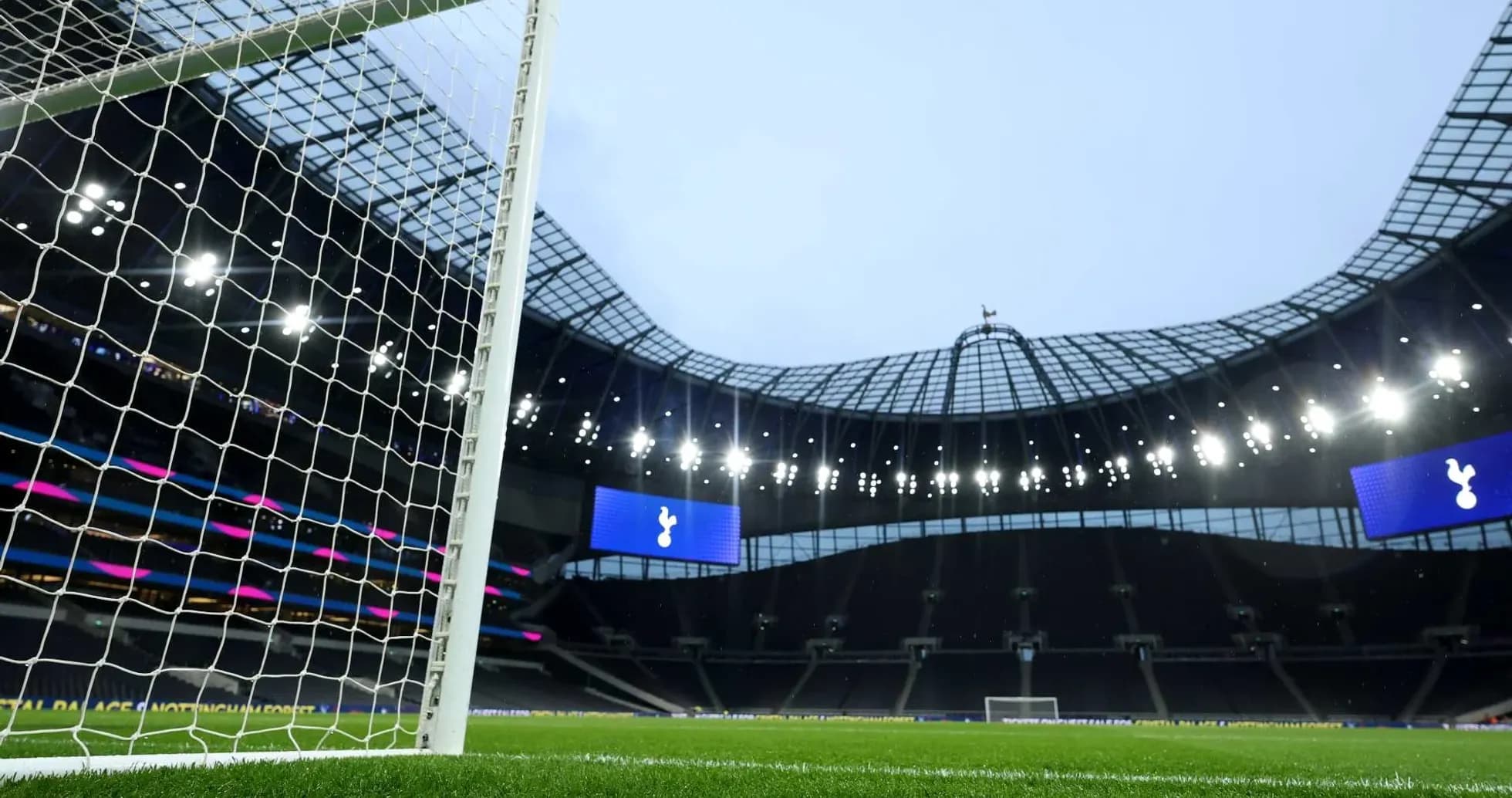
The Tottenham Hotspur Stadium was built as a symbol of football’s future. A sliding grass field, a hidden synthetic surface beneath, NFL logos one week and Premier League lines the next. An engineering showpiece.
Now that marvel is under suspicion.
Dan Lewindon, the club’s new performance director, has launched a deep review into whether that dual-surface technology is playing a part in a surge of serious leg and ligament injuries in N17. Independent tests on bounce and surface tension have already been run, but the data has not given a clear verdict. The club is now drilling down further, benchmarking its pitch against others across the Premier League.
The timing is uncomfortable. Not just because of the bodies piling up, but because the spotlight is turning on another European superpower as well. Real Madrid are conducting their own investigation into a run of ACL injuries after installing a retractable pitch at the revamped Santiago Bernabeu. Two of the continent’s most advanced stadiums, one very old problem.
Injuries Mounting at Home
The concern at Spurs is not theoretical. It is personal, visible, and increasingly expensive.
Dejan Kulusevski, Radu Dragusin, Wilson Odobert – all have suffered significant injuries at home. James Maddison partially tore his ACL in a home tie against Bodo/Glimt before later rupturing it completely. Each setback has added weight to a growing sense of unease. Same stadium, same surface, same grim pattern.
The club cannot yet prove the pitch is to blame. It may never be able to. But the volume of damage sustained on their own turf has forced Spurs to ask whether the technology that once set them apart is now quietly undermining them.
A Performance Department Under the Microscope
Lewindon’s work has not stopped at the grass line.
His three-month review has also exposed what are described internally as structural flaws within the performance operation. The picture that has emerged is of a department not fully joined up – medical staff working on one track, coaches on another, decisions made in silos rather than as a single, aligned unit.
Inside the hierarchy there is a growing belief that this disconnect has fuelled a cycle of recurring injuries. Players return, break down, return again, break down again. Not because of one bad call, but because the chain linking treatment, conditioning and on-pitch demands has too many weak links.
Spurs now want to rip up that model. The plan is to move to a “small-team approach”: specific physios attached to tight groups of around six players, responsible for tailored training plans and more detailed physical preparation. Fewer faces, more accountability. Less generic, more personal.
Four Managers, One Body of Players
The churn in the dugout has only made things harder.
In the space of a single year, four different head coaches – Ange Postecoglou, Thomas Frank, Igor Tudor and Roberto De Zerbi – have driven the same squad through four contrasting footballing ideologies. Training loads have spiked, dipped and twisted with each new appointment. Tactical demands have shifted just as players have adjusted to the last set.
Inside the club, that instability is now being acknowledged as a risk factor in its own right. Every new regime brings fresh drills, new intensity levels, different pressing triggers, different sprint patterns. For a squad already stretched, the constant recalibration has come at a physical cost.
The Xavi Simons Flashpoint
Nothing has inflamed the debate quite like the handling of Xavi Simons’ season-ending injury.
At Wolves, the midfielder went down, received ice spray, and was allowed to continue. Minutes later, he left on a stretcher with a ruptured ACL. The images travelled quickly. So did the outrage.
Spurs, though, have stood firmly behind their medical staff. Lewindon, it is understood, was very satisfied with how the case was managed. Simons wanted to carry on at Molineux, and with an ACL test notoriously difficult to perform accurately at pitchside in the heat of a match, the decision to let him attempt to play on has been judged internally as the correct call.
Crucially, the club insists that his brief return did not cause any further damage to the ligament. To them, this was not negligence, but an unfortunate injury that was always going to end his season, regardless of those extra few minutes.
It was, however, just one blow in a brutal opening spell under De Zerbi. Cristian Romero and Destiny Udogie also suffered serious injuries in the Italian’s first three games. De Zerbi is now pushing for more support around the squad, including the appointment of a team psychologist to help knit together communication across the performance and medical teams.
Maddison’s Verdict: Not Just Bad Luck
From the dressing room, Maddison has become one of the clearest voices on the crisis.
“Our situation with the injuries has been worse than any other club,” he said. “People try and say, ‘Oh, but we’ve got this and that’. But ours is astronomical, and we need to look at why that is.”
He is not buying every theory, though. “Sometimes it can just be unlucky, sometimes it can be a coincidence, like me doing my ACL or [Dejan] Kulusevski getting a horrendous knock off [Marc] Guehi. That’s not the medical team, that’s not the pitch or all the theories that you see, sometimes that’s rubbish.”
Even so, he is convinced the sheer scale of absences dragged Spurs into trouble as they fought to stay in the division. “We’ve been a bit unlucky,” he admitted. “But like I said, the big names that we’ve missed, it does affect you and you can’t just deny that. Myself, Kulusevski and [Mohammed] Kudus, and [Rodrigo] Bentancur missed three months and whatnot. If you had had them for the whole season, we wouldn’t have been in this situation, I strongly believe. That’s just not me being naive, that’s just a fact. But it is the situation we find ourselves in, and I am just proud of the lads to dig deep today.”
The message is blunt: this was not the season Spurs had planned, nor the one their talent should have delivered. Too many key players, missing for too long.
So the club now stands at an uncomfortable crossroads. A billion-pound stadium. A cutting-edge pitch. A performance department being rebuilt on the fly. And a squad that knows, to a man, that if Tottenham cannot solve the riddle of why their bodies keep breaking, the next campaign will be defined not by tactics or transfers, but by who is left standing when it matters most.