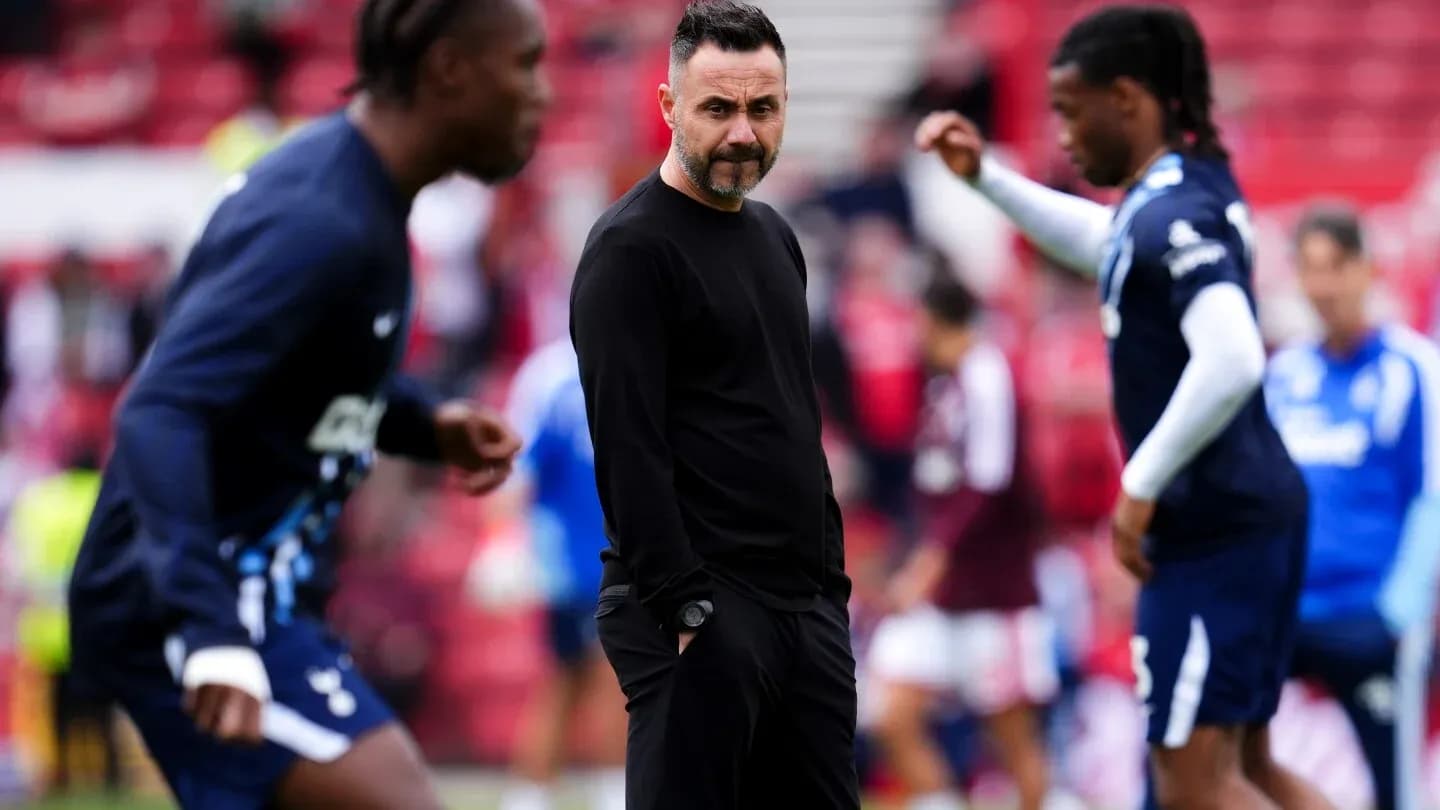
Tottenham's Struggle Continues: De Zerbi Seeks First Win
Tottenham finally stopped the bleeding on Saturday. No defeat this time, no late collapse, just a hard, bruising 0-0 at the City Ground that at least puts a single point on the board.
It doesn’t, however, solve the bigger problem. Roberto De Zerbi is still searching for his first win as Spurs head coach. His side is still searching for its first goal of the Premier League season.
De Zerbi finds positives in the fight
This was a scrap. Spurs went toe-to-toe with Nottingham Forest in a game that swung more in tempo than in quality, and they showed they’re not afraid of a fight.
“Disappointing for the result, but for the performance, very happy,” De Zerbi said afterwards. “Considering we started working together on Thursday for the first time, we played well.”
That detail matters. The Italian has barely had time with his players, yet he saw enough to believe there’s something to build on.
“I think we can improve in the last pass,” he added. “If we approve in the last third, I think we can score many, many goals because we have the players with big qualities. Now it’s a tough moment to accept this result, because I think we played well.”
The pattern of the game backed him up. Spurs moved the ball with control for long stretches, especially in their own half and through midfield. The structure worked, up to a point.
“It’s not to unlock [the final third]. It’s the mistakes. We have to work in this part,” De Zerbi said. “I think we played very well with the ball, we found the solutions because they press [our defenders] with three, but one of our full backs was always alone and we found him always in 90 minutes. So in build-up, we played very well. In the last third, I think we can be… better. Much better.”
The pressure finally told in another way: physically. The second half swung on two enforced changes.
“The second half, I’m sorry because the medical stuff pushed to change Savio and Udogie after 60 minutes,” De Zerbi explained. “Kudus and Robertson played very well, but maybe two substitutions in that moment was not so good. But now we can’t take risk with injuries again. Savio is too important for us, the same Destiny. Maybe we lost some balance, some connection [when they came off].”
Balance has been the theme of his early weeks in charge. He likes risk. His system demands it.
“I think today we defended very, very well,” he said. “We have to improve the physical condition [of some players], the connection between the players. We changed, I don’t know how many players in this transfer window. We brought very, very good players, but the team doesn’t adjust like the names on paper or Football Manager.”
Names on a teamsheet are one thing. A functioning attack is another.
Two-thirds of a team
Here’s the crux of it. Spurs are doing plenty right until they reach the bit that actually decides games.
That white rectangle they crowd around, the one they’re supposed to put the ball into? That’s where it all breaks down.
De Zerbi didn’t dodge it. He praised his side in two-thirds of the pitch and was blunt about the rest. The system he’s brought in is built to stress the backline, to drag them into uncomfortable areas, because when it works the reward at the other end outweighs the risk. When it doesn’t, you’re just exposing defenders for no real gain.
Right now, Spurs are stuck in that no-gain zone.
Micky van de Ven is almost single-handedly keeping the floor high. He relishes defending in space, relishes being dragged into those one-v-one duels, and he has started strongly alongside compatriot Jan Paul van Hecke. Even in last week’s defeat to Newcastle, it was set pieces that undid Spurs after what was otherwise another steady defensive showing.
Van de Ven raises the baseline for this team more than anyone else. But the ceiling? That’s another story.
The way Spurs are operating in the final third, Van de Ven “can’t even stand up inside Spurs’ house at the moment.” De Zerbi knows he has an exciting attacking group on paper, yet he also knows matches don’t care about paper reputations.
The squad has been overhauled from last season, but the familiar flaw remains. There is no true creator in midfield, no natural no. 10 to stitch things together. Spurs move the ball, they progress it, but almost always out wide. By the time it gets there, Forest have dropped, reset, and packed nine or ten bodies around their own box.
Spurs ran into that red wall again and again. A team full of mercurial dribblers, without a classic playmaker, had no real answer.
Maybe James Maddison returns soon and somehow snaps back into top form after effectively missing a year. Maybe he becomes that missing link. The more realistic outlook is harsher: until this team proves it can score, opponents will sit deep, clog the space and dare them to find a way through.
Spurs finally have a point. Now they need to find a goal before the season starts to feel like one long siege.