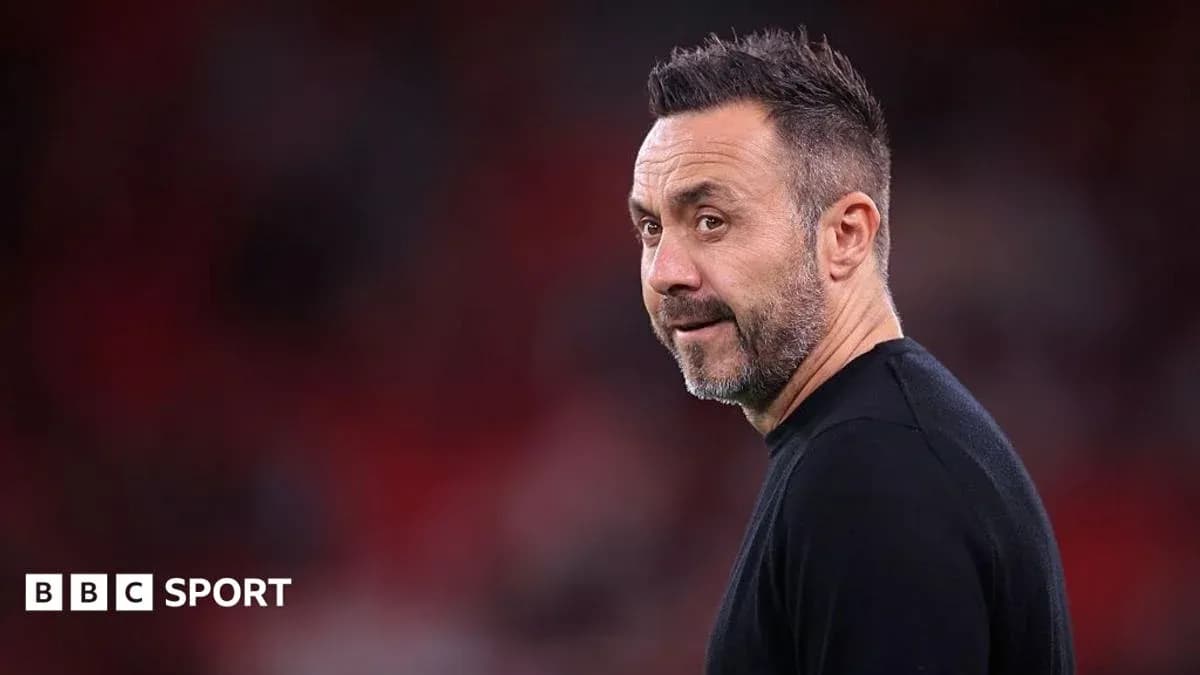
Tottenham's Struggles: Why De Zerbi's Spurs Can't Score
Four games in, the Premier League table has an odd pairing at the bottom of the goals column: Tottenham Hotspur and Coventry City. Everyone else has found the net. Spurs, despite spending around £320m and loading up on attacking talent, have not.
This isn’t a team short of forwards. It’s a team still learning how to attack.
De Zerbi’s risk, Spurs’ reward?
Roberto De Zerbi has not ripped up his playbook since leaving Brighton in 2024. He has edited it.
The Premier League he has returned to looks different, the opponents are wiser to his ideas, but the principles are familiar. His sides invite pressure. They slow the game down, roll the ball backwards, almost daring opponents to jump.
Then they go for the throat.
Once the press comes, De Zerbi wants his players to speed everything up, punch passes through the middle or carry the ball powerfully into the spaces left behind. It’s high-risk, high-reward football.
He summed it up neatly back in a 2020 coaching seminar: “The stronger the pressure of the opponent, the more vertical [our] action becomes. [The fewer opponents behind], the easier it becomes to go and score.”
The theory hasn’t changed. The execution, at Tottenham, is still catching up.
A 2-3-2-3 that’s hard to pin down
On the ball, Spurs often resemble a 2-3-2-3. It is not always obvious at first glance, but the pattern repeats.
Two centre-backs. In front of them, a holding midfielder – usually Rodrigo Bentancur – anchoring the middle. That trio stays largely fixed, forming the base.
Ahead of them, the shape remains but the faces move. Wingers, full-backs and central midfielders rotate zones. One goes wide, another tucks in, a third drops. The instruction is clear: if a team-mate vacates a space, someone fills it. The structure stays; the names change.
On top of this positional framework sit De Zerbi’s principles. They worked spectacularly at Marseille between 2024 and 2026, where his side averaged 2.3 goals per game. The same ideas are being applied in north London. The difference? Tottenham are still in the early chapters.
The tight-space test
For this system to click, the most dangerous passes are often the most uncomfortable ones: into the middle, under pressure, with opponents swarming.
That demands players who can receive the ball in a crowd, under contact, with their back to goal – and still make the right choice. Some thrive there. Others need space and grass ahead of them.
De Zerbi has already adjusted. Sandro Tonali, more effective facing forward in bigger spaces, has been seen rotating with Archie Gray, who starts at right-back. Gray has stepped into central pockets, Tonali has drifted wider or higher. It’s a sensible trade.
Gray, just 20, is not a natural midfielder in those tight zones, but he has coped. More importantly, he looks like he understands what his manager wants.
The return of James Maddison, back from a shoulder injury for the Carabao Cup tie at Liverpool, changes the picture again. Maddison is built for these areas – the half-turns, the disguised passes, the ability to take the ball in traffic. His presence should help Spurs reach dangerous zones more often and with more control.
Yet this is not only about individual quality. It’s about habits.
Under Thomas Frank at the start of last season, Spurs were drilled to avoid the middle. Build down the flanks, skip the central congestion, reduce the risk of costly turnovers. De Zerbi is asking for the opposite: embrace the risk, play through the traffic, be brave where mistakes hurt most.
Unlearning is often harder than learning.
From good positions to bad finishes
The irony is that Tottenham are frequently getting to promising positions. Their build-up often beats the opposition midfield, especially when they spring forward just after being pressed.
That’s where the problems really begin.
Turning those situations into goals involves three steps. First, recognising the best pass. Second, the movement ahead of the ball. Third, the technical ability to execute.
Right now, the biggest blockage lies in the first part. Spurs players are too often ignoring, or not spotting, the through balls that De Zerbi’s system is designed to create.
The runs are there. Omar Marmoush, in particular, has consistently attacked space in behind. Yet the ball doesn’t always follow. Gray has tried to feed passes down the line, but centrally the killer balls have been rarer.
This is where Pedro Porro could be decisive. For Spain in the summer, as they went on to win the World Cup, he often drifted into central areas in possession and still found ways to create. His instincts – aggressive, vertical, risk-taking – fit De Zerbi’s demands. As he settles back into the Spurs side, his natural game could unlock more of those final-third passes that have been missing.
If that happens, Tottenham might start to see the kind of joy De Zerbi’s forwards enjoyed at Marseille.
Width, crosses and the missing connection
Against Liverpool in midweek, Destiny Udogie offered another route. When the game opened up, he repeatedly found space on the left, driving into areas that forced Liverpool’s back line to scramble.
Andy Robertson has been reliable for Spurs this season, but Udogie’s blend of power and timing gave Tottenham a different edge when the match became stretched. It dragged Liverpool into uncomfortable positions and allowed Spurs to hit crossing zones against a disorganised defence.
When an attacking team suddenly accelerates play, defenders often react by retreating in a hurry, collapsing towards their own box. That creates a new pocket of space – just in front of the back line – for late-arriving midfielders or clever forwards who drop off.
Marmoush has tried to exploit that zone several times, drifting away from the centre-backs to receive cut-backs or second balls. Too often, he has been ignored or simply not seen.
Part of this is chemistry. New combinations, new patterns, new instincts. Part of it is technical detail.
Savio, a left-footed right-winger, is excellent at driving to the byline on his stronger side. Pulling the ball back on his weaker foot is another matter. On the opposite flank, Udogie and Robertson – both left-footed – have produced clearer chances from crosses, able to whip or cut the ball back naturally.
At Marseille, De Zerbi had a different balance. Both the right winger and right full-back were comfortable cutting back on their right foot. Those deliveries were then attacked by Pierre-Emerick Aubameyang, whose movement in the box, even at 37, remained elite. He didn’t need many chances. He just needed the ball in the right areas.
Spurs are getting close to those areas. The final touch, the final choice, is missing.
Close, but not enough – yet
Look closely at Tottenham’s attacks and a pattern emerges. The moves are often one pass away from becoming clear chances. The rotations work, the press is lured in, the space appears. Then the wrong decision, the under-hit ball, the run not found.
This is not a guarantee that everything will suddenly click. Tactics, no matter how clever, still rely on the players executing them – and Marseille’s forwards were ruthless finishers who thrived in open grass.
But the margins here are small. If Spurs sharpen the details – the timing of the runs, the courage to play the through ball, the quality of the cut-back – they should create enough chances to finally break that Premier League duck.
When they do, the question will change: from why can’t they score, to how many can this team really put past you once it all comes together?