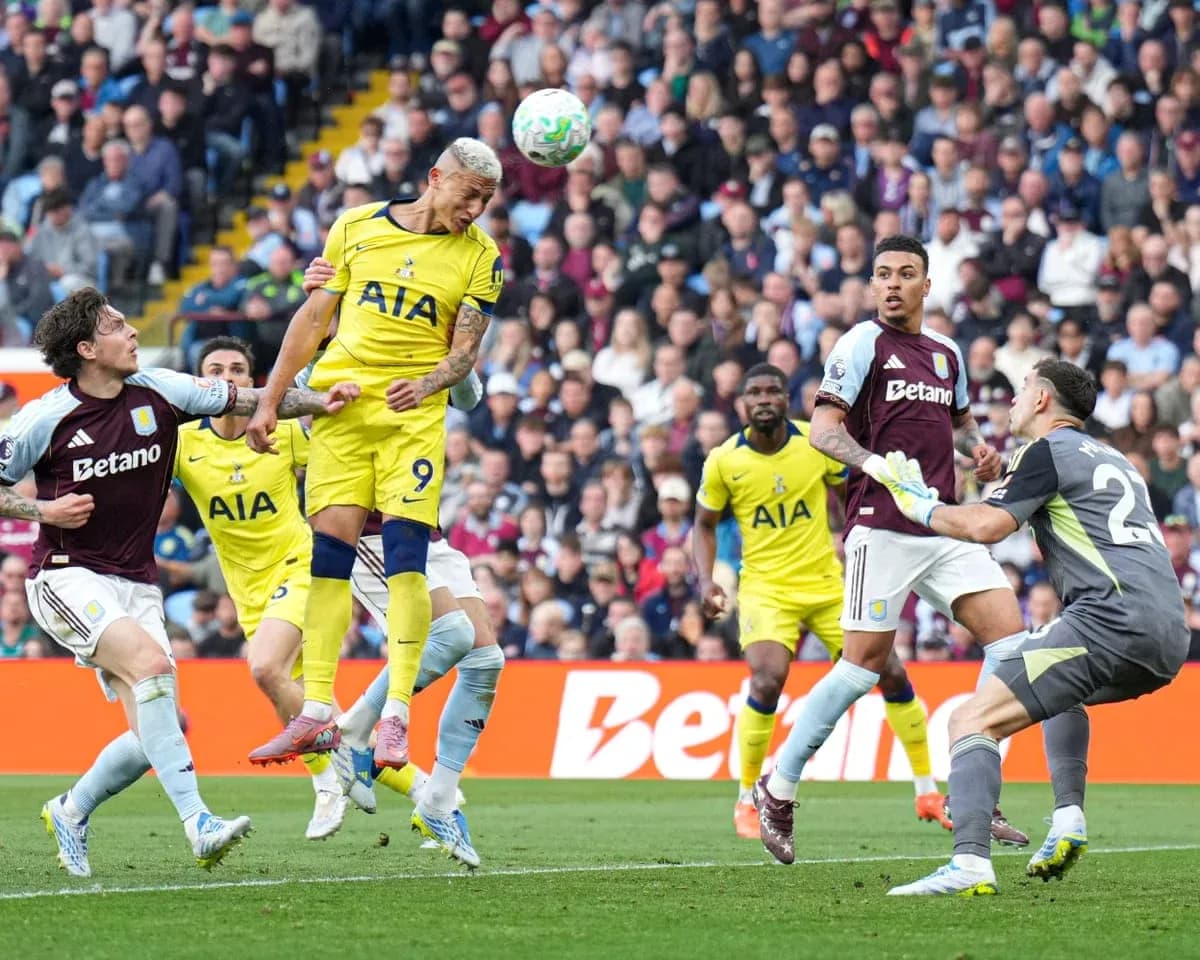
Tottenham vs Aston Villa: Early Season Six-Pointer
Relegation anxiety meets bruised ambition at Tottenham Hotspur Stadium in London on 19 September 2026, as Tottenham and Aston Villa step into an early-season six-pointer that already feels bigger than Round 5 should. Both sides are marooned near the foot of the Premier League table, short on goals, shorter on confidence, and fully aware that another defeat could set the tone for a long, difficult year.
Season Context
Tottenham arrive in front of their own fans in 17th place, with just 2 points from 4 matches (0 goals scored, 5 conceded). The numbers are stark: no wins yet, two draws, two losses, and a negative goal difference that underlines how blunt they have been in attack (0 goals in 4 games) while still looking fragile at the back (5 conceded).
Aston Villa’s situation is even more precarious. They sit 19th, inside the relegation zone, with only 1 point from 4 games (1 goal scored, 7 conceded). A single draw and three defeats, combined with a -6 goal difference, justify their current “Relegation - Championship” zone tag. Their attack has barely flickered (1 goal in 4 matches) and their defence has been porous (7 conceded), leaving them desperate for a stabilising result.
Form & Momentum
Recent form does little to reassure the Tottenham support. Their run of DDLL captures a side sliding backwards: after two battling draws, they have now lost back-to-back games, still without a single league goal (0 in 4) and conceding at a rate of 1.3 per match (5 in 4). The lack of cutting edge is alarming, especially given the attacking talent in the squad, and it forces them into tight, low-margin games they are currently losing.
Aston Villa’s own LDLL sequence tells a similarly grim tale. An opening draw has been followed by three defeats, with the team scoring only once (1 goal in 4) and conceding heavily (7 in 4, 1.8 per game). The defensive instability means that even modest attacking output from opponents has been enough to beat them, and the psychological weight of three straight losses is hard to ignore.
The predictive model’s comparison indices tilt slightly toward Aston Villa overall, with the total rating reading Tottenham 45.3 versus Aston Villa 54.8. Tottenham are graded better in defensive resilience (58 versus 42) but Aston Villa are given the edge in attacking potential (100 versus 0), a reflection less of Villa’s actual goals than of Tottenham’s complete failure to score so far.
Head-to-Head Patterns
The recent history between these clubs adds another layer of tension, with Aston Villa often finding a way to hurt Tottenham. On 3 May 2026, Aston Villa hosted Tottenham at Villa Park and lost 1-2 in the Premier League (season 2025, May 2026), a rare bright moment for Spurs in this matchup. Earlier that year, on 10 January 2026, Tottenham fell 1-2 at home to Aston Villa in the FA Cup (season 2025, January 2026), a cup blow that stung the home crowd at Tottenham Hotspur Stadium. Go back to 19 October 2025 and the pattern repeats: Tottenham 1-2 Aston Villa in the Premier League (season 2025, October 2025), again in London, again with Villa finding a way to edge a tight contest.
Those three snapshots reveal a recurring storyline: narrow margins, away wins, and Aston Villa repeatedly comfortable at this ground. For Tottenham, that psychological hurdle is real; for Aston Villa, it is a source of belief in an otherwise troubled start.
Tactical Preview
Both teams are expected to mirror each other structurally. The data shows Tottenham using a 4-2-3-1 shape in all 4 league matches so far, a system designed to control midfield and release a line of creative attackers. Yet the execution has been badly off: despite that attacking platform, they have failed to score in any of their 4 games (0 goals), suggesting slow ball circulation and ineffective final-third combinations. The double pivot in front of the defence has kept the back line from total collapse (5 conceded in 4, including 2 clean sheets), but the trade-off has been a lack of runners into the box.
Personnel-wise, Tottenham have ample technical quality between the lines. Players like J. Maddison and X. Simons can operate as playmakers, while wide options such as M. Mudryk, Sávio and Omar Marmoush provide pace and one‑v‑one threat. Central forwards Richarlison and D. Solanke offer penalty-box presence, yet the numbers show they are starved of service or lacking cohesion, given the team’s total of 0 goals in 4 league fixtures.
Aston Villa also lean on a 4-2-3-1, used in all 4 matches, but with a different problem profile. They have at least found the net once (1 goal in 4) yet their defensive structure has been far looser (7 conceded, 1.8 per game). Full-backs like M. Cash and I. Maatsen naturally push high, and with ball-playing centre-backs such as Pau Torres and V. Lindelöf, Villa try to build from the back. However, their high line and aggressive pressing leave space in behind, which opponents have punished regularly (7 goals against in 4).
In midfield, the physical presence of L. Goretzka and the energy of Joã o Gomes can set an intense pressing tone, while J. McGinn’s work rate is underlined by his disciplinary record (2 yellow cards in 4 appearances). Further forward, A. Garnacho and N. Jackson provide vertical threat, with T. Abraham as a focal point. Yet with only 1 goal so far, Villa’s final-third decision-making and finishing have been as problematic as Tottenham’s creativity.
Discipline could also shape the narrative. Aston Villa already have one player, Joã o Gomes, sent off in limited minutes this season (1 red card in 40 minutes), and McGinn’s accumulation of cautions hints at a midfield that walks a fine line between aggression and rashness. In a tense, low-scoring contest, a card-induced swing could be decisive.
Statistical Snapshot
- Competition: Premier League, season 2026 — 19 September 2026.
- Venue: Tottenham Hotspur Stadium, London.
- Prediction: Win or draw — Combo Double chance : draw or Aston Villa and -3.5 goals.
- Win Probabilities: Home 10% / Draw 45% / Away 45%.
- Model: Tottenham 45.3 — Aston Villa 54.8.
Betting Verdict
The prediction models lean firmly away from a home win, giving Tottenham only a 10% chance compared to 45% each for the draw and an Aston Villa victory, and the “Win or draw” tag for Aston Villa reflects both Tottenham’s goal drought (0 in 4) and Villa’s strong recent record in this fixture. Bookmakers, however, still price Tottenham as favourites at around 1.88–2.05 for the home win, implying roughly a 49–53% chance, with the draw and away win out at around 3.37–3.79 (approximately 26–30%). That gap between the market and the model creates value on the conservative angle recommended: double chance draw or Aston Villa, combined with under 3.5 goals, which fits two toothless attacks (1 goal between them in 8 league games) and a history of tight scorelines. In a match where fear of losing may outweigh the will to gamble, siding with Aston Villa not to lose in a low-scoring contest looks the most coherent betting position.