Tottenham vs Everton: A Battle of Evolving Identities
Under the grey North London sky, this felt less like a routine early‑season fixture and more like a stress test of two evolving identities. At the Tottenham Hotspur Stadium, a goalless draw between Tottenham and Everton closed with the scoreboard blank, but the squads on show told a far richer story than the 0‑0 suggested.
Following this result, Tottenham remain in troubled waters near the foot of the Premier League table. They sit 17th with 2 points from 4 matches, their overall goal difference at -5, the product of 0 goals scored and 5 conceded. At home, they have played 2, drawn 1 and lost 1, still yet to find the net while conceding 2. Everton, by contrast, leave London with their unbeaten record intact. They are 8th with 6 points from 4 games, having won 1 and drawn 3 overall. On their travels, they have now drawn both away fixtures, scoring 1 and conceding 1 in total away from home.
I. The Big Picture: Structures under strain
Both coaches doubled down on a shared structural language: 4‑2‑3‑1 against 4‑2‑3‑1. Roberto De Zerbi’s Tottenham are clearly built to have the ball, but the numbers underline how fragile the project currently is. Overall this campaign, Spurs have played 4, won none, drawn 2 and lost 2. They have failed to score in all 4 matches, with an overall scoring average of 0.0 goals per game and an overall concession rate of 1.3. At home, the pattern is stark: 0.0 goals scored on average, 1.0 conceded.
Yet the lineup hints at an ambitious rebuild. A. Kinský started in goal behind a back four of A. Robertson, M. van de Ven, J. van Hecke and A. Gray. Ahead of them, R. Bentancur and S. Tonali formed a double pivot, tasked with both shielding and initiating. The trio of Sávio, Mateus Fernandes and Omar Marmoush supported lone forward D. Solanke, a front four designed for vertical running and fluid rotations rather than classic penalty-box presence.
David Moyes mirrored the shape but not the intent. Everton’s 4‑2‑3‑1 is built first on security. J. Pickford anchored a back line of V. Mykolenko, J. Branthwaite, J. Tarkowski and A. Maitland‑Niles. In front, H. Armstrong and J. Garner formed a workmanlike screen, with B. Johnson, K. Dewsbury‑Hall and Tyrique George supplying T. Barry up top. Everton’s overall numbers tell of a side comfortable in tight games: 5 goals scored and 3 conceded overall, with an overall attacking average of 1.3 and an overall defensive rate of just 0.8 goals allowed per match. On their travels, they have been even more cautious: 0.5 goals scored and 0.5 conceded away on average.
II. Tactical Voids: Absences and their shadows
Tottenham’s attacking drought is not happening in a vacuum; it is happening with half a front line missing. D. Kulusevski (knee injury), M. Mudryk (ankle injury), W. Odobert (knee injury) and X. Simons (knee injury) were all unavailable, stripping De Zerbi of direct dribblers, one‑v‑one threats and between‑the‑lines creativity. Richarlison’s absence due to transfer negotiations removed a proven Premier League finisher and a focal point who could have occupied Tarkowski and Branthwaite more aggressively.
In response, De Zerbi leaned on versatility. Marmoush and Sávio were asked to drift inside to create overloads, with Robertson and Gray providing width. But with no natural penalty‑box predator beyond Solanke, Tottenham’s possession often died on the edge of the area rather than inside it.
Everton were not untouched by absences either. C. Norgaard, missing through injury, would have offered added control and experience in central midfield. Without him, the responsibility for tempo and discipline fell heavily on Armstrong and Garner.
Disciplinary trends also shaped the emotional tone. Tottenham’s yellow card distribution this season has been heavily back‑loaded: 40.00% of their bookings have arrived between 76‑90 minutes, with a steady 20.00% in each of the 0‑15, 31‑45 and 46‑60 windows. This late‑game spike hints at fatigue or frustration when chasing matches. Everton’s cautions have been more evenly spread, but with a noticeable 28.57% cluster between 61‑75 minutes, the spell when they often dig in to protect game states.
III. Key Matchups: Hunter vs Shield, Engine Room wars
The “Hunter vs Shield” narrative here was less about a prolific striker and more about systems. Tottenham, goalless overall, were trying to crack an Everton defence that has conceded only 3 times in 4 matches. Everton’s away record of just 1 goal conceded in 2 away games underlines how comfortable they are defending deep.
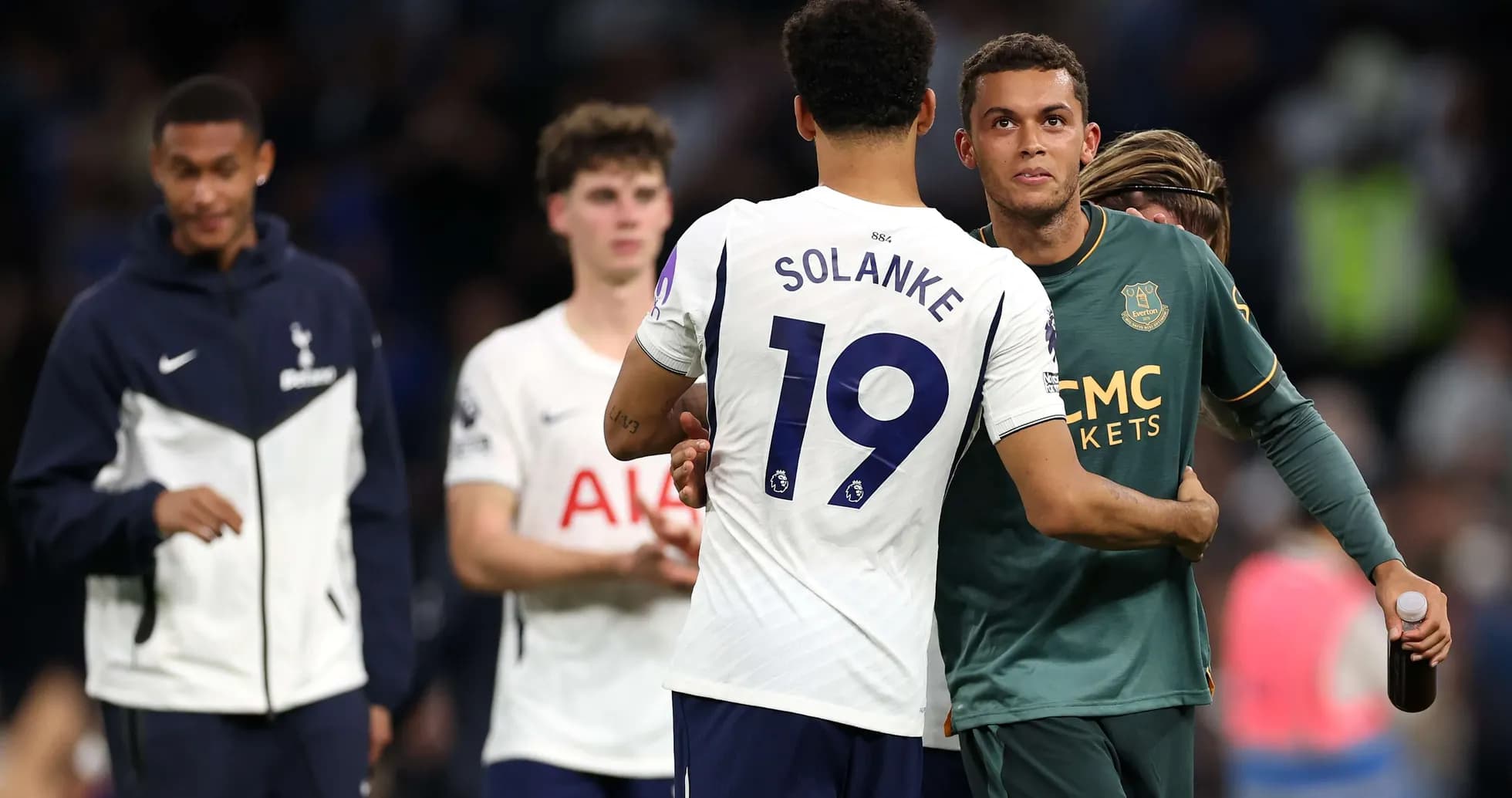
D. Solanke’s duel with Tarkowski and Branthwaite was central. Solanke thrives when he can receive early, face forward and run channels. Everton denied him that. Tarkowski’s aggression in front and Branthwaite’s cover behind meant Solanke was often forced to drop into the same spaces Marmoush and Mateus Fernandes wanted, compressing Tottenham’s own attacking structure.
In the “Engine Room”, Tonali and Bentancur met Armstrong and Garner in a battle that defined the tempo. Tonali’s role as a deep playmaker was to break Everton’s first line and feed the three behind Solanke. But Garner, one of the league’s most combative midfielders so far, brought his season profile with him: 11 tackles, 2 interceptions and 27 duels overall underline a player who relishes disruption. His 2 yellow cards this season show he plays on the edge, yet he has avoided red, balancing aggression with control. Here, his screening of central lanes forced Tottenham wide, where crosses into a crowded box rarely found a target.
IV. Statistical Prognosis: Two trajectories diverging
Following this result, the numbers suggest two very different trajectories. Tottenham’s structural base is not entirely broken: they have kept 2 clean sheets overall, including one at home, and concede only 1.0 per game at the Tottenham Hotspur Stadium. But with 4 failed‑to‑score matches out of 4, the attacking mechanism is clearly jammed. Their reliance on intricate combinations without a cutting edge, compounded by the absence of Kulusevski, Mudryk, Odobert and Simons, leaves them sterile in the final third.
Everton, meanwhile, look like a side built for marginal gains. They have kept 2 clean sheets overall, failed to score only once, and remain unbeaten. Their away profile — low scoring but low conceding — points to a team that will rarely be blown away and will often be in position to steal results late.
If we project forward, Tottenham’s revival depends less on raw xG numbers and more on personnel returning and De Zerbi finding a way to turn territorial control into high‑value chances. Everton’s defensive solidity, anchored by Pickford, Tarkowski, Branthwaite and the relentless work of Garner and Armstrong, gives them a platform to stay in the top half.
A 0‑0 in North London, then, is not just a stalemate. It is a snapshot: Tottenham as a beautifully sketched idea without ink in the penalty area, Everton as a hardened, compact unit quietly accumulating points while others search for themselves.