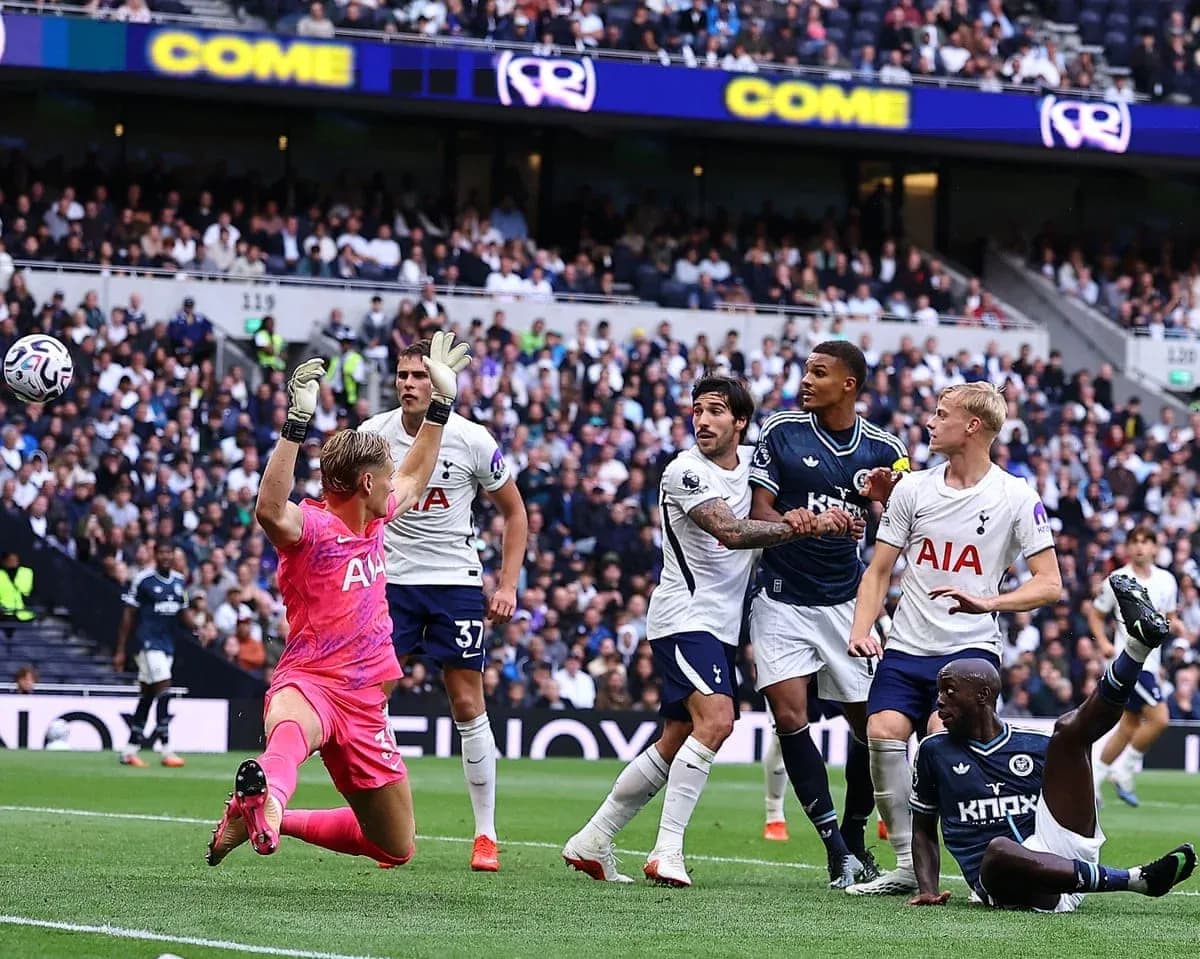
Tottenham vs Newcastle: A Tale of Two Clubs in Crisis
Under the grey London sky at Tottenham Hotspur Stadium, this fixture told a stark story of two clubs moving in opposite directions. Tottenham, beaten 0-2 by Newcastle, finished the day rooted to 20th in the Premier League with 0 points, no goals scored and a goal difference of -5 after 2 matches. Newcastle, by contrast, left with 3 points, a second unbeaten result and 4 points total, sitting 5th with a goal difference of +2.
Both managers – Roberto De Zerbi and Matthias Jaissle – mirrored each other on the tactics board with a 4-2-3-1, but the shared shape disguised very different levels of cohesion and conviction.
For Tottenham, the starting XI felt like a side still in construction. A. Kinsky in goal sat behind a back four of A. Robertson, M. van de Ven, J. P. van Hecke and A. Gray. Ahead of them, R. Bentancur and S. Tonali formed the double pivot, with a fluid trio of M. Tel, M. Fernandes and P. Porro supporting lone forward O. Marmoush.
On paper, it was a structure designed for controlled possession and aggressive full-back play. In practice, the absence of key creative figures weighed heavily. The missing list was brutal: D. Kulusevski (knee injury), J. Maddison (knock), W. Odobert (knee injury), P. M. Sarr (injury) and X. Simons (knee injury) all unavailable. That is essentially an entire tier of line-breaking, dribbling and final-third invention stripped out of De Zerbi’s toolbox.
The impact showed in the numbers and in the narrative. Heading into this game, Tottenham had played 2 matches in total, losing both, with 0 wins, 0 draws and 2 defeats. They had failed to score in both fixtures, with 0 goals for overall, 0 at home and 0 on their travels. Their average goals for stood at 0.0 in total, 0.0 at home and 0.0 away. At the same time, they had conceded 5 goals overall – 2 at home and 3 away – with an average of 2.5 conceded in total, 2.0 at home and 3.0 away.
This is not just bad luck; it is structural. Without Maddison between the lines or Kulusevski’s ball-carrying on the flank, the burden of progression fell onto Tonali and Bentancur from deep, and onto Porro and Tel in advanced zones. Tonali and Bentancur could circulate the ball, but there was a clear lack of a natural “third man” to connect midfield to Marmoush. M. Fernandes was tasked with being that conduit, yet the patterns often broke down before Tottenham could pin Newcastle back.
Even Tottenham’s disciplinary profile hints at a team chasing games rather than controlling them. Across the season so far, they have collected yellow cards early: 50.00% of their yellows have come in the 0-15 minute window and 50.00% between 31-45 minutes. That front-loaded aggression speaks to a side trying to impose intensity but lacking the structure to sustain it.
Newcastle, meanwhile, arrived with a much clearer identity and a squad largely in rhythm despite their own absences. They were without D. Burn (ankle injury), Joelinton (injury), V. Livramento (hamstring injury) and W. Osula (injury), yet Jaissle’s 4-2-3-1 looked well-rehearsed.
L. Hornicek started in goal, shielded by a back four of L. Hall, S. Botman, M. Thiaw and A. Dedic. In midfield, Nico and L. Miley formed a young but tactically disciplined double pivot. Ahead of them, the trio of H. Barnes on the left, J. Willock centrally and A. Elanga on the right supported Y. Wissa as the nominal striker.
This is where the “Hunter vs Shield” dynamic tilted decisively in Newcastle’s favour. Heading into this match, Newcastle had scored 4 goals in total this season – 2 at home and 2 away – with an average of 2.0 goals for overall, 2.0 at home and 2.0 on their travels. Against a Tottenham side conceding 2.5 goals per game in total and 2.0 at home, the attacking profiles of Elanga and Wissa were primed to exploit the gaps.
Elanga, already on 2 goals in total this Premier League campaign with a rating of 7.75 across 2 appearances, embodies Newcastle’s vertical threat. His 4 total shots with 3 on target, plus 2 successful dribbles from 3 attempts, underline a directness that Tottenham’s full-backs struggled to contain. On the opposite flank or through the middle, Wissa arrived as both scorer and creator: 1 goal, 1 assist in total, 6 shots, 2 key passes and 18 duels won from 32 contested. He is not just a finisher; he is Newcastle’s first line of chaos, constantly testing defenders in one-on-one situations.
Behind them, the “Engine Room” battle was defined by Nico and Miley against Bentancur and Tonali. Nico’s job was to break up Tottenham’s rare forays through the middle, while Miley offered calm distribution. Their work allowed Willock to time his surges into the box – he already has 1 goal this season – and freed Barnes and Elanga to attack the half-spaces around van de Ven and Robertson.
Defensively, Newcastle’s numbers gave them the platform to be bold. Heading into this fixture, they had conceded 2 goals in total – all at home – with 0 conceded away. Their average goals against stood at 1.0 in total, 2.0 at home and 0.0 on their travels. They had already kept 1 clean sheet away and failed to concede in any away match so far this season. That away solidity, combined with Botman and Thiaw’s aerial dominance and Dedic’s balanced profile – 4 tackles, 2 blocked shots and 2 key passes this campaign – meant Newcastle could hold a relatively high line without being easily exposed.
The disciplinary pattern also shaped the tactical rhythm. Newcastle’s yellow cards are spread across the match, but there is a notable late spike: 28.57% of their yellows arrive between 76-90 minutes, with further cards in every other phase. They are aggressive, but in a controlled way that allows them to disrupt opponents’ momentum without imploding. Crucially, both sides have 0 penalties taken and 0 missed this season, so there was no spot-kick volatility to distort the tactical story.
By full time, the statistical arcs had simply hardened into league-table reality. Tottenham, with 2 total defeats, 0 clean sheets and 2 matches failing to score, look like a side whose tactical idea is being strangled by injuries and a lack of cutting edge. Newcastle, unbeaten with 1 away win by 0-2, 1 total clean sheet and an attack averaging 2.0 goals per game, resemble a team ready to live in the top third of the table.
The prognosis from this snapshot is clear. Without their missing creators, Tottenham’s 4-2-3-1 becomes sterile possession and vulnerable transitions. Newcastle’s mirrored shape, powered by Elanga’s finishing, Wissa’s all-action forward play and a back line that has yet to concede away, is built on far firmer ground. In a league where underlying numbers often foreshadow the table, this 0-2 felt less like an upset and more like an early-season confirmation of where these squads currently stand.