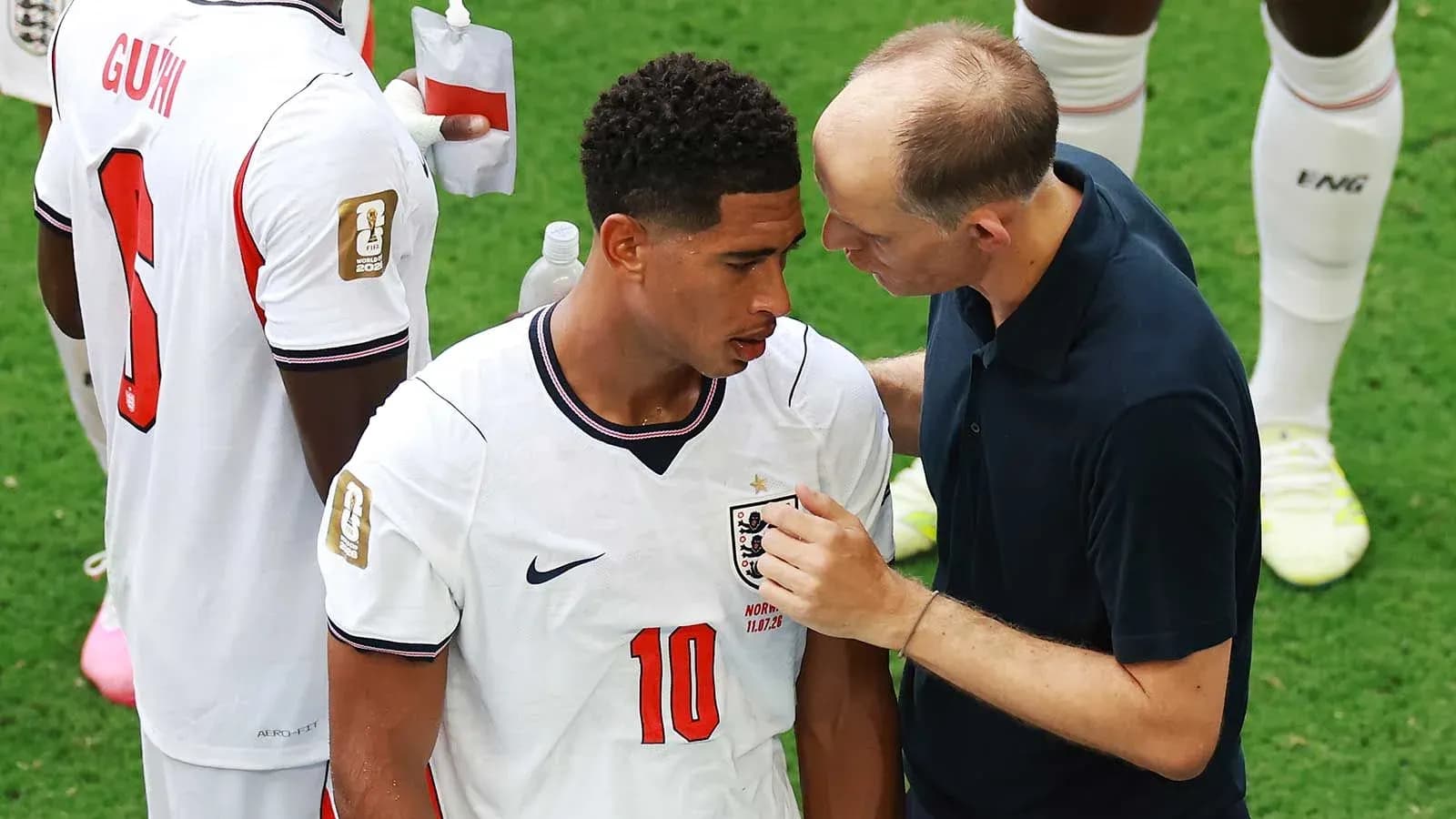
Tuchel Defends Bellingham Amid Media Storm Before Euro Semi-Final
Thomas Tuchel walked into England’s semi-final week with a storm already swirling around him and his star midfielder. He insists it is little more than a media squall.
The relationship between the German head coach and Jude Bellingham has been picked apart ever since last summer, when Tuchel’s mother described some of the midfielder’s on‑field behaviour as “repulsive”. An apology followed, the noise died down, and the pair pushed on.
Then came Norway.
England scraped through their Euro quarter-final 2-1 after extra time, a draining 120-minute fight that left bodies and tempers frayed. Tuchel, ever the demanding tactician, emerged from it saying he was “not happy with the team performance”. Bellingham, the heartbeat of this side, pushed back and called for more positivity.
The narrative wrote itself: star player vs hard-line coach. Crack in the camp. Trouble before Argentina.
Tuchel is having none of it.
The England boss revealed he gathered his squad the following day, not for a dressing-down but to lance the boil before it could grow. He wanted clarity, not conflict, going into a semi-final. As he put it to talkSPORT, the drama exists far more on the outside than in his dressing room.
“I wonder who blows these things up, eh?” he said. “So, there is nothing to blow up and if it's blown up, it's blown up in the media, of course.”
Tuchel then went out of his way to defend Bellingham’s reaction. To him, this was not a diva lashing out, but a competitor still running hot after giving everything.
“What do you expect of a player that just played 120 minutes and gave literally everything,” Tuchel said, explaining how his post-match comments had been trimmed down to the word “sloppy” and fed back to Bellingham without the praise that surrounded it. Strip out the compliments, keep the criticism, and you light the fuse.
“If you just cut all this and tell him ‘oh, your coach said you were sloppy’ what do you expect? Yeah, of course you get the comment that you get,” Tuchel argued. In his eyes, others are trying to “create misunderstandings and cracks where no cracks are”.
This is the dynamic he sees: two fierce competitors, both obsessed with standards, colliding in the white heat of a tournament. “We come from the same place,” Tuchel said. “We come from being competitive and I am a competitive coach. I push this team to the limit and that was my assessment.”
He was equally adamant that the question put to Bellingham after the match had been shaped to provoke. “I think the question was unfair in this moment towards Jude because he cut all the compliments out of my assessment and just asked about the critical points,” Tuchel said. “What do you expect of a player that just gave everything and stands there in front of a microphone in a flash interview?”
Bellingham, never shy of speaking his mind, appeared to take a sharper line in his own post-match remarks. He suggested Tuchel “maybe… doesn't know what it's like to play in those kind of conditions” or to face a striker of Erling Haaland’s level. It was a pointed reference to Tuchel’s modest playing career, and it landed.
Tuchel, though, brushed aside any suggestion that his lack of elite playing experience undermines his authority or his understanding of what his players endure. He remains adamant that the bond between him and his 23-year-old leader is not only intact, but thriving.
“It's just what it is but we're as close as ever, and close more than ever before,” he said. “You can see that on the field. The energy and mentality in camp is excellent in the last days and we are ready to go for it tomorrow.”
There is a humility to Tuchel when he talks about how he ended up in charge of England. This was never the plan. “I would still like to have a player's career, that was my dream,” the former Chelsea manager admitted. “I never thought about being a coach, never dreamt about being a coach on that kind of level, so I think this is basically the dream.”
He still has moments on the touchline where the scale of it all hits him. “I just feel also on the sideline very humbled, and from time to time it just strikes me on the sideline right before the match ‘I couldn't play here on this occasion.’”
Yet that sense of wonder does not, in his mind, disqualify him from dictating tactics to men who have lived the playing career he never had. “I don't think that you have to play [to be a coach],” Tuchel said, before delivering the line that sums up his stance. “A funny quote, you don't have to be a horse to be a good jockey!”
So the coach who never played at the highest level goes into a European Championship semi-final leaning on the midfielder who very much does. The outside world can frame it as friction. Tuchel insists it is fuel.