Two Greeks Transform Borussia Dortmund's Attack
The Signal Iduna Park crowd had been waiting for this. Not just a routine opening-day win, but something to jolt the place awake again.
They got it – and then, in the space of a few seconds, they felt it all slip away.
Two Greeks, one new dimension
“These are two lads who can and will give us a different dimension here, and they showed that today,” Niko Kovac told Sky after Borussia Dortmund’s 2-0 victory over Hamburger SV.
Giannis Konstantelias and Konstantinos Karetsas walked into the Bundesliga like they owned the stage. On debut, the two Greeks didn’t just decorate Dortmund’s game, they drove it. This was not showboating for the cameras; it was spectacular football with a purpose, the kind BVB have often lacked at home in recent seasons.
Kovac had trailed it even before kick-off. “The personnel give you what many perhaps also demand: spectacular things. We have improved that again this year. I hope these lads, who are technically very strong, show their abilities.” They did exactly that.
What sets them apart is not simply that they can do everything Julian Brandt once did in black and yellow. It’s that they add a gear he never quite had. Both Konstantelias and Karetsas can explode from a standing start, ripping open spaces between the lines with a single touch or feint. They are more proactive, more vertical, and they repeatedly create fresh match situations where nothing seemed to be on.
Konstantelias lights it up
For 45 minutes against HSV, Dortmund’s attack ran through them. Karetsas drifted, dropped, spun away from markers. Konstantelias, who had already hinted at his talent in the Super Cup defeat to Bayern Munich, simply took over.
His close control at full speed stood out, but so did the way he moved – light, elastic, always one step ahead. He hunted without the ball too, snapping into duels. Around the half-hour mark he won a ball in midfield that sent the Südtribüne into a frenzy. This was not a luxury playmaker. This was a No. 10 who wanted the fight.
Then came the moment that seemed to crown his debut. Just before the break, Konstantelias made it 2-0 and marked his first Bundesliga game with his first BVB goal. The shot took a deflection off a Hamburg defender, yes, but the idea behind it crackled with imagination: a no-look effort aimed at the near corner, executed with the swagger of someone who had been here for years.
“First half top, it was perfect. We implemented everything we wanted to implement,” defensive leader Waldemar Anton enthused on Sky. He could have been talking about the Greek playmaker alone.
Barely 100 minutes into his Dortmund career, Konstantelias already looked like a future fan favourite. The kind of player people come early to the stadium to watch in warm-ups.
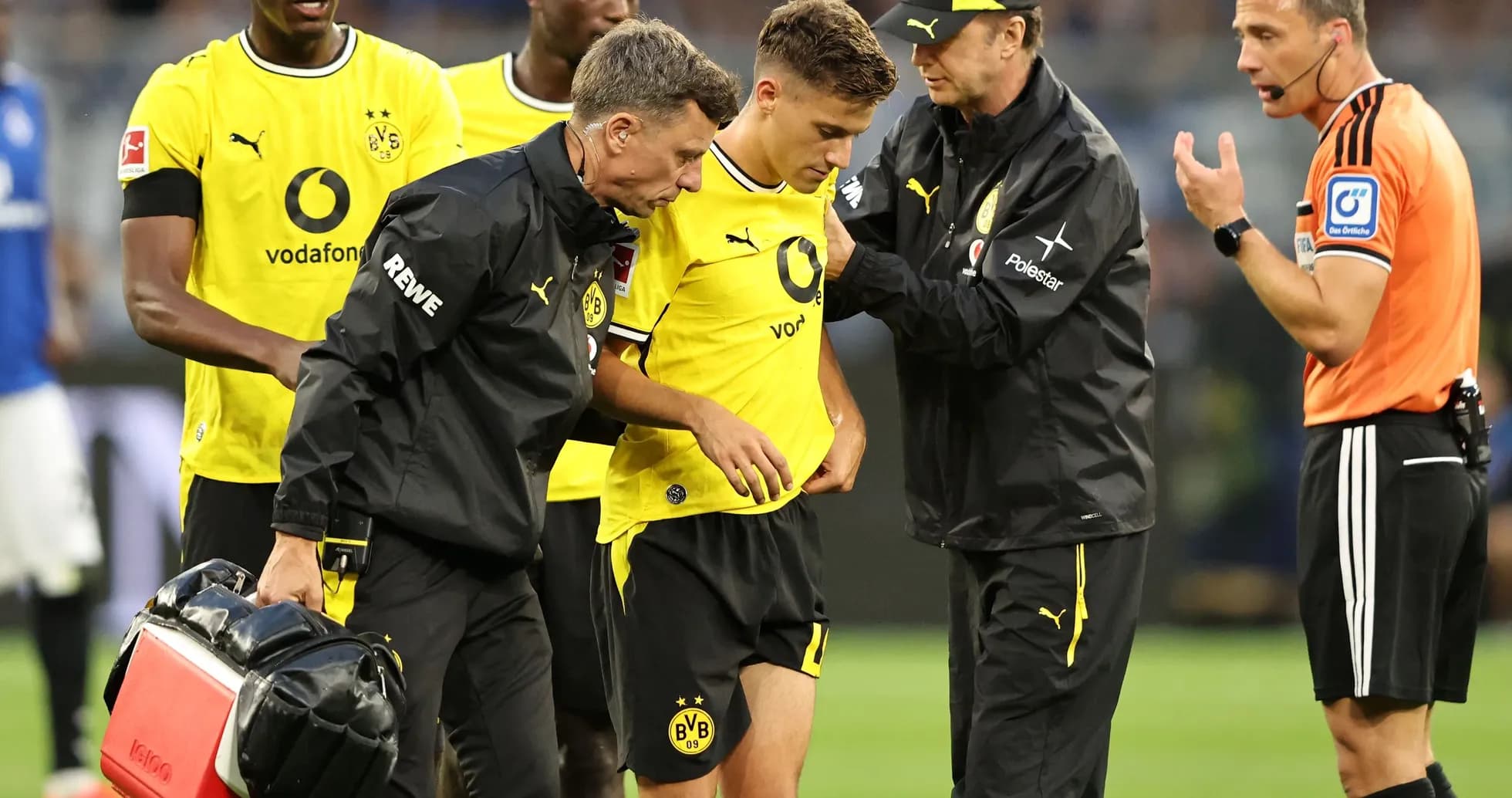
And then his knee twisted.
From euphoria to fear
Just after narrowly missing his second goal, Konstantelias went into a challenge, his leg planted awkwardly. He went down, stayed down, and the noise inside the stadium changed instantly. When he left the pitch in the 54th minute, the expression on his face said he feared exactly what everyone else did.
“Of course, we should be a little bit careful today about what we communicate. But we are certainly concerned about a more serious injury,” sporting director Ole Book admitted on Sky. Asked specifically about a cruciate ligament tear, he did not dodge it: “That concern is there.”
Kovac did not sound any more optimistic. “We will have the examination on Sunday. But at least it doesn’t sound good from what the doctor told me,” the BVB coach said afterwards.
If Sunday’s tests confirm the worst and Konstantelias is ruled out for months, it would be a brutal twist. A player who had transformed Dortmund’s attacking play in little more than a game and a half could suddenly disappear from the picture just as he arrived in it.
The difference without him was immediate. Dortmund lost their fluency, their dominance. HSV improved after the break, but it was also clear that a huge chunk of BVB’s mobility and inventiveness had walked off with the number on Konstantelias’ back.
“When Dortmund play from right to left, play into the spaces in between, then first of all you do a lot of chasing and don’t really manage to get into the press. That was our problem,” Hamburg captain Nicolai Remberg explained on Sky, describing the first half in which Konstantelias and Karetsas had run the show.
“Brutal” Greeks and a looming problem
Those two were the core of Hamburg’s headache. Constant rotation, perfect first touches, quick, precise combinations between the lines – the Greeks kept BVB’s attacking level high and HSV constantly off-balance.
“Brutal,” was Anton’s verdict on their performance. “The mobility they have, how dangerous they are, that is a great quality at that age and we need that for the future as well. I am glad we have them with us.”
Now the question hangs over Dortmund: how much of that future will Karetsas have to shoulder alone?
Book did not hide how much Konstantelias has already meant inside the club. “I felt incredibly sorry for the lad. He has had a great presence here from day one, also in the dressing room. We all already like him very much. When you then play such a good first half and have to be substituted and something more serious is feared, it is just unbelievably annoying,” he said, visibly affected.
On Saturday, Kovac turned to Marcel Sabitzer as a replacement. The Austrian, more defensively minded by nature, could not replicate Konstantelias’ spark. In theory, Samuele Inacio fits the profile best. In practice, his cameo against HSV ended almost as soon as it began with a lightning red card. Throwing the role of chief creator at an 18-year-old on the back of that would be a significant gamble.
Maximilian Beier is the more seasoned option, but using him centrally would force Kovac to rip up his plan of deploying the Germany international on one of the flanks. Solve one problem, create another. Beier’s spot out wide would suddenly be vacant again.
Transfer clock ticking – and the Sancho question
The timing could hardly be worse. The summer transfer window closes on Tuesday, 1 September, at 8pm. Officially, Dortmund are not planning anything in these final days.
“Depending on how serious the injury actually is, we will align our next steps accordingly. But one thing is certain: over the next three days, we are not planning anything,” said sporting managing director Lars Ricken.
That “depending” hangs over everything. If the scans confirm the fears Ricken himself already assumes, the club’s transfer department may yet be dragged back into the market.
Some options have already gone. Said El Mala, once Dortmund’s preferred target before the Konstantelias deal, has extended his contract at 1. FC Köln and is off the table.
One name, though, refuses to go away: Jadon Sancho.
The Englishman fits the template. Like Konstantelias and Karetsas, he can create dynamism from a standing start, unpick deep blocks, and tilt a game with a single surge. Rumours of a third spell in Dortmund had cooled after the arrivals of the two Greeks, but the landscape has shifted again.
Sancho’s situation is simple. His contract at Manchester United has expired, he has not found a new club, and he is available on a free transfer. Financially, the risk would be limited, though he would have to accept a significant pay cut to return. The sporting risk is different: can the 26-year-old ever rediscover the form he showed in his first BVB spell? His recent loans at Chelsea and Aston Villa were, by common consent, largely disappointing.
Dortmund know exactly what they would be getting – and what they might not be getting anymore.
For now, everything rests on the results of one scan. If Konstantelias’ knee allows him to come back quickly, BVB have already seen how radically he can reshape their attack. If it doesn’t, the club that thought it had finally refreshed its creative heart may find itself asking an old question again.
Is the answer to their future still hiding in their past?