USMNT Advances to Knockout Round Without Pulisic
SEATTLE — No Christian Pulisic. No problem, at least for now.
On a cool Seattle night that felt made for World Cup tension, the U.S. men’s national team punched its ticket to the knockout round with a 2-0 win over Australia, securing progression with a game to spare and proving its depth is more than just a talking point.
Life without Pulisic
All day, the conversation circled around one name. Pulisic, the AC Milan forward and heartbeat of this U.S. side, watched from the sidelines with a calf injury, his 33 international goals and big-tournament aura unavailable.
In past eras, that kind of absence might have hollowed out an American World Cup campaign. This time, it sharpened the focus.
From the opening whistle, the U.S. played like a team intent on ending the suspense early. Folarin Balogun, already in form after his two-goal show in the 4-1 win over Paraguay on June 12, attacked the left flank with purpose, stretching Australia’s back line and demanding attention every time he picked up the ball.
The breakthrough came quickly.
In the 11th minute, Balogun surged down the left sideline, drove toward the box, and whipped a centering ball toward Ricardo Pepi, who had stepped into the starting lineup in Pulisic’s place. Pepi never touched it. He didn’t have to. Australia defender Cameron Burgess, under pressure and facing his own goal, saw the cross clip off him and skid past his goalkeeper for an own-goal and a 1-0 U.S. lead.
The goal might have been scruffy, but the intent behind it was not. The U.S. had seized control.
Freeman’s moment
Once ahead, the Americans didn’t retreat. They pressed, harried, and forced Australia to chase the game. The Socceroos tried to settle, tried to hold the ball and quiet the crowd, but the U.S. midfield and fullbacks kept pushing the tempo.
Then came the moment that will live a long time in one family’s memory.
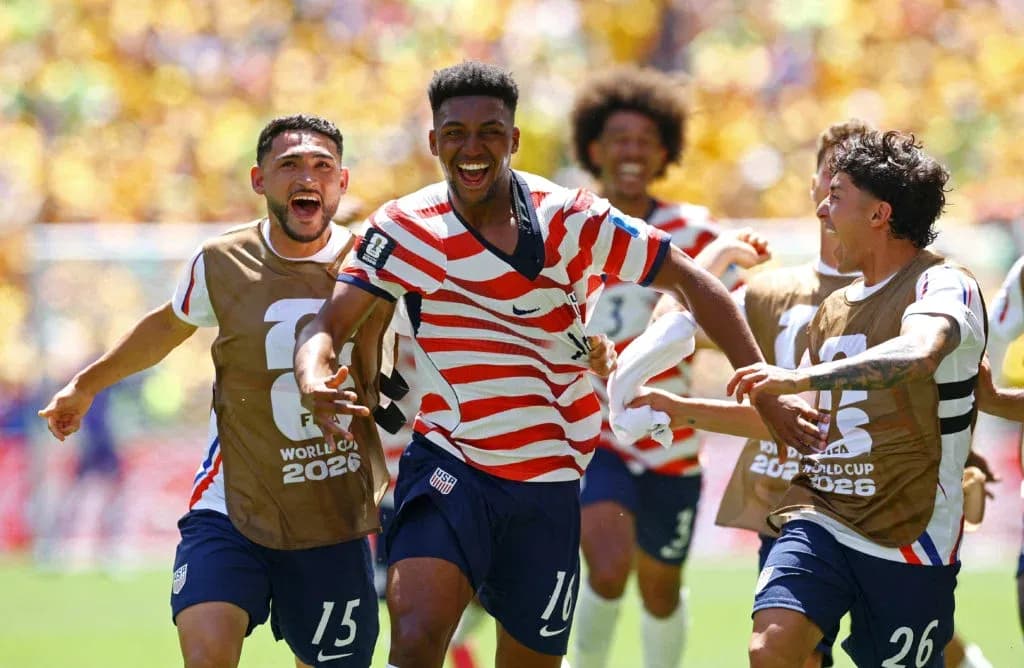
With halftime approaching and the U.S. still probing, a set piece in the 43rd minute turned into a landmark. Sergiño Dest’s effort took a deflection inside the box, the ball hanging in the air just long enough for Alex Freeman to attack it.
Freeman, the youngest player on the roster at 21 and the son of former Super Bowl champion Antonio Freeman, rose above the pack and snapped his header goalward. It was his first World Cup goal, a clean, decisive finish that doubled the lead to 2-0.
There was a brief pause as video review checked the play. No foul, no offside, no reprieve for Australia. Goal confirmed. Arms raised. Noise pouring down from the stands.
In the space of one night, Freeman went from promising youngster to World Cup goalscorer.
A different kind of host nation
This is not 1994. Back then, the U.S. rode emotion, home support, and a bit of good fortune into the knockout stage as one of the best third-place finishers, only to fall to eventual champion Brazil in the round of 16.
This time, the numbers tell a different story. Two games. Two wins. Knockout berth clinched with a match to spare. No reliance on other results, no waiting for permutations to break their way.
The roster is deeper. The attack is more varied. On a night when the team’s marquee star was unavailable, the supporting cast handled the responsibility with a calm that would have been unthinkable three decades ago.
Balogun’s aggressive running. Pepi’s movement, even without getting the final touch on the opener. Dest’s involvement in the second goal. Freeman’s fearless finish. Each piece contributed to a performance that looked less like a plucky host nation and more like a side expecting to be here.
What it signals
Australia had its moments, but the U.S. never truly looked rattled after taking the lead. The back line held firm, the midfield controlled the rhythm, and the attack kept asking questions. It was professional, assured, and, crucially, efficient.
Clinching a knockout place after just two matches marks a milestone for a program that has long chased consistency at the highest level. Doing it without Pulisic on the field underlines something even more important: this team is no longer built around a single savior.
Pulisic will still be central to how far the U.S. can go when he returns from injury. His creativity, his timing in big moments, his experience — all of it will be needed as the stakes rise and the opponents sharpen.
But on this night in Seattle, the U.S. showed it can win without him. It showed that a 21-year-old in his first World Cup can step into the spotlight, that an own-goal forced by pressure counts just as much as a top-corner strike, and that knockout qualification no longer has to be a late-tournament scramble.
The Americans are through. The question now isn’t whether they belong in the knockout rounds.
It’s how far this deeper, more mature version of the U.S. can push the story this time.