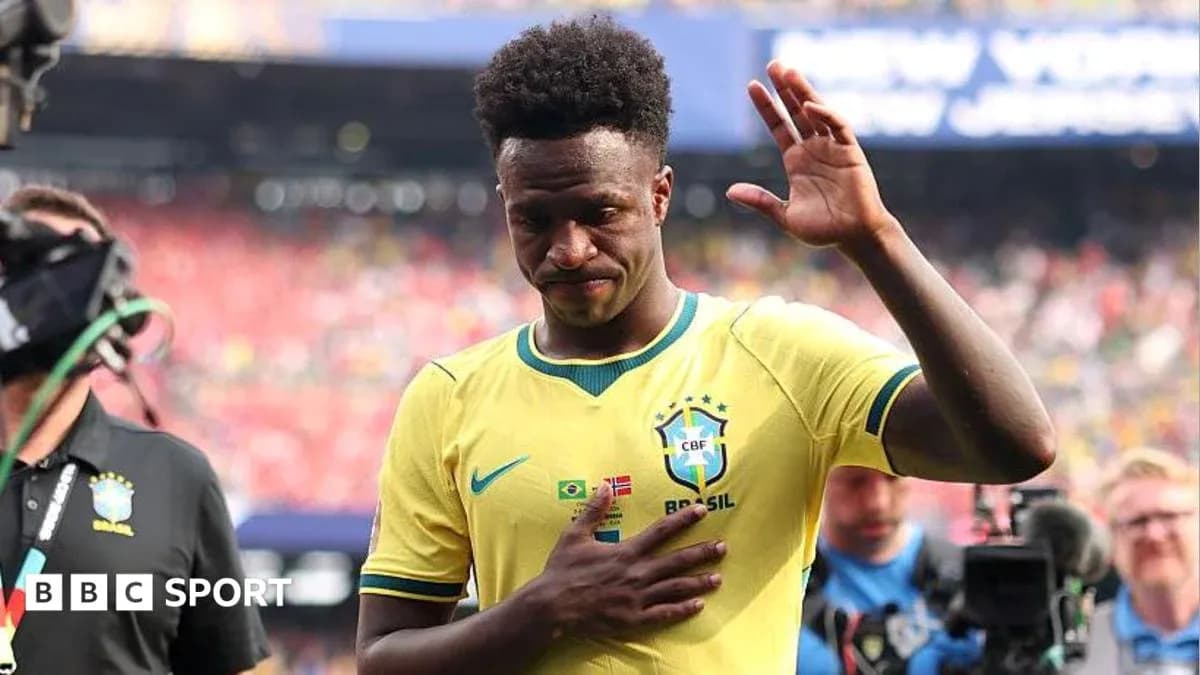
Vinicius Jr's Potential Move to Arsenal: A Premier League Dilemma
If Vinicius Jr had walked into Arsenal’s dressing room this summer, it would have felt like a rupture in football’s natural order.
A genuine, current, global superstar. In his prime. Swapping the white of Real Madrid for north London red. The kind of move the Premier League, for all its money and noise, almost never pulls off.
Arsenal were ready. Vinicius, 26, was at least listening. The club were prepared to build their summer around him, to make him the headline act of a project already stacked with emerging stars. For a brief moment, the idea lived.
Then reality reasserted itself. Vinicius signed a new deal at the Bernabeu, tying him to Madrid until 2032. The door closed with a familiar thud.
England’s richest league, someone else’s biggest stars
The Vinicius saga underlines a contradiction the Premier League cannot quite shake.
No league spends like England’s top flight. No league sells itself better. The stadiums are full, the TV deals are gargantuan, the global reach is unmatched. Yet when it comes to attracting the very top tier — the players already orbiting the Ballon d’Or — the pull of the Premier League often stops just short.
Centre-backs? Goalkeepers? No problem. Clubs in England hoard them. The best in those positions arrive, stay, and often peak there.
It is different higher up the pitch. The sharp end of the game — the elite forwards and attacking midfielders, the faces on billboards and video-game covers — still tends to gravitate elsewhere.
Since the Premier League’s inception in 1992, only three players have lifted the men’s Ballon d’Or while playing for an English club: Michael Owen with Liverpool in 2001, Cristiano Ronaldo with Manchester United in 2008, and Rodri with Manchester City in 2024. Three decades, three winners.
The Premier League, for all its glamour, has been better at forging superstars than importing them fully formed.
The league that makes stars, not just buys them
Look back at some of the defining names of the Premier League era and a pattern emerges.
Dennis Bergkamp did not arrive at Arsenal as a global icon. He came off a bruising spell at Inter Milan, his reputation dented, his future uncertain. England gave him space to breathe, to create, to become one of the most elegant and influential players the league has ever seen.
Eric Cantona had flickered in France and at Leeds. At Manchester United, he became a symbol — the swaggering embodiment of their first great Premier League side.
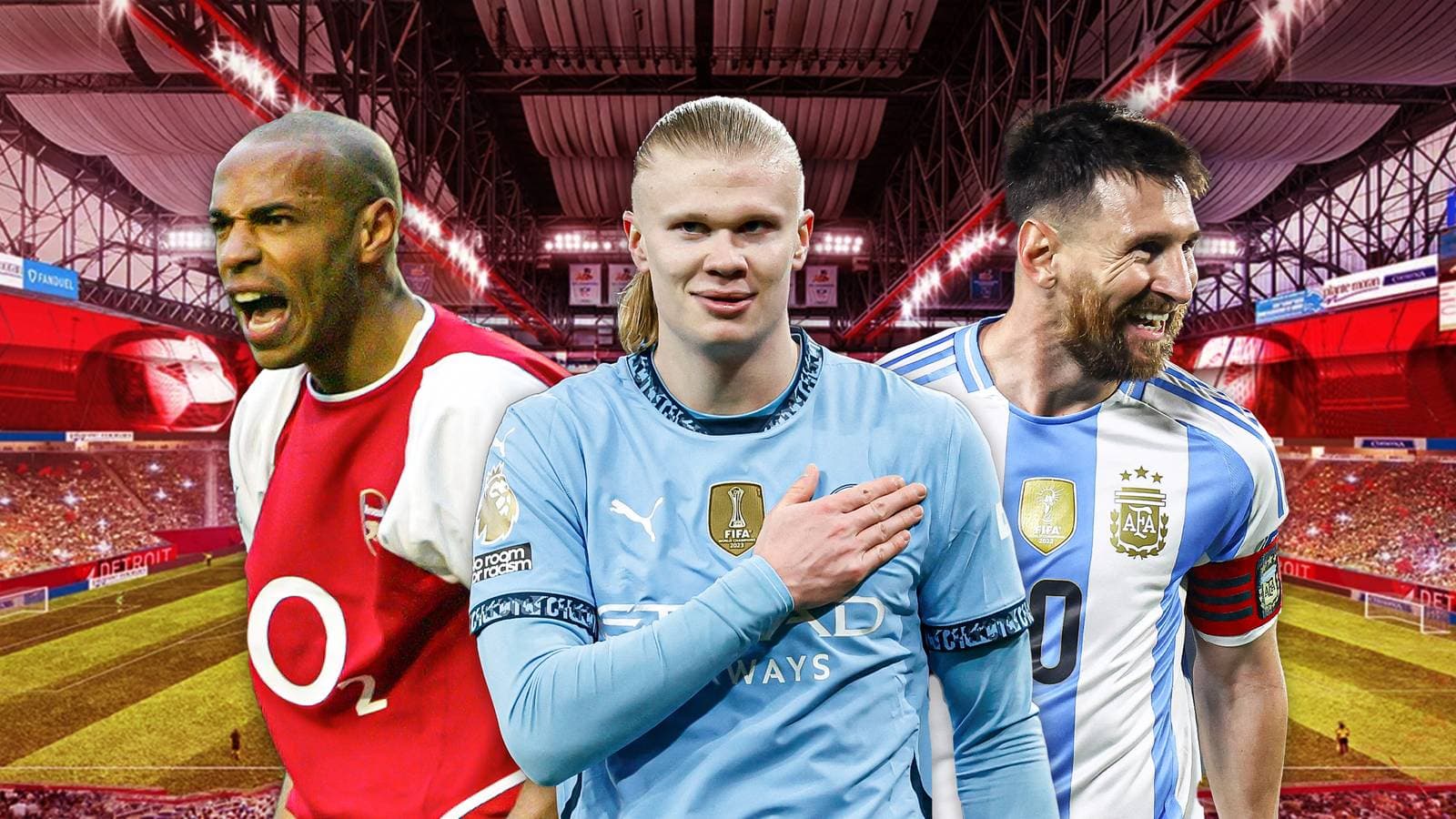
Thierry Henry reached Arsenal as a winger who had underwhelmed at Juventus. In north London he morphed into something else entirely: a forward who dominated seasons, a player who defined an era.
Cristiano Ronaldo is perhaps the clearest case study. United signed him at 18 from Sporting, a raw talent with tricks and promise. Five years later he was a Ballon d’Or winner. One year after that, he was gone, pulled towards Madrid’s gravitational field.
Erling Haaland fits the same arc, in a modern frame. When Manchester City took him from Borussia Dortmund in 2022, he was already one of Europe’s most coveted young strikers. But he was not yet the ruthless, record-breaking force he has become in England. The Premier League was his launchpad, not his final destination.
That is a very different proposition from signing a player like Vinicius after he has already won multiple Champions Leagues and cemented himself as one of the most recognisable footballers on the planet.
The rare true Galactico who came
There have been exceptions — and they stand out precisely because of their rarity.
The closest comparison to a hypothetical Vinicius-to-Arsenal move is Andriy Shevchenko’s switch to Chelsea from AC Milan in 2006. Shevchenko was 29, a recent Ballon d’Or winner in 2004 and fifth in the voting in 2005. He arrived in England not as a prospect or a reclamation project, but as an established global superstar still close to his peak.
Other Ballon d’Or winners did land in the Premier League, though their timing told its own story.
Ruud Gullit and George Weah both joined Chelsea, but later in their careers. Ronaldo returned to Manchester United at 36, long after his first Old Trafford spell and his Madrid prime. Zlatan Ibrahimovic walked into United at 34, more icon than long-term cornerstone. Jurgen Klinsmann signed for Tottenham at 30, a marquee name but not a player being prised away from his apex.
Those deals added prestige and narrative weight. They did not alter the broader trend.
From Serie A’s golden age to England’s deep squads
Once upon a time, it was Serie A that held this power.
In the 1980s and 1990s, Italy was the undisputed home of football’s giants. The league was rich, glamorous, and ruthless. If you wanted to see the best, you watched Serie A.
Diego Maradona left Barcelona for Napoli and turned a struggling club into a champion. Brazil’s Ronaldo swapped Barcelona for Inter at his explosive peak. Michel Platini, Marco van Basten, Lothar Matthaus, Zinedine Zidane — all spent some of their finest years in Italy, drawn by the money and the mystique.
The Premier League now dwarfs Serie A financially, but that dominance has produced a different kind of transfer market.
English clubs spend heavily, yet the money often spreads across entire squads rather than being funnelled into one or two untouchable superstars. Fees that once would have gone on a single Galactico now get sliced across multiple signings, or recycled within the league itself.
- Alexander Isak
- Morgan Rogers
- Elliot Anderson
- Moises Caicedo
- Declan Rice
- Jack Grealish
— all have moved between Premier League clubs for more than £100m. Not global icons, but elite or emerging talents valued as part of a collective arms race.
Others, such as Liverpool’s Florian Wirtz, arrive from abroad with huge reputations and sky-high expectations, but with the sense that their true peak still lies ahead.
The model has shifted. Less about one man as the face of the project, more about assembling 18 to 22 players capable of surviving a schedule that grinds down even the deepest squads.
Haaland, Madrid, and the ceiling on England’s pull
Haaland stands as the argument against any notion that the Premier League cannot attract top-tier talent at all. City signed him at 21, and he has since grown into one of the most feared number nines in world football, a striker who bends seasons to his will.
Yet even his story hints at the limits of England’s appeal.
During the 2026 World Cup, his father Alfie spoke to DAZN about the prospect of his son one day moving to Real Madrid. The answer was polite, but pointed.
"He's happy at City, he's got a long contract… but any player wants to play for Real Madrid," he said.
No transfer request. No immediate drama. Just an admission that Madrid still sits at the top of the sport’s hierarchy in the minds of many players, even those thriving in England.
That is the challenge the Premier League cannot quite solve with TV money or branding campaigns. It can offer the stage on which superstars are made. It can turn rough diamonds into Ballon d’Or winners. It can pay more than almost anyone.
Convincing those who have already conquered Europe to swap Madrid for Manchester or London at their absolute peak — and persuading those who reach that summit in England to resist the Bernabeu’s call — remains the hardest part of all.