West Ham's Tumultuous Return to the Championship: Ownership Crisis and Future Uncertainty
Ten summers in at the London Stadium and West Ham arrive at a place they never thought they’d see again: the Championship, the Carabao Cup first round, Portsmouth at home. A decade on from leaving the Boleyn, the grand Olympic bowl stages a reminder of reduced status. The glamour has drained away. The glare has not.
Relegation last season did not trigger a cleansing reset. It triggered a storm.
A club in the second tier – and in limbo
Some clubs use a year downstairs to clear their heads. West Ham did exactly that in 2011-12, when Sam Allardyce marched them straight back up. The current odds suggest they could do it again; bookmakers have them as short-odds favourites for promotion.
The mood tells a different story.
The summer has been dominated not by signings or fresh ideas, but by boardroom manoeuvring and a deepening distrust between ownership and support. The club that lifted the Europa Conference League in May 2023 has since fallen off a cliff, on and off the pitch.
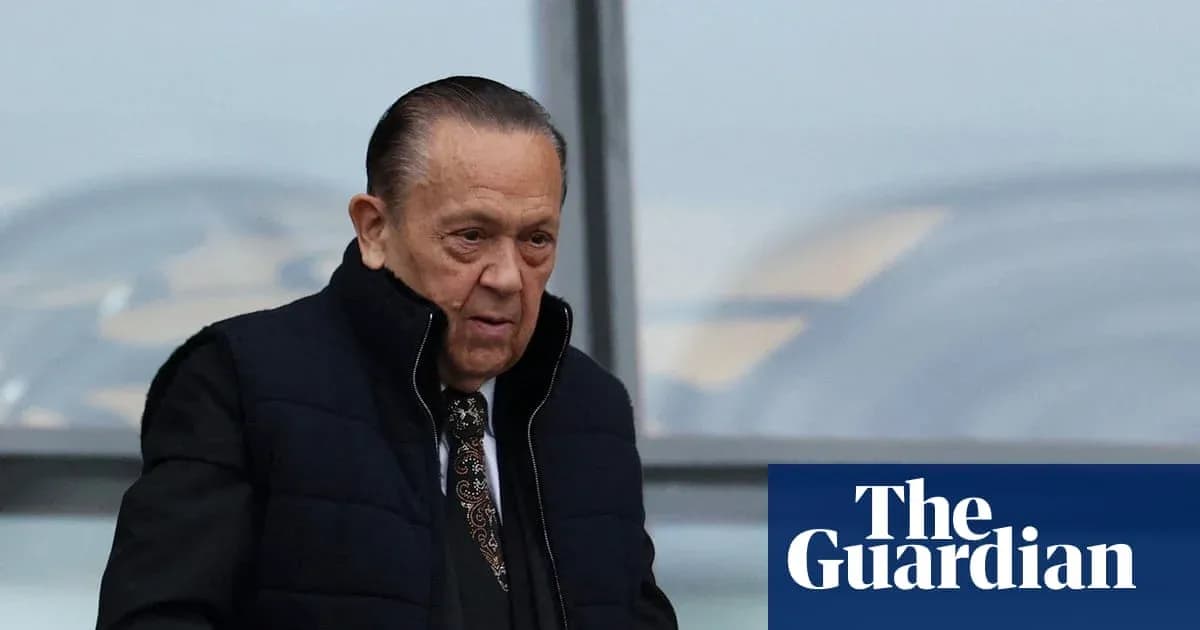
Saturday’s tie with Portsmouth, who will bring 9,000 travelling fans, is supposed to mark a new beginning. Instead, it centres on a familiar question: will David Sullivan turn up?
Stadium operators have advised the former joint-chair, still a 38.8% shareholder, to stay away because of the “potential for demonstrations and anti-social behaviour by some spectators”. The fans advisory board has said his presence would cause “offence and upset”.
Yet the expectation is that he will walk back into the stadium anyway, intent on watching as a supporter, content for now to hold his stake and his ground. It would be an act of defiance in a place where his position has rarely felt weaker.
On the day relegation was confirmed, a home win over Leeds on 25 May, Sullivan had to leave early for his own safety. Since then, the pressure has only intensified.
Sullivan, scandal and a vacuum at the top
In June, a BBC Panorama documentary carried allegations of sexually exploitative and predatory behaviour towards women over several decades. Sullivan denies them. On the eve of broadcast, he stepped down from his role at the club “to avoid disruption to the club while he addresses the matter privately”.
He was already a lightning rod. Years of hands-on control in the transfer market, years of being the de facto director of football, had left many inside the football operation exasperated. Outside, supporters watched a team slide from European glory into relegation, the £100m received for Declan Rice in the summer of 2023 scattered without building a coherent side.
Jarrod Bowen, the captain and hero of Prague, has committed to stay and lead the fightback. The symbolism is powerful. The structure above him is anything but.
Karren Brady, Sullivan’s long-time ally from a partnership stretching back to 1990, stepped down in April as the clouds gathered. The hierarchy that once ran West Ham with a tight, unified grip has fractured, leaving a vacuum where clarity should be.
And into that space, the bidders and brokers have begun to move.
Kretinsky steps sideways, Staveley steps in
Supporters have bought in heavily to the on-field cause: 50,000 season tickets sold for a Championship season underline the size and loyalty of the fanbase. Their message is equally loud. They want Sullivan out altogether.
His announcement that he would step back offered a sliver of optimism, a sense that a new era might finally be coming. The reality has been murkier.
Daniel Kretinsky, the Czech billionaire and Royal Mail owner who bought 27% of the club in 2021, looked the obvious heir. When Sullivan stepped aside, many expected Kretinsky to move for control. Instead, this week he trimmed his share to just under 25%, transferring 2% to fellow Czech entrepreneur Jakub Havrlant. The move keeps him below the threshold that would trigger a mandatory takeover bid if he also exercised his right of first refusal on another crucial block of shares.
That block is the 25% stake left by the late David Gold, now held by his daughter and co-chair, Vanessa Gold. Whoever secures it will reshape the power map.
As Amanda Staveley reappeared on the scene last weekend, that stake became the focal point. Fresh from her exit at Newcastle in July 2024, where she had been instrumental in bringing in Saudi Arabia’s Public Investment Fund, Staveley wants another club. She was linked with Tottenham last September. Now West Ham is her target, with suggestions she could again draw on major external funding.
Among Newcastle supporters, her departure has been noted; her drive and visibility are missed. Among West Ham’s, some see in her the possibility of a similar jolt of energy, a figure who could galvanise a club stuck between eras.
Kretinsky’s move complicates that. By staying just under 25% himself and potentially buying the Gold stake, he could approach control without being forced into an immediate full takeover bid. Any attempt by Staveley to secure that same 25% would run straight into his contractual rights.
Sullivan, with his 38.8%, still holds the balance of power. The next move belongs to Staveley, but the boardroom chessboard is his.
Transfers on hold, nerves on edge
While the ownership saga plays out, Nuno Espírito Santo is left to prepare a Championship campaign with limited new blood and a fanbase braced for more turbulence.
The first signing of the summer, free agent Joël Veltman, brings experience from Brighton and Ajax. It is a sensible addition, but hardly the kind of statement that calms a restless crowd.
Sales have done the shouting instead. Mateus Fernandes has gone to Tottenham and Crysencio Summerville to Al-Hilal, deals worth a combined £140m – roughly a year’s worth of Premier League television revenue. Homegrown midfielder Freddie Potts has been sold to Club Brugge for £10m, a move that stung sections of the support who saw him as one of their own.
The logic is brutal. To rebuild a relegated squad, money must come from somewhere. The Championship is a harder sell for elite players, and every incoming deal depends on the exits that precede it. Interest in Ireland’s World Cup playoff hero Troy Parrott, now at AZ Alkmaar, shows West Ham are looking for goals, but closing that kind of signing from the second tier is not straightforward.
In the dugout, Nuno remains when many assumed he would depart with relegation. His calm demeanour, almost detached at times, might be exactly what a panicked club needs. Around him, though, anxiety seeps through every conversation: Sullivan’s future, the lack of transfer activity, the sheer scale of the rebuild.
The fixture list offers no gentle landing. By 1 September, West Ham will have faced Burnley, Charlton, Watford and Wolves. For a club that still thinks of itself as Premier League-sized, those games will be a sharp test of both ego and ambition.
Karim Virani has returned as interim chief executive after a spell at Rangers, another attempt to restore some institutional memory and stitch together a fractured operation. The intention is clear: to pull the club into some kind of unity before the season runs away from them.
A stadium that still doesn’t feel like home
Away from the football, the London Stadium has carried on being what it has always really been: a multi-use venue where West Ham rent space rather than rule.
This summer it hosted Take That and Metallica. In July, it staged a Diamond League meet in which Josh Kerr broke the world mile record. On Thursday, a bid was confirmed to host the 2029 World Athletics Championships, the latest twist in a long-running tussle between the club and the stadium’s owners.
For West Ham supporters, each announcement lands like another reminder. Ten years after leaving the Boleyn Ground, their home still doesn’t quite feel like theirs. The terms agreed by Sullivan, Gold Sr and Brady, hailed as transformational at the time, remain a source of resentment.
Now, as the club prepares for a Carabao Cup tie that underlines its fall from the elite, the man who signed those terms may walk back through the turnstiles against the wishes of many inside.
The crowd will roar for Bowen, for Nuno, for the claret and blue. How they respond to Sullivan, and how long this uneasy stalemate can last, will shape not just this season’s promotion push, but the very identity of West Ham United in the years to come.