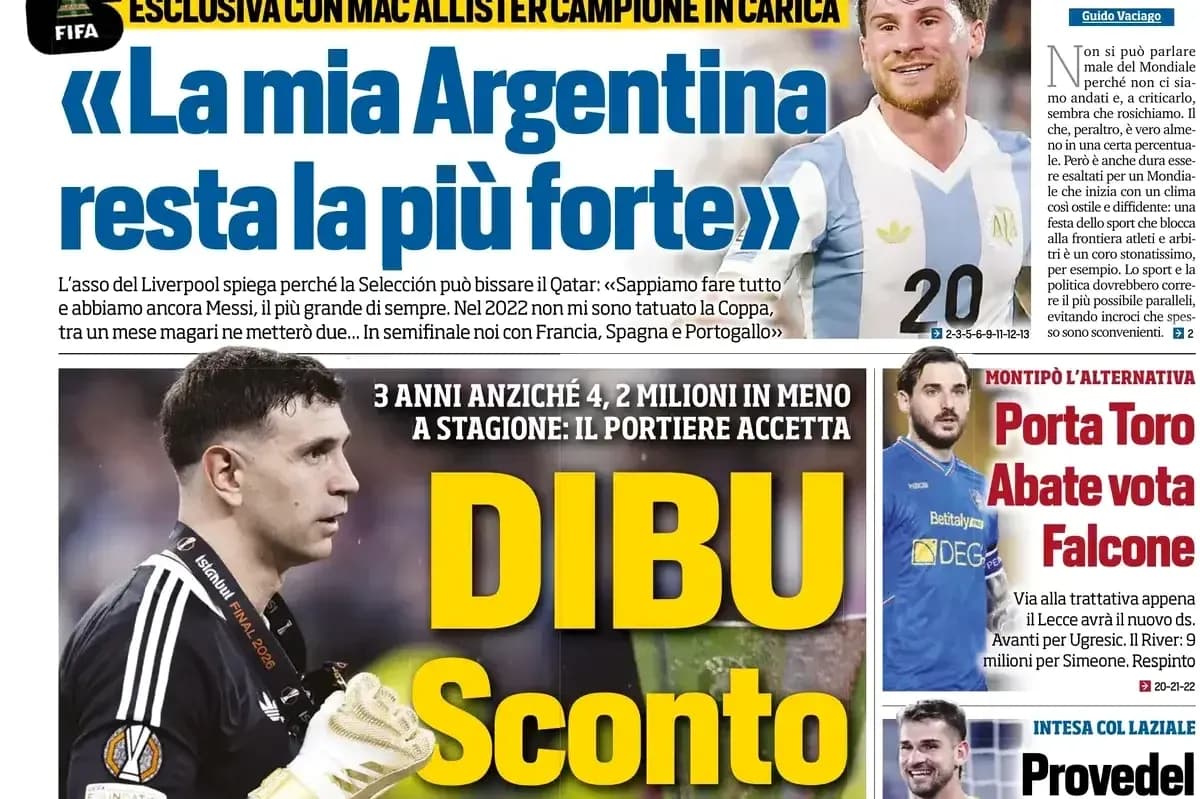
World Cup 2023: A Bold Tournament Without Italy
At 20:00 tonight, football’s biggest experiment kicks off. A maxi World Cup, American-sized and unapologetically bold, opens at the legendary Estadio Azteca with Mexico–South Africa. Forty-eight national teams, three host countries, three opening ceremonies, one final ringed in red on July 19.
Everyone is there. Almost. Italy, once more, watches from the outside, reduced to a supporting role through three men in suits: Carlo Ancelotti, Fabio Cannavaro and Vincenzo Montella. The tricolour won’t fly on the pitch, but it will sit on the benches, trying to bend this swollen tournament to its will.
Messi the hunted, not the hunter
The defending champions arrive with the same quiet menace that carried them through Qatar. Lionel Messi, still the axis around which Argentina’s game spins, set the tone with a simple warning: it will be tough to beat us. He knows what it takes. So does his dressing room.
Alexis Mac Allister, now a pillar in Liverpool’s midfield and a world champion in sky blue and white, has no doubts about where the bar is set. For him, the Selección remain the team to beat. The formula hasn’t changed: a hardened core, a coach who knows exactly which strings to pull, and the presence of the player many now call the greatest of all time.
Mac Allister did not mark 2022 with a tattoo of the World Cup. He might correct that omission this summer. “In a month’s time, I might get two,” he admitted, half-joking, half-deadly serious about another run at the trophy. His bracket is clear in his mind: semi-finals with Argentina, France, Spain and Portugal. The usual giants, the usual pressure.
Spain raise their hand
If Argentina and France carry the weight of recent finals, Spain arrive with a different kind of swagger. Rodri, the metronome of both Manchester City and La Roja, doesn’t bother with false modesty. For him, the level of this World Cup has risen, and Spain are favourites.
It is a bold line in a tournament packed with superstars. But it fits the tone of a group that has been rebuilt on youth, aggression and the belief that possession is a weapon, not a shield. In a field this crowded, conviction counts as much as any tactical tweak.
France, a galaxy with a question mark
Then there is France, a squad so rich in talent that the debate is no longer about whether they are strong enough, but whether they might be too strong, too loaded, too full of egos and options.
The attack alone intimidates. Kylian Mbappé leads a frontline that can change shape, tempo and personality in a heartbeat. On paper, it is an assault force no defence wants to see in a knockout game. On the grass, it still needs balance, sacrifice, a hierarchy that holds when the pressure bites.
This is the paradox of the French: so many solutions they risk creating new problems. If it clicks, they can steamroller anyone. If it doesn’t, the same depth that should be a blessing can turn into noise.
A new generation at the door
As Messi tries to defend his crown and Mbappé hunts the one trophy that still eludes him, a new name has already stolen part of the spotlight: Lamine Yamal. The teenager arrives as the symbol of the World Cup’s next era, a prodigy asked to produce on the biggest stage before he has even finished writing his first full chapter at club level.
This tournament will not be short on storylines. Yamal’s rise, Mbappé’s chase, Messi’s defence of his throne, Portugal’s last tilt with a star-studded group, Spain’s claim to favouritism. All of it played out across a swollen calendar and a continent-sized stage.
Italy’s role: three benches, one pride
And Italy? No anthem in the group stage, no blue wave in the stands. Just three coaches carrying a nation’s know-how into foreign dressing rooms.
Carlo Ancelotti, the most decorated of them all, steps into this World Cup as the elder statesman, a coach whose calm has weathered every type of storm. Fabio Cannavaro brings the steel of a former World Cup-winning captain, now tasked with transmitting that same competitive edge from the touchline. Vincenzo Montella, the more daring tactician of the trio, will try to imprint his ideas on a stage that rarely forgives hesitation.
It is a strange reality for a country that once set the standard. The whole world is there, as La Gazzetta dello Sport put it. Apart from Italy. The flag, this time, is a detail on a coach’s lapel, not on a captain’s chest.
The curtain rises at the Azteca
All roads tonight lead to the Azteca, a stadium soaked in World Cup mythology. Mexico–South Africa will not decide the trophy, but it will light the fuse. The first of three opening ceremonies will paint the picture the organisers crave: global, oversized, relentless.
From there, the machine will not stop. Forty-eight participants, days stitched together by kick-offs and time zones, a month of football where the margins between glory and oblivion shrink with every passing match.
Messi wants to keep what he has. Mbappé wants to take it. Spain say they are ready to own the stage. France bring a galaxy. Portugal lurk with experience and firepower. And Italy, from a distance, must decide what to make of a World Cup that no longer feels like home.
On July 19, one captain will climb the steps and lift the trophy. The question, for a country watching without a team, is simple: how long until the Azzurri are back on that stage, not as spectators in the technical area, but as protagonists in the centre circle?