World Cup 2023: USA Dominates Paraguay in Historic Opener
LOS ANGELES — For months, the World Cup felt like a political summit disguised as a tournament. Protests, ticket outrage, border headaches, transit chaos. Then the whistle went, the ball rolled, and all that noise faded into the background hum of a competition that has burst into life across Mexico, Canada, and the United States.
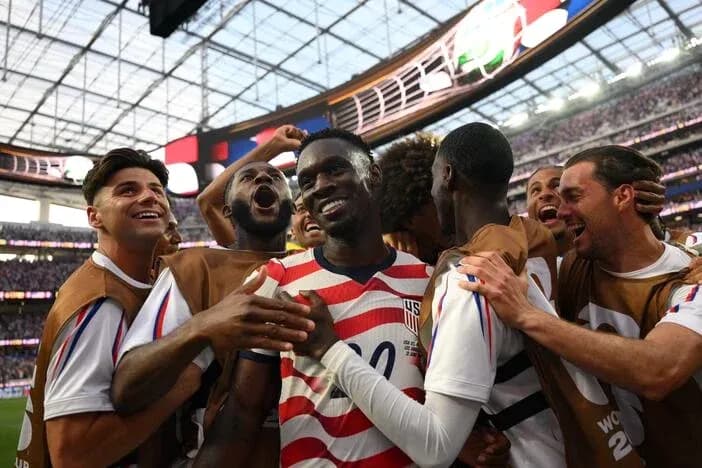
And in Los Angeles, the U.S. men delivered a statement that echoed far beyond the city limits.
A Night the U.S. Will Remember
The opener against Paraguay at Los Angeles Stadium had the crackle of a big occasion and the ruthlessness of a team that has heard every doubt and decided to answer all at once.
Final score: United States 4, Paraguay 1.
No U.S. men’s team had ever scored this many goals in a World Cup match. Not in 1930, not in 2002, not in any of the plucky runs that built this program’s reputation as stubborn underdogs. This was different. This was dominant.
At the heart of it, Folarin Balogun. The striker produced the kind of performance American fans have been waiting on for generations, striking twice to record the first multi-goal game by a U.S. player at a World Cup since the inaugural tournament in 1930. Clinical finishes, sharp movement, a constant threat. Paraguay never really solved him.
Behind him, the platform was immaculate.
Chris Richards, back from an injury that kept him out of both pre-World Cup warm-ups, stepped into the back line and turned in one of the most efficient passing displays the tournament has ever seen. Eighty-three passes attempted. Eighty-three completed. No player has hit that mark in a World Cup match since records began in 1966.
Every build-out seemed to flow through him. Every tempo change ran at his pace. For a defender returning cold, it was as if he’d never been away.
Not everything went the Americans’ way, though. Christian Pulisic, the star around whom so much of this project revolves, came off at halftime with a calf problem. He walked gingerly to the team bus afterward, his status unclear. On a night when almost everything sparkled, that was the cloud hanging over the skyline.
It was, undeniably, a great start. It was not a completed mission.
Australia Crash the Party
Group D offered a reminder less than 24 hours later: tournaments turn quickly.
Turkey arrived with the sheen of European pedigree. Names from Real Madrid and Juventus. Arda Güler pulling strings, Kenan Yildiz offering cutting edge. On paper, they were the heavyweight in the U.S. group.
Australia tore that script up.
A 2-0 win for the underdog sent a shockwave through the bracket and jolted the narrative. Turkey’s stars never found their rhythm; Australia’s discipline and belief carried the day. Suddenly, next Friday’s USA–Australia clash looks enormous.
If the U.S. beats Australia, it takes control of Group D and, with it, a strong lane into the knockout rounds. Drop points, and that opening-night euphoria starts to feel a little less secure.
One game never defines a World Cup. The second one often does.
Scotland’s Surprise and a Royal Group C
Elsewhere, another storyline emerged from a country that has waited nearly three decades for this stage.
Scotland, back at a World Cup for the first time in 28 years, sits on top of Group C after beating Haiti. On its own, that’s a nice story. In this group, it’s something more.
Because sharing that space are Brazil, the five-time champions, and Morocco, one of the powerhouses of the modern international game. Those two met and drew 1-1, a heavyweight contest that left both with work to do and opened the door for Scotland to enjoy the view from the summit. For now.
No one is writing off Brazil or Morocco. Both remain favorites to advance. But the early math has shifted, and Scotland, of all teams, currently holds the high ground in a group built for giants.
Qatar’s First Point, Japan and the Dutch Trade Blows
World Cups always find room for smaller milestones, the quieter moments that matter deeply to one nation.
On Saturday, Qatar drew 1-1 with Switzerland and claimed its first-ever World Cup point. This is only Qatar’s second appearance at the tournament, after qualifying automatically as host in 2022 and losing all three matches. This time, they walk away from their opener with something tangible: a foothold.
Sunday brought a different kind of contest. Netherlands vs. Japan, two established forces in Group F, went toe-to-toe and refused to blink. A 2-2 draw felt about right in a match where neither side backed down and both left the pitch knowing they had just shared one of the early standouts of the group stage.
Curaçao’s Seventeen Minutes
Then there was Curaçao.
Population: 158,000. The smallest country ever to play in a World Cup. On Sunday, it walked out to face Germany, a nation whose World Cup history swings from triumph to trauma but rarely touches the ordinary.
Germany scored early. Routine, everyone thought.
Curaçao equalized.
For 17 minutes, the scoreboard read 1-1, and the Caribbean underdog stood level with one of the game’s superpowers on the biggest stage of all. Those 17 minutes will live forever on the island.
Then Germany did what Germany so often does. They reset, accelerated, and ran away with it, winning 7-1 — a scoreline that carries its own famous place in German World Cup lore. The gulf in depth and experience told in brutal fashion, but Curaçao’s debut still carved out its own piece of history.
Politics at the Door, Iran on the Pitch
The week ahead offers more than just footballing intrigue.
On Monday, Iran faces New Zealand at Los Angeles Stadium in a match loaded with context before a ball is kicked. There had been real doubt over whether Iran would even take part after the U.S. and Israel attacked the country in February. Plans for a training base in Tucson, Arizona, were abandoned; the team instead set up camp in Tijuana, Mexico, citing security concerns and ongoing hostilities.
The U.S. government has limited Iran’s entry, allowing the team into the country only the day before each of its three group matches. So Iran will cross the border, play, and leave — a team moving in and out of the host nation on a tight, politically charged schedule.
Once the whistle blows, all that tension meets New Zealand’s stubborn, hard-running style. It’s a fixture that could reshape Group dynamics and headlines in equal measure.
Mbappé, Messi, and the Weight of History
Tuesday belongs to the superstars.
France, with Kylian Mbappé at the peak of his powers, opens its World Cup campaign against Senegal in Group I. Mbappé has long since graduated from prodigy to standard-bearer, and every French tournament now feels like a referendum on how far he can drag his country toward another trophy.
Senegal will not play the role of willing foil. Physical, organized, and dangerous in transition, they have the tools to turn a showcase into a scrap. For France, this is a test of control as much as talent.
Later that day, the defending champions walk back onto the stage.
Argentina and Lionel Messi begin their bid for back-to-back titles against Algeria in Group J. Only two nations have ever successfully defended the World Cup: Italy in 1938 and Brazil in 1962. That’s the scale of the task facing Messi and company.
He has already delivered the trophy that defined a generation. Now comes the chase for something even rarer — not just glory, but dynasty.
The tournament has barely started, and records have fallen, underdogs have barked, and giants have stumbled. The noise outside the stadiums hasn’t disappeared, but inside, the story is clear: this World Cup has arrived at full speed.
The question now is who can keep up.