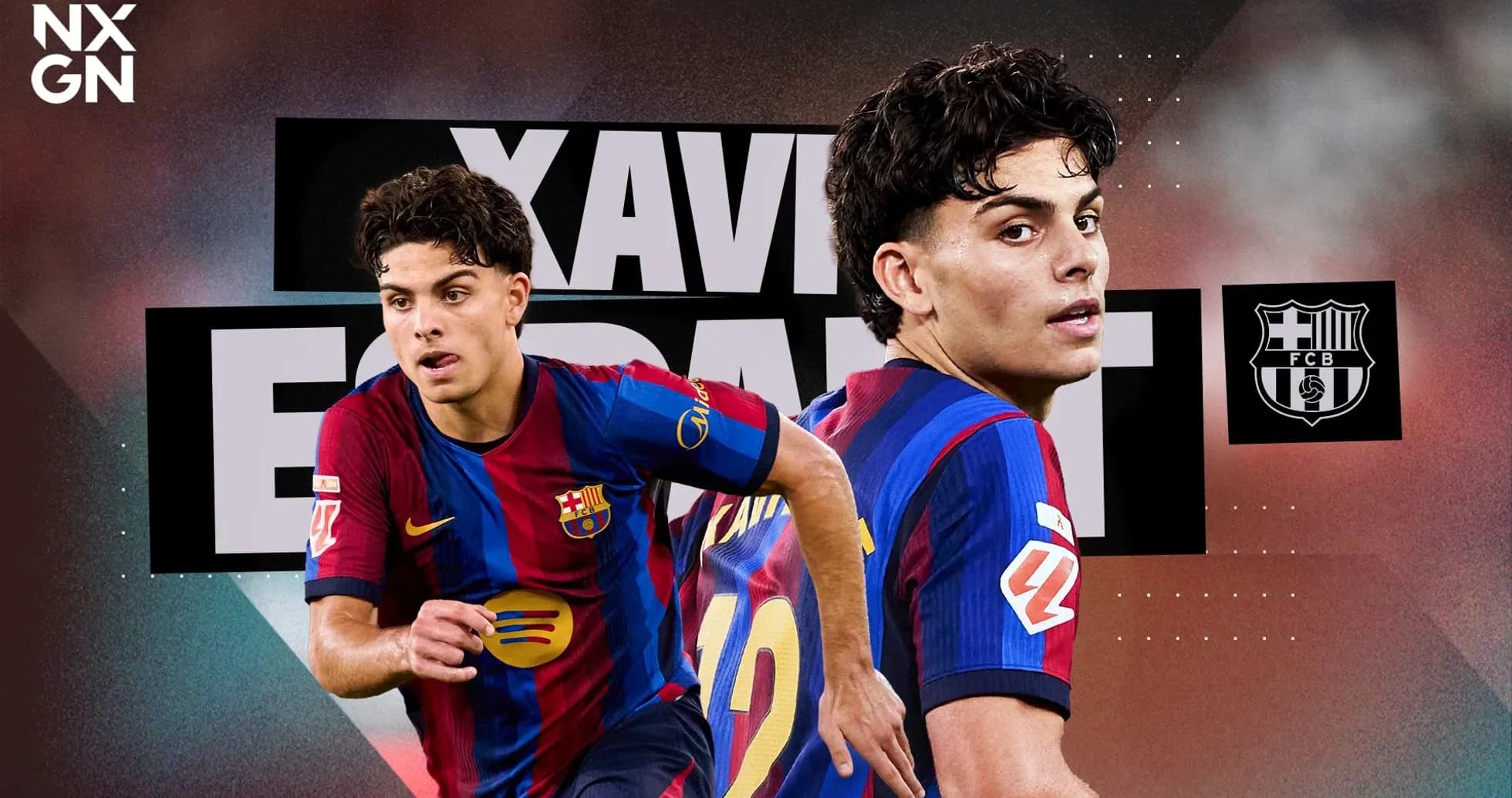
Xavi Espart: Barcelona's Versatile Rising Star
In Barcelona, the next great full-back might actually be a midfielder.
Xavi Espart grew up in the Catalan capital, a La Masia kid who knew the badge long before he knew tactics. He joined Barcelona’s academy at eight, sharing dressing rooms and training pitches with Lamine Yamal, Pau Cubarsi and Marc Bernal as a midfielder. Back then, he was the one knitting moves together, not the one stopping them.
By 16, that had already started to change. Coaches saw a player who could do a bit of everything, so he split his time between midfield and right-back, even stepping up to play UEFA Youth League football with the U19s. He adapted, learned, and kept his place. That versatility would become his calling card.
Treble winner before turning 18
The real breakout came when Juliano Belletti took charge of the youth side. Espart, mostly at right-back, became one of the pillars of a team that swept to a domestic and European treble in 2024-25.
On the continental stage, he didn’t just blend in. He decided games.
Against Newcastle, he scored one and set up another in a 3-2 win. Against Paris Saint-Germain, he hit the winner. Not long after that, Hansi Flick called him up. The pathway was clear.
Then football did what it so often does to young dreams. It stopped him in his tracks.
Espart spent the opening weeks of the new campaign on the bench, hovering on the verge of a debut, when a knee injury struck. Three months out. Momentum gone, or so it seemed.
Flick didn’t forget.
Thrown in at St James’ Park
March. St James’ Park. Barcelona trailing 1-0 to Newcastle in the first leg of a Champions League last-16 tie. Flick turned to the teenager who had grown up watching nights like this.
Espart replaced captain Ronald Araujo in the 88th minute. No gentle easing in, no dead rubber. Straight into a hostile away leg.
He didn’t flinch.
Chasing Joe Willock all the way to the byline, he slid in, won the ball cleanly, bounced back to his feet and fed Lamine Yamal. Minutes later, Barcelona equalised. His touch won’t appear on every highlight reel, but inside the club they noticed.
"When I saw myself coming onto the pitch, I couldn't believe it. I enjoyed it so much and my emotions were running high," he told the club’s website afterwards.
Five days later, Flick trusted him from the start. Ninety minutes in a 5-2 La Liga win over Sevilla at Camp Nou. Sevilla pressed him, hurried him, forced a few errors, but he never hid. As the game opened up, so did he, growing calmer on the ball and more assertive off it.
Then came another pause. He drifted back to the bench and made only four more league appearances in a title-winning season. Yet by then it was obvious: Flick liked what he saw.
"For a young player like me, the manager's trust in me has meant everything," Espart said. "His confidence in me has allowed me to stay calm, without pressure, and play the way I know how."
Running Spain’s midfield
If his Barcelona minutes were still rationed, Spain’s U19s gave him the keys.
In Wales over the summer, Espart was sublime in midfield as Spain stormed to the U19 European Championship. He didn’t just fit into games, he dictated them — gliding past challenges, hunting down loose balls, recycling possession, then slicing teams open.
He smashed in his first goal of the tournament in a 7-0 win over hosts Wales, cushioning the ball with a delicate touch before thundering it home. In the semi-final against Croatia, he struck again with a 12th-minute opener.
Often he’d receive the ball, lift his head and see all 11 opponents in front of him. It rarely fazed him. A sharp pass through the middle. A one-two to break a line. A surge straight between defenders. One way or another, he usually found a route to goal.
Spain didn’t concede once all tournament. Espart made the Team of the Tournament and returned to Barcelona with a medal, a reputation and a very clear idea: this was his moment.
Number 12, no holidays
The club made it official. Promoted to the first team. Given the number 12 shirt. The rest of the summer was his to enjoy.
He chose not to.
Reports around the club say he cut short his holiday to keep his rhythm from the Euros, determined not to lose an inch of sharpness. Flick rewarded that decision by using him at right-back throughout pre-season.
"I feel Flick's confidence and I want to stay in the first team; you have to take advantage of the opportunities," he said. "Since coming back from the European Championship, I've tried to give 100 per cent here and show that I belong here and what I'm capable of."
In a friendly against Birmingham, he looked like he’d been there for years. Calm on the ball, relentless without it, tight to his winger when defending the box. When Flick asked him to tuck inside as an inverted full-back or step into midfield to dictate tempo, he did it seamlessly.
Afterwards, the coach didn’t hold back: the teenager, he said, "has made it clear to us that he is a top-level player."
Solving a problem from the wrong side
Right-back has been a headache for Barcelona. The club’s money went on Rodri, Anthony Gordon and Karim Adeyemi in the summer, leaving Jules Kounde and Joao Cancelo as the only established options there.
Logic said Espart would be next in line on the right.
Football, again, had other ideas.
Flick has started him in all four La Liga games this season — at left-back, ahead of Alejandro Balde.
He looked instantly at home. Against Elche, he was solid defensively and registered his first assist, clipping a diagonal pass into the path of Fermin on the edge of the box to complete a 5-0 win.
Four days later came a more rugged test against Athletic Club. Espart relished it. He threw himself into duels, built attacks from deep and occasionally burst through the middle, looking to unpick a packed defence. One superb cross found Raphinha free in the area, only for the Brazilian’s header to crash off the post.
"Xavi Espart is incredible," Joan Garcia said after the 2-0 victory, praising his defensive work.
Flick sounded just as impressed. "I’m very pleased with what I’m seeing, even a little surprised by how he’s playing at left-back," he said. "He’s always focused. He’s a player with great quality and, in one-on-one situations in defence, he’s top-class. I’m very happy with him. Like all players, he has room for improvement."
Espart and Raphinha linked up again in the 5-2 win over Rayo Vallecano. This time, Espart drifted into the half-space, fired a sharp pass into his captain and watched Raphinha surge through to score the equaliser.
A different kind of full-back
The qualities that marked Espart out as a midfielder still define him. His reading of the game, his positioning, his awareness under pressure — all of it translates perfectly to full-back.
He doesn’t shy away from contact. He steps into wingers, presses high, and when he wins the ball he looks to play forward immediately.
He is not the classic overlapping full-back who lives on the touchline. He prefers to combine inside, drift into the interior channel, or dribble towards the box before releasing a team-mate.
"I can be a different kind of full-back, one who can link up with teammates centrally instead of being a wing-back," he explained.
Whether he’s in midfield or at full-back, his passing carries threat and keeps the tempo high. One or two touches, then the ball is gone again.
His adaptability has been striking. From midfielder to right-back in the academy, then suddenly left-back in La Liga to start the season. He hasn’t blinked.
"You've all seen it: he's spectacular with the ball, he can play at full-back and in midfield... and he always does it perfectly," Pau Cubarsi told Marca.
The Lahm comparison
The comparisons were inevitable once Flick started talking.
"When I see Xavi play, I really like his confidence on the ball," the coach said in the summer. "He reminds me of Philipp Lahm, as he can play as a No. 6 or a 2. I like to see him with and without the ball."
Lahm began his career at left-back, flourished on the right, then under Pep Guardiola moved into midfield. Germany coach Joachim Low, with Flick as his assistant, followed that blueprint at the 2014 World Cup and was rewarded with a trophy.
Espart is at the very start of his journey, but the parallels are clear. Excellent close control, the ability to dictate play from deep, and the intelligence to shift between positions without losing his identity. Flick seems intent on moulding him into his own multi-purpose leader.
Holding his place, managing the load
For now, the numbers are simple: Espart has played every minute of Barcelona’s first four La Liga matches this season. Flick, aware of the physical and mental demands, chose to rest him for the Champions League win over Feyenoord, leaving him on the bench.
That caution will likely continue. Barcelona know how quickly a young player can be burned out. Espart has moved ahead of Balde in the left-back hierarchy, but midweek showed that Cancelo remains a trusted option there when rotation is needed.
Espart understands the stakes.
"For now, I'm happy, but football is a day-by-day thing, and I'll keep giving 100% to stay here," he said last month. "It's very difficult to make it here, but what's really tough is staying here because of the high standards set by these players.
"At the end of the day, this is Barca, the best team in the world, and the demands are there every single day.
"You can never let your guard down."
Left-back, right-back, or back in midfield — wherever Flick finally pins his name on the teamsheet, Espart’s intelligence and versatility are already reshaping Barcelona’s options. The only real question now is not whether he belongs, but what kind of player he will become at the very top.