Youssef Chermiti's Injury Devastates Rangers Season
Youssef Chermiti’s Rangers season lies in ruins, and the timing could hardly be crueller.
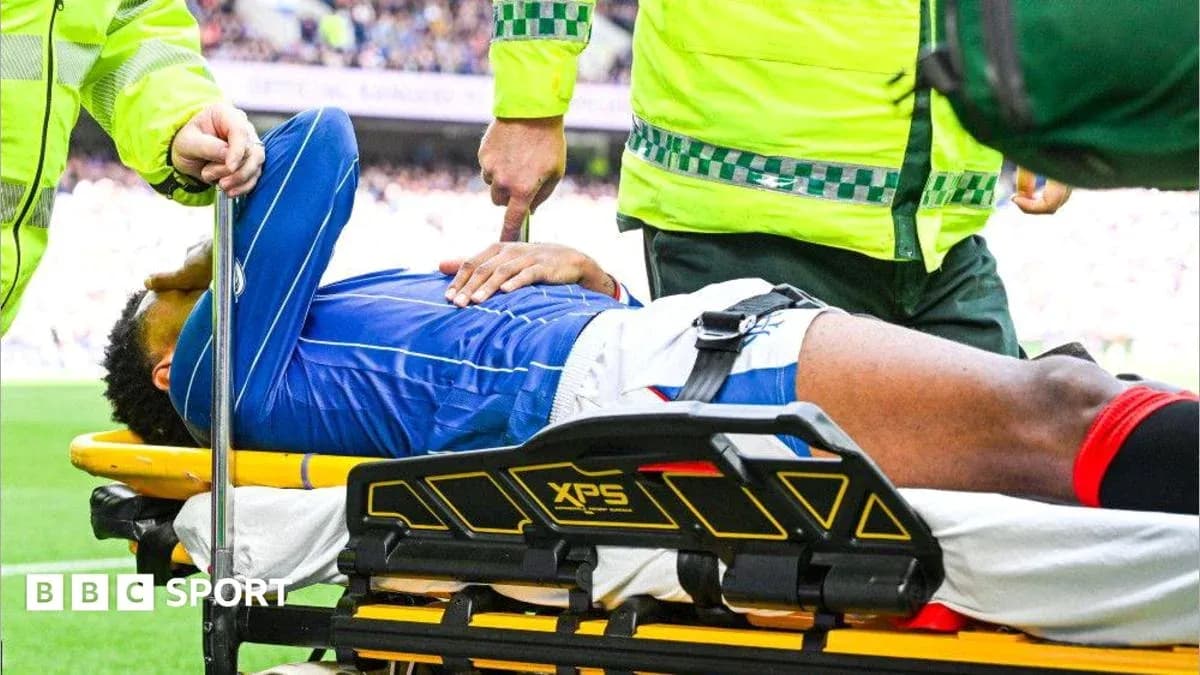
The 22-year-old striker faces a long spell out after suffering anterior cruciate ligament damage in Sunday’s 2-1 home defeat to Hibernian, an injury that came just hours after Rangers had rejected a major bid for him.
He crashed into the advertising boards behind Raphael Sallinger’s goal following a heavy challenge, immediately throwing an arm into the air to summon help. The pain was obvious. So was the fear. His afternoon ended on the turf, and Rangers now wait to discover if their season has just lost its focal point.
The club confirmed on social media that Chermiti “will be out of action for a significant period of time” – the kind of phrase that, in football, usually signals months rather than weeks.
A Record Signing Cut Down
Chermiti arrived at Ibrox from Everton in September 2025, reportedly becoming Rangers’ most expensive signing since Tore Andre Flo back in 2000. He was supposed to be the centrepiece of a new attack, the statement signing to usher in a fresh era.
He had begun to justify the outlay. Capped by Portugal at under-21 level, the centre forward has made 43 appearances for Rangers, 30 of them starts, scoring 15 goals. Not just numbers, but presence: a physical focal point, a willing runner, a forward with obvious upside and resale value.
That potential had not gone unnoticed abroad. On the very day he was hurt, Rangers had turned down what was reported to be a £22m offer for the striker, with Turkish champions Galatasaray widely believed to be the club testing their resolve.
Risk, Reward, and Regret
The decision to play him in such circumstances became a live issue at Monday’s shareholders’ meeting. Chairman Andrew Cavenagh was asked whether it was wise to risk such a valuable asset with serious money on the table.
His answer was blunt.
“Just because someone lobs an unsolicited offer in on one sheet of paper, you don't yank a player from a really important match,” he said.
The board had faced a stark choice: cash in and wrap their prize asset in cotton wool, or back their valuation, reject the approach and send him out to lead the line. They chose the latter. Now they are left to live with the consequences.
On the touchline, Derek McInnes had already made his stance clear before kick-off against Hibs. Asked about Galatasaray’s interest, the Rangers manager told BBC Scotland: “I'm led to believe the club's valuation of the player hasn't been met.
“It's no surprise that he's a player who's got a big (price) tag on him and he's got high potential, but thankfully he's our player and that will continue to be the case.
“We're trying to build a team here at the minute and we're trying to still bring additions to the team that helps us add to the good players that we've got, including Youssef.
“So it's not something we would encourage at any point.”
McInnes wanted his main striker on the pitch, not in the shop window. He got his wish, but at a heavy cost.
A Manager Under an Early Cloud
From the main stand at Ibrox, the incident looked bad from the moment Chermiti’s body folded behind the goal. He stayed down, motionless, then signalled desperately for the medics. The game moved on without him. Rangers’ season might not.
A cruciate ligament injury is, by definition, serious. When a club publicly concedes a player is out for a “significant period”, it rarely ends in good news.
For McInnes, still in the early days of his tenure, it is another blow in a start that is beginning to feel cursed. On the day Rangers refused a substantial bid for their marquee forward, that same player suffered an injury that is likely to keep him out for months.
The sense of “what if?” will linger. If they could turn back time, would the board bank the money and bench him? Or does a club of Rangers’ stature always back its football decisions over its balance sheet?
What is certain is that McInnes now has a major problem at the top end of the pitch.
Striker Puzzle Deepens
Cavenagh has tried to ease concerns, telling shareholders that “three to five” new signings will still arrive. That is welcome news for a manager suddenly staring at a hole in his forward line.
He may now need one of those recruits to be a striker.
Lawrence Shankland has yet to ignite his Rangers career. The goals that flowed so freely elsewhere have not yet followed him to Ibrox. Ryan Naderi, on current evidence, does not look like the solution to the team’s shortage of cutting edge. Bojan Miovski is on the books but has not played a competitive minute under McInnes.
Chermiti had started both of Rangers’ last two matches, a clear indication of where he sat in the pecking order. He was the man entrusted to carry the burden while others found form or fitness. Now he is gone, and the responsibility shifts to a group still searching for rhythm.
Europe Looms Without the Focal Point
There is no time for self-pity. Rangers face Jagiellonia Bialystok in Europa League qualifying, a tie that will help define the mood around McInnes’ early reign. They must now negotiate it without their primary striker, their most valuable asset, and arguably their most dangerous forward.
The injury to Chermiti has stripped Rangers of more than just a number nine. It has removed a tactical reference point, a financial safety net, and a symbol of the club’s ambition in the transfer market.
The decision to play him against Hibs has been made. The bid has been rejected. The ligament has gone.
What happens next will say a great deal about Rangers’ resilience – and about how quickly McInnes can rebuild an attack that has lost its cornerstone just as the season truly begins.