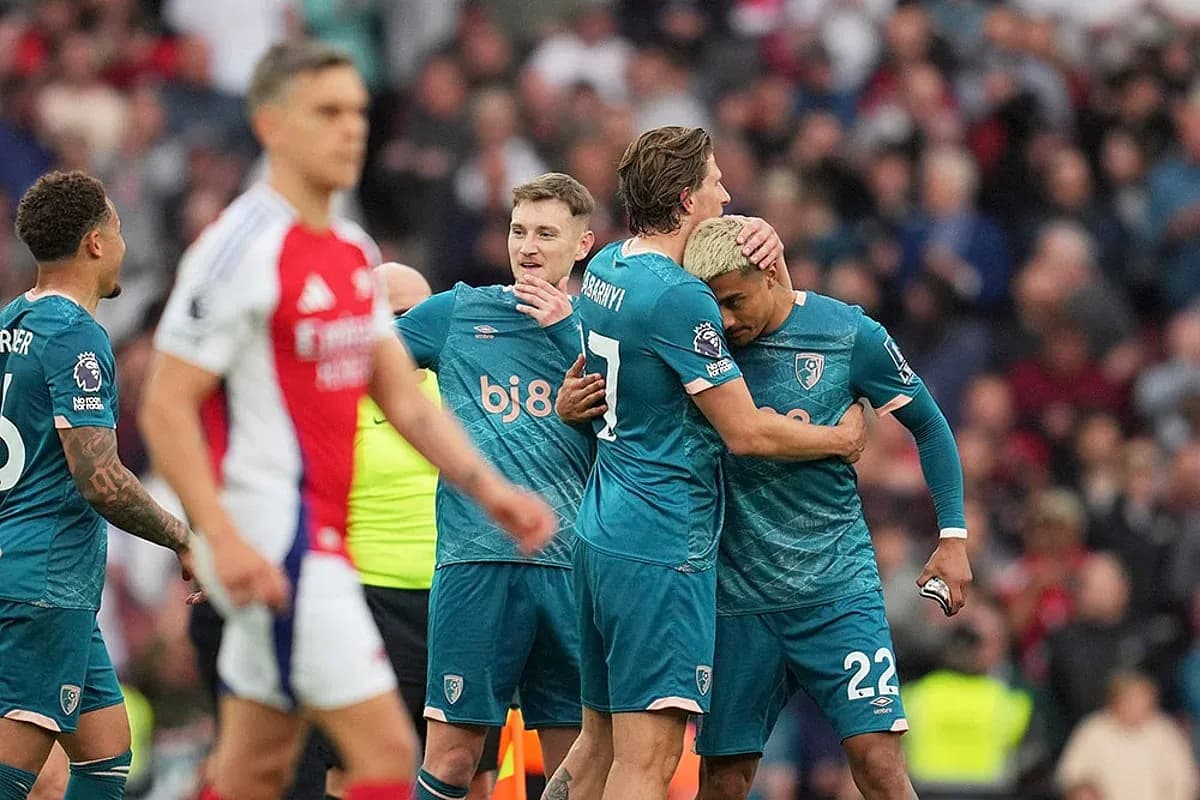
Arsenal's Defeat to Bournemouth: Tactical Analysis
Arsenal’s 2–1 home defeat to Bournemouth at Emirates Stadium unfolded as a structural problem rather than a pure finishing issue. Despite edging possession 53–47 and generating the better shot volume (15–8) and xG (2.41 to 1.2), Mikel Arteta’s side were repeatedly funneled into low-quality zones, while Andoni Iraola’s Bournemouth maximised transitions and key central breaks. Both teams set up in a 4-2-3-1, but Bournemouth’s compactness between the lines and targeted pressing triggers on Arsenal’s double pivot tilted the tie away from the nominal favourites, especially in the second half.
Bournemouth's Opening Goal
Bournemouth struck first on 17'. Eli Junior Kroupi attacked the half-spaces from his nominal No.10 line, exploiting the channel between Myles Lewis-Skelly and William Saliba. The move typified Bournemouth’s plan: win second balls around Alex Scott and Ryan Christie, then immediately look for Kroupi between Arsenal’s midfield and defence. Arsenal responded on 35', Viktor Gyökeres converting a penalty to level at 1–1, reflecting their territory but also that they needed a set piece to break Bournemouth’s block. The halftime scoreline matched the pattern: Arsenal on the front foot but without consistent incision from open play.
Arteta's Tactical Adjustments
Arteta’s triple substitution at 54' was a clear tactical reset. Leandro Trossard (IN) came on for Gabriel Martinelli (OUT), Max Dowman (IN) came on for Noni Madueke (OUT), and Eberechi Eze (IN) came on for Kai Havertz (OUT). The intent was to add more between-the-lines craft and inside movements, with Eze as a more natural No.10 and Trossard narrowing from the left. Structurally, Arsenal shifted from a relatively rigid 4-2-3-1 to something closer to a 2-3-5 in possession: Ben White and Lewis-Skelly stayed deeper and narrower, Declan Rice often dropped to form a three in build-up with Martín Zubimendi initially staying as the more advanced pivot before his later withdrawal.
Bournemouth's Strategic Response
Bournemouth’s response was to refresh their own pressing and transition threats. At 70', David Brooks (IN) came on for Rayan (OUT), and Tyler Adams (IN) came on for Ryan Christie (OUT). Adams’ introduction was pivotal: he provided extra defensive range and aggression in front of the back four, allowing Scott to push higher in certain phases and join Kroupi in pressing Arsenal’s first pass into midfield. Bournemouth’s 4-2-3-1 often morphed into a 4-4-2 without the ball, with Kroupi stepping up alongside Evanilson to block central lanes into Rice and Zubimendi.
Decisive Moments
The decisive moment arrived on 74'. Evanilson dropped off the front line to link play, dragging one centre-back with him and creating a temporary overload in the right half-space. With Arsenal’s double pivot stretched laterally, Scott surged into the vacated central lane, receiving from Evanilson and finishing Bournemouth’s second “Normal Goal”. This was the clearest example of Bournemouth’s verticality: few shots (only eight total), but a high proportion from dangerous central zones, reflected in a respectable 1.2 xG from limited volume.
Final Attempts and Game Management
Arteta’s final attempt to rebalance came on 76'. Gabriel Jesus (IN) came on for Martín Zubimendi (OUT), and Cristhian Mosquera (IN) came on for Ben White (OUT). Jesus’ entry signalled an all-out attacking posture, with Gyökeres and Jesus often sharing central spaces, Eze and Trossard tucking inside, and Rice left as the lone true midfielder in rest defence. Mosquera’s arrival for White was more about fresh legs and aerial presence than a systemic change; Arsenal continued to build with a back two, pushing full-backs high and wide.
Bournemouth, however, managed the closing stages with discipline. Adrien Truffert’s yellow card for a foul on 77' underlined the physical edge in Bournemouth’s defending, particularly on Arsenal’s wide players. Kroupi then picked up a yellow card on 79' (no additional reason listed), a by-product of his aggressive work without the ball. Gyökeres was booked on 80' for a foul, symptomatic of Arsenal’s frustration as Bournemouth slowed the tempo and disrupted rhythm.
Key Substitutions and Time Management
On 85', Bournemouth made a key game-management switch: Alex Tóth (IN) came on for Eli Junior Kroupi (OUT). With Kroupi already on a yellow, this substitution reduced the risk of a dismissal while adding fresh legs to help screen central passes. In stoppage time, James Hill was cautioned at 90+6' for time wasting, a deliberate attempt to run down the clock as Arsenal chased an equaliser. Just before that, Bournemouth added defensive and transitional security: Adam Smith (IN) came on for Álex Jiménez (OUT) at 90', and Enes Ünal (IN) came on for Evanilson (OUT) at 90', ensuring fresh energy at full-back and up front for pressing clearances.
Goalkeeping Performance
From a goalkeeping perspective, the numbers are stark. David Raya registered only one save for Arsenal, despite conceding two from Bournemouth’s three shots on target. The underlying metrics (0 goals prevented) suggest he neither bailed Arsenal out nor committed a clear error, but Bournemouth’s finishing was ruthlessly efficient relative to their volume. At the other end, Đorđe Petrović made two saves from three Arsenal shots on target and also finished with zero goals prevented, which, combined with Arsenal’s 2.41 xG, indicates that many of Arsenal’s 15 shots were either blocked (eight) or from less threatening positions, rather than Petrović being forced into repeated high-difficulty interventions.
Statistical Overview
Statistically, Arsenal’s structure delivered territory but not control of chance quality. They took 10 of their 15 shots inside the box but met a packed Bournemouth defence that blocked over half of their attempts (eight blocked shots). Bournemouth’s single corner to Arsenal’s 10 underscores how little they relied on set pieces; instead, their attacking value came from quick, vertical moves through Scott, Kroupi, and Evanilson. Both teams completed passes at 80%, but Bournemouth were more selective with their risk, committing 18 fouls to Arsenal’s 12 to break play and protect their lead.
Conclusion
In synthesis, the overall form index favours Arsenal in terms of volume, possession, and xG, yet Bournemouth’s defensive index—compactness, foul management, and transition sharpness—was superior. Arsenal’s 4-2-3-1, even after the attacking substitutions, left them vulnerable to central runs in transition and overly reliant on penalties and crowded box play. Bournemouth’s mirrored 4-2-3-1, with better spacing in the second phase and more efficient shot selection, turned a lower statistical output into a high-impact 2–1 away win.