Everton vs Manchester City: A 3-3 Draw That Redefined Identities
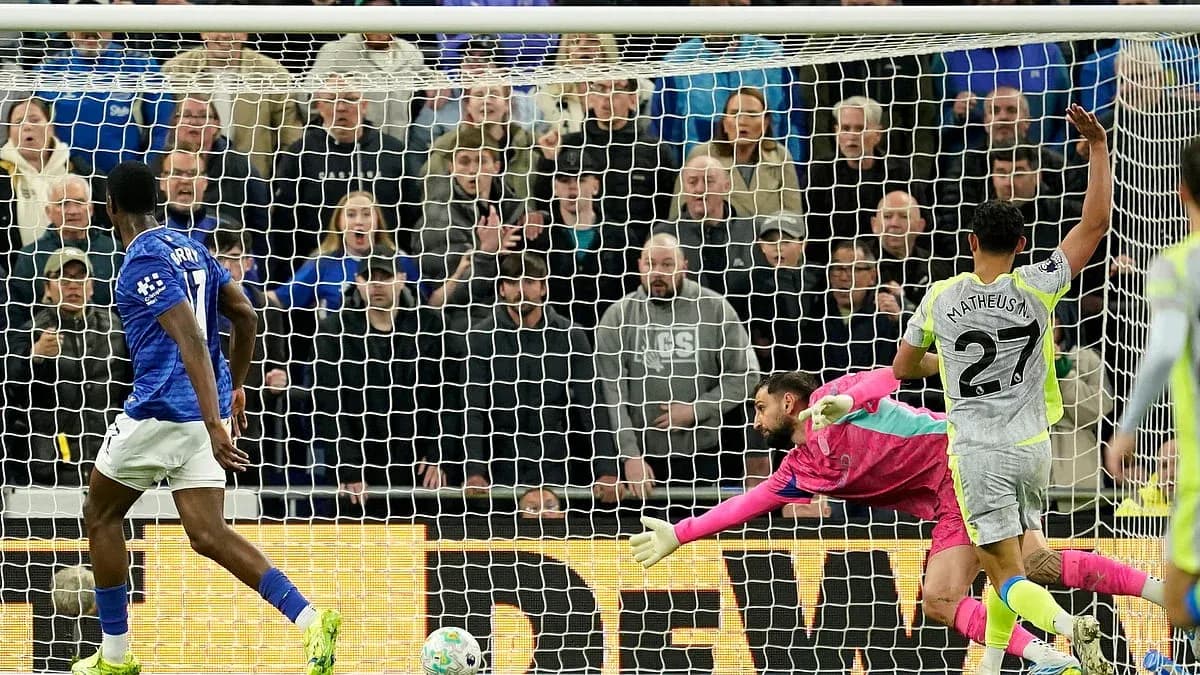
Under the lights at Hill Dickinson Stadium, a 3-3 draw between Everton and Manchester City felt less like a routine league fixture and more like a stress test of both squads’ identities. Following this result, the table still says City are the title hunters (2nd with 71 points) and Everton the disruptors (10th with 48 points and a goal difference of 0), but the 90 minutes told a richer story of improvisation, tactical compromise and individual duels.
I. The Big Picture – Two 4-2-3-1s, two very different DNAs
Both coaches mirrored each other on the board: 4-2-3-1 on each side, but with contrasting intentions.
Everton’s shape under Leighton Baines was built on Premier League survival instincts refined into something more ambitious. Across the season they have averaged 1.4 goals at home and 1.3 overall, but that comes wrapped in grit: 11 clean sheets in total, and a willingness to live on the edge in games that can swing either way (13 wins, 13 defeats from 35 matches). The full-time 3-3 felt like the most distilled version of that volatility.
Manchester City arrived as the league’s most polished machine. Overall they have scored 2.0 goals per game, with 2.4 at home and 1.7 on their travels, and conceded just 0.9 overall. Yet here, Pep Guardiola’s side were forced into something more makeshift. Injuries to Rúben Dias, Joško Gvardiol and Rodri stripped away their usual spine, and the 4-2-3-1 felt less like a preference and more like a patchwork response.
II. Tactical Voids – When absences redraw the map
The absences shaped everything.
For Everton, the loss of Jarrad Branthwaite and Idrissa Gana Gueye removed a natural left-sided stopper and their best pure ball-winner. That thrust responsibility onto the central trio of James Tarkowski, Michael Keane and Jake O’Brien, with James Garner and Tim Iroegbunam sitting ahead as a double pivot. Garner, one of the league’s top assist providers with 7 overall, had to be both regista and firefighter.
City’s voids were even more structural. No Dias, no Gvardiol, no Rodri. The back four of Matheus Nunes, Abdukodir Khusanov, Marc Guéhi and Niall O’Reilly was functional but unfamiliar. In front, the double pivot of Nico and Bernardo Silva had to replace Rodri’s control, defensive positioning and tempo-setting. Bernardo, who has 9 yellow cards this campaign, walked the line between aggression and risk as he tried to plug gaps in transition.
Discipline was always likely to be a subplot. Everton’s season-long card profile shows a clear late-game spike: 22.39% of their yellow cards come between 76-90 minutes, with 50.00% of their reds also arriving in that same window. City’s bookings also swell late, with 20.00% of their yellows in the 76-90 range. In a match that stayed chaotic to the end, both sides leaned into that combustible identity rather than away from it.
III. Key Matchups – Hunter vs Shield, Engine Room vs Chaos
Hunter vs Shield: Erling Haaland vs Everton’s centre-backs
Erling Haaland came into this game as the league’s most ruthless finisher: 25 goals overall from 96 shots, 54 on target, with 3 penalties scored but 1 missed. His duel with Tarkowski, Keane and O’Brien was the clearest “Hunter vs Shield” narrative on the pitch.
Everton’s defensive record – 44 goals conceded overall, 24 at home – is solid but not elite. Without Branthwaite, they lacked a naturally dominant left-sided presence, forcing O’Brien to defend more aggressively in wide channels. That was always going to invite Haaland to attack the space between centre-back and full-back, especially with Rayan Cherki and Jérémy Doku feeding him from the half-spaces.
Haaland’s physicality and movement asked constant questions, but Everton’s trio answered enough of them to keep the game in chaos rather than submission. O’Brien’s season numbers hint at why: 54 tackles, 16 blocked shots and 14 interceptions overall speak to a defender who relishes emergency defending. Against City’s No. 9, he needed every ounce of that.
Engine Room: Garner and Iroegbunam vs Nico and Bernardo
If Haaland vs the back line was the headline, the game’s rhythm was written in midfield.
Garner, nominally listed as a defender in the season data but operating here as a deep midfielder, brought his blend of bite and progression. With 1617 passes overall at an 86% accuracy and 49 key passes, he is Everton’s metronome and their most creative outlet from deep. Alongside him, Iroegbunam provided legs and vertical aggression, allowing Everton to step onto City’s double pivot rather than simply retreat.
On the other side, Nico and Bernardo were asked to reconstruct Rodri’s control. Bernardo’s 1952 passes at 90% accuracy this season underline his technical security, but his 36 fouls committed and 9 yellow cards show the cost when he is dragged into more defensive work. Everton targeted that. I. Ndiaye and Kieran Dewsbury-Hall drifted into the inside channels to overload Bernardo’s zone, forcing him to defend on the turn rather than face-to-face.
The result was an engine room that never quite belonged to City. They had spells of control, but Everton repeatedly broke their structure with direct passes into Beto and late runs from Ndiaye and Dewsbury-Hall, turning the game into a series of broken-field attacks rather than the positional play City prefer.
Flank warfare: Doku and Cherki vs Mykolenko and O’Brien
City’s wide threat was concentrated in Doku and Cherki. Doku’s season numbers – 132 dribbles attempted with 74 successful – mark him out as a pure destabiliser. Cherki, with 11 assists and 57 key passes, is the league’s second-ranked creator.
They attacked Everton’s left, where Vitaliy Mykolenko and O’Brien had to manage both the one-v-one threat and the cut-back lanes to Haaland. Mykolenko’s conservative positioning and O’Brien’s willingness to step out aggressively limited the damage, but every City surge down that side felt like a coin flip.
IV. Statistical Prognosis – What this 3-3 tells us going forward
Following this result, the numbers reinforce the eye test. Everton remain a team of fine margins: 44 goals scored, 44 conceded overall, 13 wins and 13 defeats from 35 matches. Their home averages of 1.4 goals for and 1.3 against suggest that high-scoring, knife-edge games like this are not an anomaly but their natural habitat.
City, meanwhile, showed both their ceiling and their vulnerability when stripped of their usual spine. Overall they still boast a formidable profile – 69 goals for, 32 against, a goal difference of 37, and 14 clean sheets – but this match underlined how much their defensive solidity depends on Rodri and a settled back line.
In xG terms, a 3-3 between a side averaging 1.3 goals overall and another at 2.0 feels roughly in line with expectation once game state and individual quality are factored in. Haaland’s chance volume, Doku’s dribbling gravity and Cherki’s creative output almost guarantee City a high xG floor. Everton’s directness, set-piece threat and willingness to commit numbers forward at home inflate their own.
The tactical verdict: in a repeat of this fixture, City’s underlying metrics and attacking depth would still make them favourites. But Everton’s capacity to drag elite opponents into chaos – and their proven ability to live there – means that any pre-match prognosis has to leave space for another wild, high-scoring script at Hill Dickinson Stadium.