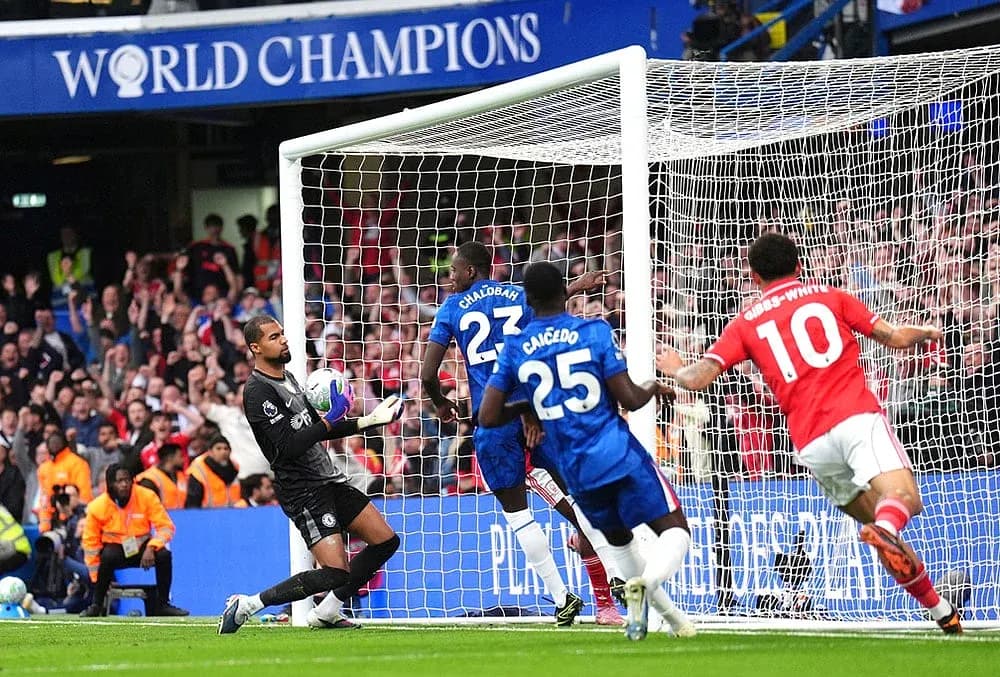
Chelsea's Tactical Struggles Highlighted in 3-1 Defeat to Nottingham Forest
Stamford Bridge felt heavy at full time. Under a grey London sky, Chelsea’s season-long inconsistency crystallised into a 3-1 home defeat to Nottingham Forest, a result that cut against the grain of the league table and laid bare contrasting tactical identities.
Following this result, the league picture is stark. Chelsea, ninth in the Premier League on 48 points with a goal difference of 6 (54 scored, 48 conceded), look like a side whose numbers hint at balance but whose form – five straight losses heading into this game – speaks of fragility. Forest, 16th with 42 points and a goal difference of -2 (44 scored, 46 conceded), arrived as a team more used to suffering than dictating, yet left London with a statement away win.
I. The Big Picture – Structures and Seasonal DNA
On paper, this was Chelsea in their comfort shape. Calum McFarlane once again leaned on the 4-2-3-1 that has been his default – the club have used it 30 times in the league – with Robert Sánchez behind a back four of Malo Gusto, Trevoh Chalobah, Tosin Adarabioyo and Marc Cucurella. Romeo Lavia and Moisés Caicedo anchored midfield, with a creative band of Cole Palmer, Enzo Fernández and J. Derry supporting Joao Pedro as the lone striker.
The structure fits Chelsea’s season-long profile: a side that, overall, scores 1.5 goals per game and concedes 1.4, with a clear intent to play front-foot football. Away from home they have actually been more incisive, averaging 1.8 goals, but at Stamford Bridge that figure drops to 1.3, and the caution in their home numbers – 24 goals for and 24 against in 18 games – foreshadowed the lack of control they would show once Forest punched first.
Forest’s choice was more surprising. Vitor Pereira moved away from his usual 4-2-3-1 (used 29 times this season) and set his side up in a 4-4-2. Matz Sels was protected by a back line of Z. Abbott, Cunha, Morato and Luca Netz, with a flat midfield of D. Bakwa, Ryan Yates, Nicolás Domínguez and J. McAtee behind the front pairing of Igor Jesus and Taiwo Awoniyi.
For a side that on their travels averages 1.4 goals scored and 1.4 conceded, this was a bolder, more vertical version of Forest. The twin strikers were a clear signal: they came to exploit Chelsea’s structural gaps rather than simply survive.
II. Tactical Voids – Absences and Discipline
Both managers had to navigate significant absences. Chelsea were without M. Mudryk (suspended), J. Gittens (muscle injury), A. Garnacho and P. Neto (both listed as inactive), as well as another unnamed hamstring casualty. That stripped McFarlane of wide, direct runners and left Joao Pedro as both finisher and creator, with Palmer and Fernández tasked with threading passes rather than stretching the pitch.
Forest’s injury list was even longer: O. Aina, W. Boly, C. Hudson-Odoi, John Victor, Murillo, D. Ndoye, I. Sangaré and N. Savona all missed out. Deprived of key defenders and ball-winners, Pereira had to reconfigure his defensive block around Morato and Cunha, trusting Yates and Domínguez to hold the centre.
Disciplinary trends also framed the contest. Chelsea’s season-long yellow card distribution shows a late-game spike: 22.35% of their yellows arrive between 76-90 minutes, with another 15.29% from 91-105. Their red cards are spread, but 28.57% fall between 61-75 minutes, a sign of emotional volatility as matches tighten. Forest, by contrast, see 23.21% of their yellows in each of the 46-60 and 61-75 windows, and their lone league red card has come in the 31-45 range. This game followed those patterns: Chelsea chased, Forest absorbed, and the London side once again looked more ragged as the contest wore on.
III. Key Matchups – Hunter vs Shield, Engine Room
The headline duel was “Hunter vs Shield”: Joao Pedro against a Forest defence that has conceded 46 goals overall, 25 of them away. Pedro’s league output – 15 goals and 5 assists – underlines his status as Chelsea’s spearhead and chief creator. He arrived with 48 shots (28 on target) and 29 key passes, a player who both finishes and knits attacks together.
Forest’s response was collective rather than star-led. Morato, Cunha and Netz formed a left-sided triangle that compressed space around Pedro’s preferred inside-left channel, while Yates and Domínguez screened central lanes. The visitors’ away record – 26 goals scored, 25 conceded – suggests a side used to open games, but here their 4-4-2 narrowed into a compact 4-4-1-1 out of possession, suffocating Chelsea’s No.10 zone where Palmer and Fernández like to combine.
In the “Engine Room”, Caicedo’s battle with Yates and Domínguez defined Chelsea’s ability to reset. Caicedo’s season is a study in high-intensity control: 83 tackles, 14 successful blocks, 56 interceptions and 10 yellow cards plus 1 red. He is both metronome and enforcer. Yet with Lavia still finding rhythm after injury and no true destroyer alongside him, Chelsea’s double pivot was repeatedly asked to cover huge spaces in transition. Forest’s flat four in midfield, with Bakwa and McAtee tucking in, overloaded those channels whenever possession turned over.
Pereira’s trump card off the bench was Morgan Gibbs-White. Although he did not start, his season numbers – 13 goals, 4 assists, 46 key passes – make him Forest’s creative fulcrum. Introduced from the bench, he floated between the lines, forcing Chalobah and Adarabioyo to step out and further isolating Cucurella and Gusto against Forest’s wide players and overlapping full-backs.
IV. Statistical Prognosis – Why the Game Tilted Forest’s Way
Strip away the emotion and the numbers explain why a 3-1 away win felt less like a smash-and-grab and more like a logical extension of trends.
Chelsea came into the match with identical home goals for and against (24 each), signalling a side that cannot turn territory into control. Their nine clean sheets overall are offset by seven games in which they failed to score; when the first goal goes against them, their structure tends to fray. Forest, meanwhile, had already claimed seven away wins from 18, scoring 26 and conceding 25 – a profile of a team that is comfortable in open, transition-heavy contests.
Expected Goals data is not provided, but the pattern of chances is implicit. Forest’s double-striker system was designed to generate high-quality opportunities on the break, and Chelsea’s season-long concession rate of 1.4 goals per game overall – 1.3 at home – was always vulnerable to a side that commits runners through the middle. With Chelsea pushing numbers forward to chase a two-goal half-time deficit, the defensive line repeatedly found itself exposed without the safety of a third centre-back.
Following this result, the tactical verdict is clear. Forest’s pragmatic shift to 4-4-2, their willingness to cede sterile possession and attack vertically, and the intelligent introduction of Gibbs-White to exploit a tiring Chelsea midfield combined to produce a win that aligns with their away DNA. Chelsea, by contrast, remain a side whose structure promises control but whose emotional and positional discipline – especially late in games – continues to betray them.