Bayern München vs Arsenal: Tactical Insights from a 2-2 Draw
Under the lights of the Allianz Arena, this “League Stage - 3” meeting felt less like an early checkpoint and more like a rehearsal for the latter stages of the UEFA Champions League. Bayern München and Arsenal arrived unbeaten, stylistically distinct but statistically aligned in one key respect: both are built to impose themselves, not to react.
I. The Big Picture – Two contenders, one shared standard
Heading into this game, Bayern sat 14th in the overall league table on 5 points from 3 matches, with a striking attacking profile: 10 goals in total and only 5 conceded. Their overall goal difference of 5 is exactly the product of that balance, and at home they have been ruthless – 7 goals for and just 2 against across 2 fixtures. An average of 3.5 goals scored at home and only 1.0 conceded underlines the Allianz as an attacking laboratory for Vincent Kompany’s ideas.
Arsenal, ranked 7th with 7 points from 3 matches, carried a more measured but equally effective profile. Overall they had scored 6 and conceded 2, a goal difference of 4 that reflects control rather than chaos. On their travels they had played 2, winning 1 and drawing 1, with 3 goals scored and 2 conceded; an away average of 1.5 goals for and 1.0 against suggests a side that travels with structure and pragmatism.
The match finished 2–2, the half-time scoreline already 1–1, a fitting mirror of the broader narrative: Bayern’s expansive aggression meeting Arsenal’s compact, layered possession. Following this result, both teams preserved their unbeaten records in the competition, but the draw also exposed the tactical fissures that future opponents will probe.
II. Tactical Voids – Absences that reshape identities
Bayern’s squad sheet carried conspicuous gaps. Joshua Kimmich (personal reasons) and Jamal Musiala (muscle injury) are not just names; they are structural pillars. Kimmich’s absence removed the metronome and long-range distributor from the base of midfield, while Musiala’s injury stripped away the most natural between-the-lines dribbler. Michael Olise was also missing through suspension after a red card, further thinning Bayern’s creative and wide 1v1 threat. T. Buchmann’s knee injury limited defensive rotation.
In response, Kompany doubled down on a 4-2-3-1 that leaned on adaptability rather than star power. T. Bischof and A. Pavlović formed the double pivot, offering legs and vertical passing but inevitably less orchestration than Kimmich. I. Saibari operated as a central connector, with S. Gnabry and Alphonso Davies from the flanks supporting H. Kane. The structure asked Bayern’s collective to replace the absent specialists.
Arsenal’s absentees were equally defining. W. Saliba (back injury) and P. Hincapié (ankle injury) removed two high-level centre-back options, forcing Mikel Arteta to trust a new axis: E. Konsa alongside Gabriel Magalhães, with R. Calafiori at left-back and J. Timber at right-back. C. Tzolis (hamstring injury) limited attacking rotation, nudging Arteta toward a front three of B. Saka, K. Havertz and N. Madueke.
Disciplinary trends also shaped the risk landscape. Bayern’s yellow cards this campaign have clustered heavily between 61–75 minutes, with 75.00% of their cautions in that window and a red card already shown in the same phase of another match. Arsenal, by contrast, spread their cautions more evenly but still show a late spike: 40.00% of their yellows arriving from 91–105 minutes. In a contest this finely balanced, the final quarter-hour was always likely to be coloured by caution as much as ambition.
III. Key Matchups – Hunter vs Shield, and the battle for the engine room
Hunter vs Shield: H. Kane vs Arsenal’s back four
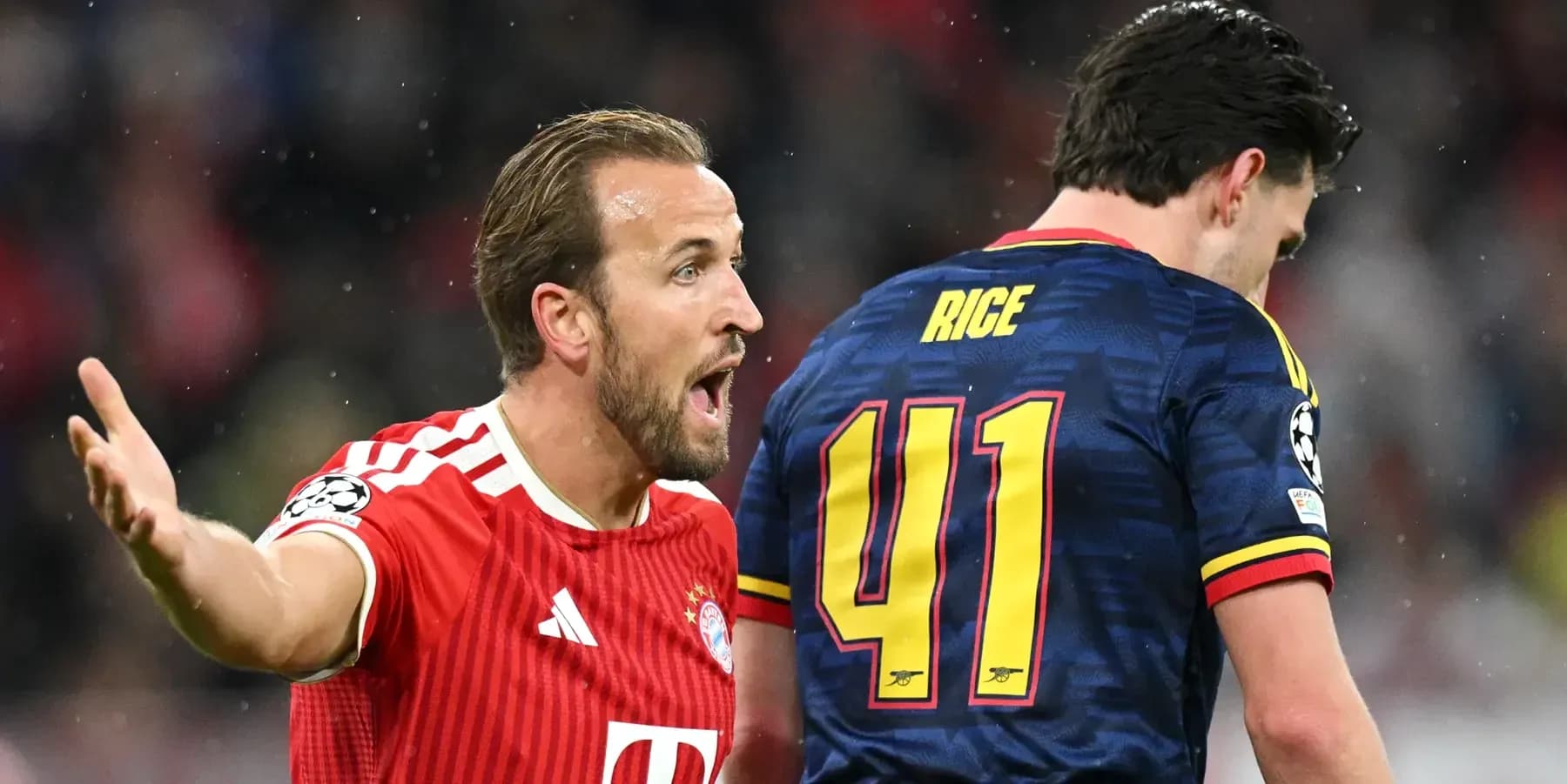
Harry Kane arrived as one of the competition’s standout performers. Across the campaign he has 4 goals and 2 assists in 3 appearances, with 11 shots (7 on target) and a rating of 8.17. Crucially, he has converted 2 penalties from 2 attempts, maintaining a perfect record from the spot. His passing – 69 completed with 7 key passes at 81% accuracy – underlines that he is not simply a finisher but Bayern’s primary attacking hub.
Against him stood an improvised but high-ceiling Arsenal defence. On their travels they had conceded only 2 goals in 2 matches, and overall just 2 in 3. Gabriel Magalhães and E. Konsa were tasked with dealing not only with Kane’s penalty-box presence but his habit of dropping into midfield to overload Bruno Guimarães and D. Rice. Kane’s ability to block 3 shots defensively this season also hints at his work rate in Bayern’s first line of pressure, a subtle but important factor in pinning Arsenal deeper than they would like when building.
Engine Room: Bischof & Pavlović vs Bruno Guimarães & Rice
With Kimmich absent, Bayern’s double pivot of T. Bischof and A. Pavlović had to anchor transitions and feed the attacking line. Their mandate was twofold: protect D. Upamecano and Kim Min-Jae from Arsenal’s vertical surges, and circulate the ball quickly enough to keep Gnabry, Saibari, Davies and Kane in advanced, threatening positions.
For Arsenal, the axis of Bruno Guimarães and D. Rice, with M. Ødegaard slightly higher, offered one of the most balanced midfields in Europe. Bruno’s press-resistance and Rice’s range allowed Arsenal to step through Bayern’s first wave, while Ødegaard looked to exploit the half-spaces behind Bayern’s double pivot. If Arsenal could consistently escape that first pressure, Saka and Madueke would find themselves isolated against Bayern’s full-backs, a matchup Arteta would happily script.
Flanks and transitions
On Bayern’s left, Davies and Gnabry’s rotations were designed to pull Timber and Konsa into uncomfortable zones, while Saibari’s occupation of the right half-space tried to pin Calafiori and Gabriel. Arsenal, in turn, sought to isolate Saka against J. Stanišić and create overloads with Ødegaard drifting wide. With neither side failing to score in the competition so far, the flanks were always likely to be the ignition point for goals.
IV. Statistical Prognosis – A draw that confirms their ceilings
Bayern’s overall averages – 3.3 goals scored and 1.7 conceded per match in total – frame them as a high-variance, high-reward side. Arsenal’s more controlled profile – 2.0 goals for and 0.7 against overall – paints a picture of calculated dominance. Even without explicit xG values, the patterns are clear: Bayern manufacture volume and chaos, Arsenal manufacture control and selectivity.
The 2–2 scoreline ultimately fits the statistical and tactical balance. Bayern’s attacking volume, spearheaded by Kane’s all-round influence, was always likely to breach an Arsenal back line missing Saliba and Hincapié. Arsenal’s compact structure and high technical level in midfield, meanwhile, were well suited to exploiting the spaces Bayern naturally leave when chasing superiority.
Following this result, both teams emerge validated rather than exposed. Bayern proved that even without Kimmich and Musiala they can sustain an elite attacking output. Arsenal showed that their defensive framework and midfield control travel well, even into one of Europe’s most hostile arenas. Should they meet again deeper in the tournament, the blueprint has been drawn: Bayern will try to raise the tempo beyond Arsenal’s comfort zone, while Arsenal will seek to compress the game into controlled, surgical moments. The margins, as this night in Munich confirmed, will be razor-thin.