Benfica vs AC Milan: A Tactical Contrast in UEFA Europa League
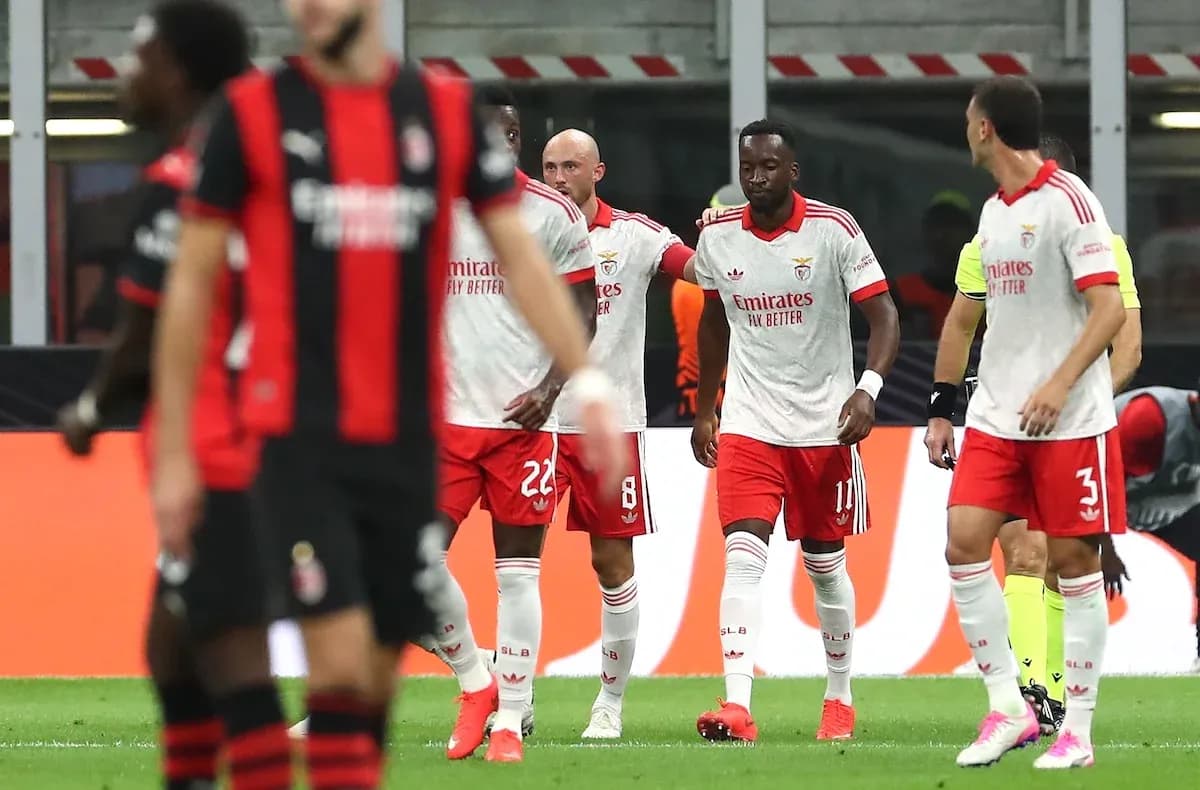
Under the San Siro lights, this League Stage opener in the UEFA Europa League felt like a tactical manifesto from Marco Silva’s Benfica and a stark reality check for Ruben Amorim’s evolving AC Milan. By the final whistle, the scoreboard read 0–2, and the numbers behind it underlined a clear early-season contrast: Benfica stepping into Europe with the assurance of a side already in rhythm, Milan still sketching the outlines of a new identity.
I. The Big Picture – Structures and Seasonal DNA
AC Milan lined up in a 3-4-2-1, a bold, aggressive shape that put the responsibility for progression on a young, mobile core. Mike Maignan anchored a back three of Koni De Winter, Filippo Terracciano and Strahinja Pavlovic, with the width and transition work handed to Samuel Chukwueze and Davide Bartesaghi as wing‑backs. In central areas, Ardon Jashari and Yunus Musah were asked to be both press-resistors and screeners, while the forward line of Omari Hutchinson, A. Cisse and Gonçalo Ramos was built for vertical thrust rather than patient circulation.
Heading into this game, Milan’s Europa League story was unwritten. Following this result, it is brutally simple: one match played, one defeat, no goals scored and two conceded overall. The goal difference of −2 is precisely the mirror image of Benfica’s +2, and the standings table reflects it: Milan sitting 31st in the league-wide ranking, Benfica up in 7th after their away win.
Benfica arrived with a very different body of work. Across seven Europa League fixtures overall, they had five wins, one draw and one defeat, scoring 21 goals and conceding 6. On their travels alone, they had played 4 times, winning 2, drawing 1 and losing 1, with 7 away goals scored and 4 conceded. The 4-2-3-1 Silva chose at San Siro was the continuation of a template that has already been used four times this European season.
Anatoliy Trubin sat behind a back four of D. Banjaqui, Alessandro Circati, Tomás Araújo and Souffian El Karouani. In front, the double pivot of Fredrik Aursnes and João Palhinha provided both circulation and bite, freeing a dangerous trio of Dodi Lukebakio, Georgiy Sudakov and Jakub Kamiński behind lone forward Jhon Durán.
II. Tactical Voids – Absences and Discipline
The most notable absentee was on the Benfica side: Alexander Bah, officially listed as “Missing Fixture” through injury. In a side that thrives on high, aggressive full‑back play, his absence could have been a structural issue. Instead, Banjaqui stepped into that corridor and, supported by the protection of Palhinha and Aursnes, Benfica’s right flank remained secure and progressive.
From a disciplinary perspective, the pre‑existing data painted two different temperaments. Milan’s Europa campaign now shows a single yellow card overall, taken in the 0–15 minute window – an early, slightly anxious imprint of a side still calibrating its aggression. Benfica, by contrast, have lived with a higher card load but have managed it. Across their Europa League season overall, 10% of their yellow cards arrive in the opening 15 minutes, but the real spike is late: 30% between 76–90 minutes, with further cautions even in added time. That speaks of a team willing to defend a lead with controlled cynicism.
Vangelis Pavlidis and Leandro Barreiro embody that edge. Each has 2 yellow cards overall in this competition, and both are among the most frequently booked players in the league. Yet Benfica have kept their discipline just shy of meltdown: no red cards at all in Europa League action, and crucially, their penalty record is spotless – 4 penalties overall, all 4 scored, none missed.
III. Key Matchups – Hunter vs Shield, Engine Room Battles
The “Hunter vs Shield” duel in this tie was less about a single striker and more about Benfica’s collective attacking wave against Milan’s new back three. Benfica’s attacking minute distribution overall is remarkably even, but with pronounced surges: 19.05% of their goals come between 31–45 minutes, another 19.05% between 46–60, and yet another 19.05% between 76–90. They are a side that can hurt you just before the break, immediately after it, and again in the closing stretch.
Milan’s defensive pattern heading into and following this game is revealingly fragile in precisely those pressure zones. Both of their Europa League goals conceded overall have come at home, one between 16–30 minutes (50% of their concessions) and one between 46–60 (the remaining 50%). That second‑half window, where Benfica already show a 19.05% scoring surge, aligned perfectly with Milan’s vulnerability.
Within that framework, Lukebakio and Kamiński are the sharpest individual threats. Kamiński is already among the competition’s top scorers and assisters, with 1 goal and 1 assist overall from just 80 minutes, plus 3 key passes and 76% passing accuracy. Lukebakio, with 1 goal overall, 3 shots all on target, 3 tackles and 7 duels won from 10, is the prototype wide forward for Silva’s plan: direct, hard‑working, and ruthless in transition.
They operated in and around Milan’s wing‑backs, particularly targeting the spaces behind Chukwueze and Bartesaghi. Every time Musah or Jashari stepped out to press Sudakov or Kamiński between the lines, Benfica had the technical quality to play around the corner, forcing De Winter and Pavlovic into lateral, reactive defending rather than proactive stepping.
In the engine room, Palhinha’s presence was decisive. Benfica’s defensive record overall – 6 goals conceded in 7 matches, an average of 0.9 per game – owes much to the screening he provides. On their travels, that defensive line concedes 1.0 goal on average, but at San Siro, Milan never truly stretched that metric. With no goals scored overall in the competition and an average of 0.0 goals per game at home and in total, Milan’s attacking structure is still theoretical rather than proven.
IV. Statistical Prognosis – What This Result Tells Us
Following this result, the trajectories are sharply divergent. Milan’s Europa League profile is that of a side yet to find any attacking rhythm: they have failed to score in their only match, have no clean sheets, and all of their goals conceded have come at home, at an average of 2.0 per game in their own stadium. Their under/over record is stark: in their single fixture, they have finished under 0.5, 1.5, 2.5, 3.5 and 4.5 goals for, underlining how sterile their attack has been so far.
Benfica, conversely, look like a side built for deep progress in this League Stage. Overall, they average 3.0 goals scored per match and concede fewer than one. On their travels, they still score 1.8 on average and concede just 1.0, a profile of a team that can impose itself away without losing defensive balance. They have never failed to score in any of their 7 Europa League games overall and already have 2 clean sheets.
The tactical story of this 0–2 at San Siro, then, is not just about one night. It is about a Benfica side whose attacking peaks intersect almost perfectly with Milan’s current defensive soft spots, and a Milan team whose new 3-4-2-1 is still searching for mechanisms to turn territory into threat. For now, the numbers and the narrative agree: Benfica are already a finished article in this competition; Milan are still very much a work in progress.