Brazil vs Norway: Tactical Analysis of the 2-1 Defeat
Brazil’s 2-1 defeat to Norway at MetLife Stadium in the Round of 16 was defined by a stark clash of styles: Brazil’s high‑risk, transition‑heavy approach against Norway’s controlled, possession‑based structure built around Erling Haaland and Martin Ødegaard. The statistical and event profile shows a game where Brazil generated more penalty‑box volume and xG, but Norway’s superior control and Haaland’s ruthlessness decided the tie.
Norway owned the ball with 66% possession and a huge passing volume (680 passes, 617 accurate, 91%), using a clear positional structure. Kristoffer Ajer and Torbjørn Heggem formed a calm, ball‑playing base, with David Møller Wolfe and Julian Ryerson (later replaced) stepping high to pin Brazil’s wide players. In midfield, Patrick Berg and Sander Berge provided a double pivot that recycled possession and shielded transitions, while Ødegaard operated between the lines as the main connector into the front line.
Brazil, by contrast, accepted a reactive role: only 34% possession and 329 passes (279 accurate, 85%), but 14 total shots to Norway’s 9 and a significantly higher xG (2.73 vs 0.84). That attacking profile reveals Carlo Ancelotti’s plan: compress central spaces with Casemiro, Bruno Guimarães and Rayan, then break quickly through Vinícius Júnior and Matheus Cunha, with Gabriel Martinelli adding directness from midfield zones.
Key Moments
The early key moment set the tone. At 12', VAR confirmed a penalty for Brazil after an incident involving Matheus Cunha. Bruno Guimarães then produced a “Missed Penalty” at 14', a huge psychological and tactical swing. Norway were allowed to stay in their patient rhythm without being forced to chase the game, which would have opened more space for Brazilian counters.
Out of possession, Norway’s defensive block was compact and vertically disciplined. With only 1 blocked shot and 5 shots on target faced, their structure largely forced Brazil into less clean looks, despite Brazil accumulating 10 shots inside the box. The double pivot tracked Brazilian midfield runners, while the centre‑backs stayed tight to Cunha and later Endrick, trusting the full‑backs to handle wide 1v1s as much as possible.
Brazil’s defensive idea was more aggressive and transition‑oriented. Casemiro anchored in front of Marquinhos and Gabriel Magalhães, with Danilo and Douglas Santos tasked with stepping out to Norway’s full‑backs and wingers. The risk was always space around the sides of the centre‑backs and in the channels for Haaland. As the game wore on and Brazil chased, those spaces widened.
Second Half Substitutions
The second‑half substitutions were decisive. At 46', Stale Solbakken reshaped his attack: Andreas Schjelderup (IN) came on for Antonio Nusa (OUT), and Oscar Bobb (IN) came on for Alexander Sørloth (OUT). Schjelderup immediately became the key link to Haaland, providing both assists on the night. His movements between Brazil’s midfield and defence pulled Marquinhos and Gabriel Magalhães into awkward decisions, especially in transition.
Ancelotti’s response was to inject more vertical threat and creativity. At 58', Endrick (IN) came on for Matheus Cunha (OUT), adding more dynamic movement off the last line. At 68', Danilo Santos (IN) came on for Rayan (OUT) and Neymar (IN) came on for Gabriel Martinelli (OUT), shifting Brazil towards a more playmaker‑centric structure with Neymar dropping into pockets to orchestrate. Later, at 79', Éderson (IN) came on for Bruno Guimarães (OUT), freshening the midfield legs but also slightly reducing Brazil’s control in deeper build‑up.
Norway's Tactical Plan
Norway’s first breakthrough at 80' encapsulated their tactical plan: Erling Haaland finished a “Normal Goal” for Norway, assisted by Andreas Schjelderup. The pattern was typical – patient possession, then a precise vertical action into Haaland exploiting the gaps as Brazil pushed more numbers forward.
Defensively, Norway relied heavily on Ørjan Nyland’s command of his area and positioning. Nyland (Norway) made 4 saves and, crucially, matched Alisson’s shot‑stopping impact despite facing a lower xG total. His interventions, especially on Brazilian efforts from central zones, underpinned Norway’s ability to sit on a narrow lead and still threaten in transition.
Alisson (Brazil), for his part, made 3 saves. The goals prevented metric for Brazil (0.76) suggests that Alisson’s shot‑stopping was roughly in line with expectation; he was not the problem. Instead, the issue lay in the exposure of the back line once Brazil had to chase the game, and in the lack of clinical edge at the other end despite the higher xG.
Late Game Sequence
The late‑game sequence was chaotic and tactically revealing. At 90', Erling Haaland again struck a “Normal Goal” for Norway, once more assisted by Andreas Schjelderup, punishing Brazil’s stretched shape as they committed bodies forward. Almost simultaneously, Norway freshened their left side with Leo Østigård (IN) coming on for David Møller Wolfe (OUT) at 90', adding aerial security and defensive solidity for the final moments.
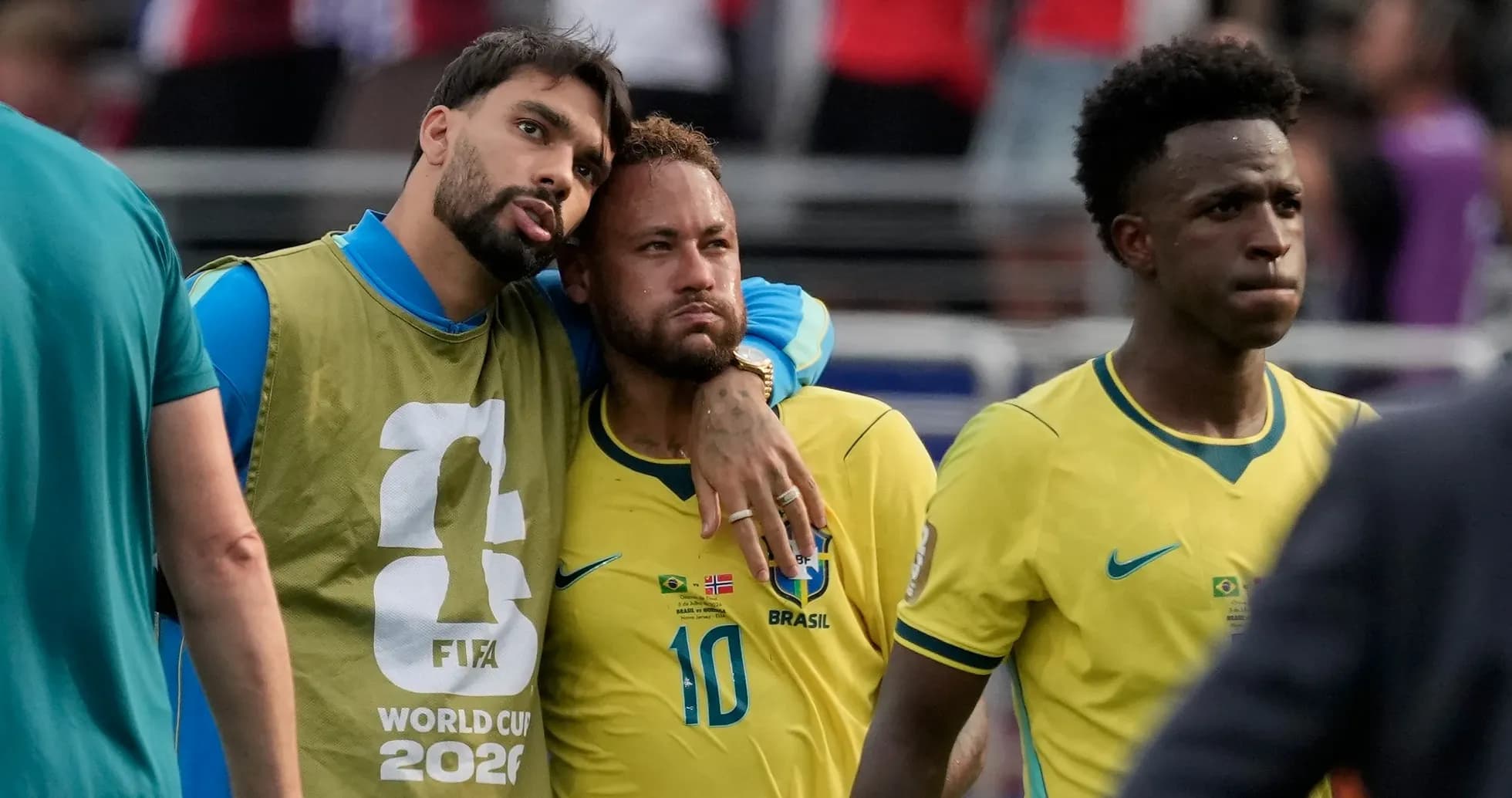
Brazil still manufactured a lifeline deep into added time. Neymar’s influence grew as he drifted across the final third, and at 90+9' he converted a “Penalty” for Brazil, finally beating Nyland from the spot after Bruno Guimarães’ earlier failure. Yet the key disciplinary moment had already come at 90+6', when Neymar (Brazil) received a Yellow Card — Foul. It symbolised Brazil’s increasing desperation and the breakdown of their emotional control as the tie slipped away.
Statistical Verdict
From a statistical verdict, the contrast is sharp. Brazil: 14 total shots, 4 on goal, 10 inside the box, 4 blocked, 5 corners, 7 fouls, 1 offside, xG 2.73, goals prevented 0.76, and just 1 yellow card (Neymar). Norway: 9 total shots, 5 on goal, 7 inside the box, 1 blocked, 5 corners, 6 fouls, 1 offside, xG 0.84, goals prevented 0.76, and no cards. Norway’s superior possession and passing accuracy allowed them to dictate tempo, while Haaland’s finishing and Schjelderup’s impact ensured that their fewer chances were of decisive quality.
Tactically, Brazil’s plan produced volume and xG but lacked composure in the key moments, especially from the spot and in rest‑defence after turnovers. Norway executed a mature, possession‑heavy game with a clear vertical trigger into Haaland, and their structural discipline without the ball turned a lower‑xG performance into a clinical, high‑impact victory.