Burnley vs Aston Villa: Tactical Insights from a 2-2 Draw
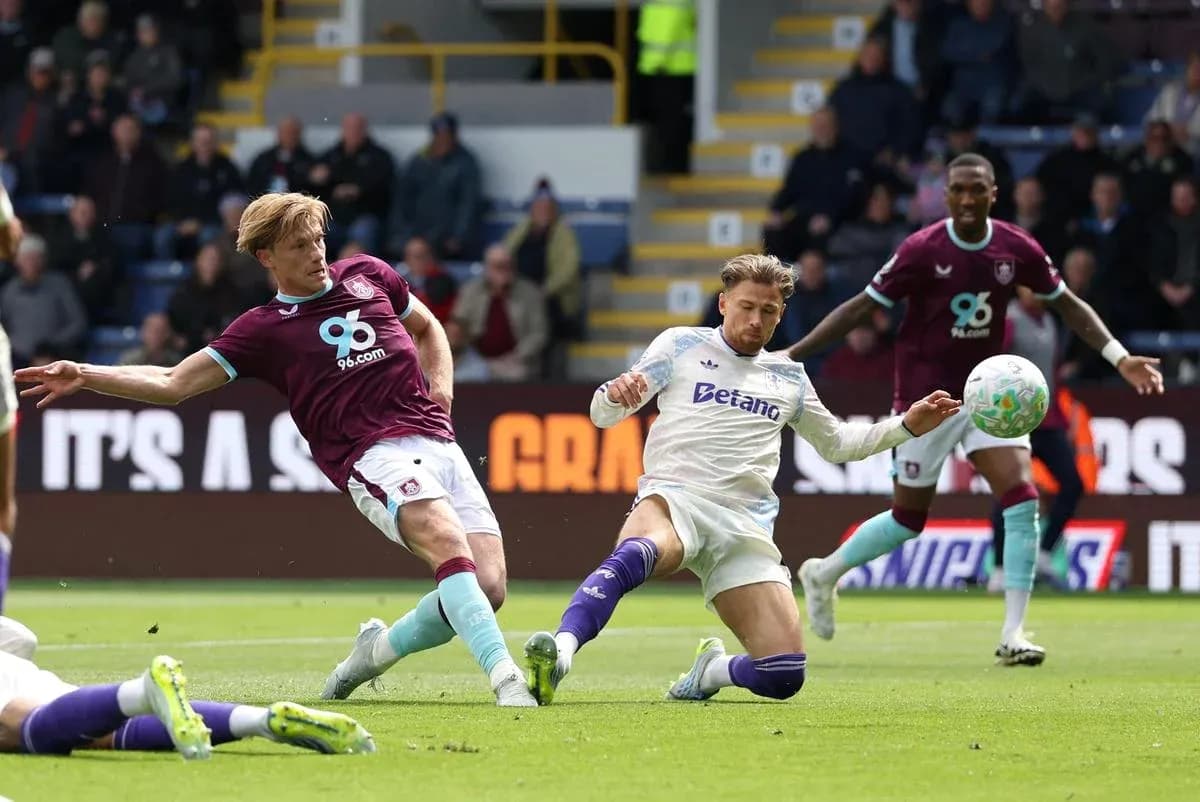
Burnley and Aston Villa shared a 2-2 draw at Turf Moor in Premier League Regular Season Round 36, a match defined by contrasting structures within the same nominal 4-2-3-1 and a clear territorial advantage for the visitors. Burnley’s direct, transition-heavy approach produced enough threat to match Villa’s output on the scoreboard, even as Unai Emery’s side controlled possession and territory for long stretches.
The scoring opened early when Jaidon Anthony struck for Burnley on 8', capitalising on Burnley’s aggressive use of the wide areas and quick vertical play. Aston Villa thought they had an equaliser when a potential goal by Ollie Watkins was disallowed by VAR at 40', a key tactical warning that Villa’s direct runs in behind were starting to break Burnley’s line. The visitors did level properly on 42', Ross Barkley finishing after John McGinn’s supply from the right half-space. After the interval, Tyrone Mings’ 49' yellow card for “Foul” reflected Villa’s need to halt Burnley transitions, but Villa then flipped the game: on 56', Ollie Watkins scored from a direct connection with Emiliano Martínez, exploiting Burnley’s high line. Burnley responded immediately in structural terms and on the scoreboard. On 58', Zian Flemming equalised, assisted by Hannibal Mejbri, arriving from the No. 10 lane to punish space between Villa’s centre-backs and midfield. Two minutes later, Flemming was booked on 60' for “Persistent fouling”, underlining Burnley’s increasingly combative mid-block as they tried to disrupt Villa’s rhythm without ceding further territory.
Disciplinary Log
- 49' Tyrone Mings (Aston Villa) — Foul
- 60' Zian Flemming (Burnley) — Persistent fouling
From the outset, both coaches deployed 4-2-3-1 but with very different interpretations. Mike Jackson’s Burnley used Max Weiss behind a back four of Lucas Pires, Maxime Estève, Axel Tuanzebe and Kyle Walker, with Florentino Luís and Lesley Ugochukwu as a double pivot. Their job was less about slow build-up and more about screening second balls and launching quick vertical passes into Hannibal Mejbri, Loum Tchaouna, Jaidon Anthony and central forward Zian Flemming. Burnley’s 34% possession and 255 passes, 186 accurate (73%), reflect a plan built on fast, risk-tolerant progression and transitions rather than sustained circulation.
Unai Emery’s Aston Villa mirrored the shape but leaned heavily into controlled possession. Emiliano Martínez sat behind a line of Ian Maatsen, Tyrone Mings, Ezri Konsa and Matty Cash. Ahead, Victor Lindelöf and Youri Tielemans formed a double pivot with McGinn and Barkley as dual advanced interiors and Morgan Rogers supporting Ollie Watkins. Villa’s 66% possession and 510 passes, 439 accurate (86%), show a textbook Emery side: patient circulation, repeated use of the half-spaces, and wide full-backs providing width while the No. 10s (Barkley, McGinn) attacked the pockets behind Burnley’s double pivot.
The statistical shot profile underlines this structural contrast. Burnley generated 15 total shots (6 on goal, 4 off, 5 blocked), splitting their attempts almost evenly between inside (7) and outside (8) the box. That balance reflects a mix of fast-break entries into the area and speculative efforts when Villa’s block was set. Aston Villa, with 18 total shots (7 on goal, 6 off, 5 blocked), leaned slightly more towards box presence (9 inside, 9 outside), consistent with their territorial dominance and repeated waves of possession around Burnley’s area.
In goal, both keepers had similar numerical workloads but in different contexts. Max Weiss made 5 saves, facing Villa’s more sustained pressure and sequences that often forced Burnley into emergency defending. Emiliano Martínez produced 4 saves, with Burnley’s chances generally arriving in sharper, more transition-based moments. The underlying numbers support the eye test: Burnley posted 1.77 xG, slightly ahead of Villa’s 1.42 xG, suggesting that while Villa controlled the ball, Burnley carved out marginally higher-quality chances when they did attack.
Substitutions further reveal the tactical evolution. For Burnley, Lyle Foster (IN) came on for Hannibal Mejbri (OUT) on 69', adding a more direct, penalty-box oriented threat and effectively shifting Flemming’s role. At 79', Josh Laurent (IN) replaced Lesley Ugochukwu (OUT), and Zeki Amdouni (IN) came on for Zian Flemming (OUT), rebalancing the midfield with fresh legs and keeping a mobile front line to counter Villa’s high defensive line. Late on, James Ward-Prowse (IN) replaced Florentino Luís (OUT) on 87', injecting set-piece quality and long passing, while Jacob Bruun Larsen (IN) took over from Jaidon Anthony (OUT), preserving width and one‑v‑one threat on the flank.
Villa’s changes were more about maintaining control and fresh energy in possession. Lucas Digne (IN) for Ian Maatsen (OUT) on 74' retained the attacking full-back profile on the left. Simultaneously, Emiliano Buendía (IN) replaced Victor Lindelöf (OUT), a clear shift towards greater creative presence in midfield at some cost to defensive solidity. On 80', Douglas Luiz (IN) came on for Ross Barkley (OUT) and Lamare Bogarde (IN) for Matty Cash (OUT), re-establishing a stronger double pivot and slightly more conservative right side. Finally, Leon Bailey (IN) replaced John McGinn (OUT) on 85', giving Villa a pure wide runner to stretch Burnley’s tiring back line in the closing stages.
Statistically, the verdict is of a territorially dominant Villa side checked by Burnley’s efficient attacking structure. Villa’s 8 corners to Burnley’s 2 and only 8 fouls (to Burnley’s 17) underline their control and calmer defensive behaviour, while Burnley’s higher foul count and their single yellow for “Persistent fouling” highlight the intensity and risk in their mid-block. Yet both teams finished with the same goals prevented figure (-0.16), suggesting that neither goalkeeper significantly overperformed or underperformed relative to shot quality faced. In overall form terms, Villa’s possession and passing superiority did not translate into a decisive xG or scoreline edge; Burnley’s defensive index, while stretched, held sufficiently firm, and their direct attacking plan extracted maximum value from limited possession to earn a tactically credible point.