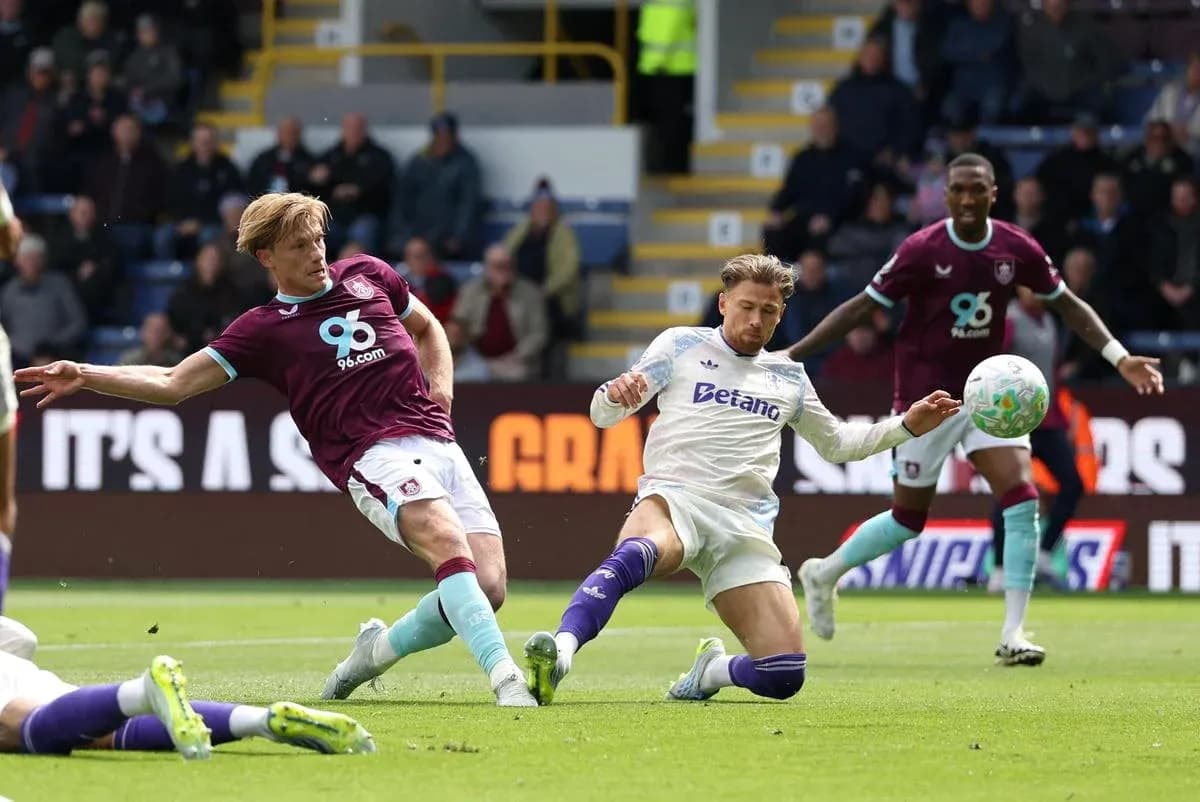
Burnley vs Aston Villa: A Tactical Analysis of the 2-2 Draw
Turf Moor under a leaden May sky felt like a crossroads rather than just another Premier League date. Burnley, 19th and deep in relegation trouble with 21 points and a goal difference of -36 (37 scored, 73 conceded in total this campaign), met an Aston Villa side chasing Europe from 5th place on 59 points, their overall goal difference a far slimmer +4 (50 for, 46 against). It finished 2-2, a scoreline that mirrored the season-long contrast: Burnley’s fragility against Villa’s intermittent ruthlessness.
Both managers leaned into the familiar. Mike Jackson returned to Burnley’s most-used shape this season, a 4-2-3-1 that has started 11 league matches, while Unai Emery mirrored it with his own preferred 4-2-3-1, a formation Villa have deployed 32 times. On the white lines of Turf Moor, the symmetry of the shapes masked the asymmetry of the stakes.
Burnley’s Setup
For Burnley, the spine was youthful and urgent. M. Weiss in goal, protected by a back four of K. Walker, A. Tuanzebe, M. Esteve and Lucas Pires, had the unenviable task of steadying a defence that has conceded an average of 1.6 goals at home and 2.0 overall. In front of them, Florentino and L. Ugochukwu formed the double pivot, tasked with both shielding and sparking transitions. Ahead, a fluid trio of L. Tchaouna, H. Mejbri and J. Anthony orbited around their talisman: Z. Flemming, the nominal No. 9 but emotionally the side’s reference point.
Flemming’s season has been Burnley’s brightest thread. With 10 league goals in total and two penalties scored from two, he arrived as their primary hunter, a midfielder by designation but a forward in everything that matters. His 37 total shots and 20 on target underscore his willingness to carry a broken attack; his 5 blocked shots this season speak to a work rate that does not end when Burnley lose the ball. In a side that has failed to score in 13 league matches overall, his presence is less luxury and more lifeline.
Behind him, Walker embodies the other side of Burnley’s edge. The right-back, who started again here, leads their disciplinary charts with 9 yellow cards in total. His 53 tackles, 10 successful blocks and 43 interceptions paint a picture of an aggressive, front-foot defender. But they also explain why Burnley’s card profile is so spiky: heading into this game, 19.67% of their yellows came between 16-30 minutes and another 19.67% between 76-90, a pattern of early and late lunges from a team forever chasing.
In midfield, J. Laurent waited on the bench, a red-card presence even in absence. His 1 dismissal this season and 7 yellows in total make him the embodiment of Burnley’s high-risk edge in the engine room. When he enters games, the tempo rises and so does the disciplinary jeopardy.
Aston Villa’s Approach
If Burnley’s 4-2-3-1 was about survival, Villa’s was about refinement. E. Martinez, one of the league’s steadiest goalkeepers, stood behind a back four of M. Cash, E. Konsa, T. Mings and I. Maatsen. In front of them, V. Lindelof and Y. Tielemans formed an unusually technical double pivot, more about progression than pure destruction.
Higher up, the structure tilted around two key figures: M. Rogers and O. Watkins. Rogers, starting on the left but drifting inside, came into this fixture as one of the league’s most complete attacking midfielders: 9 goals and 5 assists in total, 43 key passes, 117 dribble attempts with 41 successful, and 433 total duels with 155 won. He is both Villa’s top assister and a secondary scorer, the player who turns sterile possession into incision.
Watkins, leading the line, brought 12 goals and 2 assists into the afternoon. His 51 shots in total, 31 on target, frame him as the pure finisher in this system. Where Rogers drifts and creates, Watkins lives on the shoulder, his 271 total duels and 31 fouls drawn hinting at a forward who never stops wrestling with centre-backs.
Around them, J. McGinn and R. Barkley added weight and craft in the half-spaces, while the bench offered different knives: L. Bailey’s direct running, T. Abraham’s penalty-box presence, J. Sancho’s ball-carrying and E. Buendia’s creativity.
Injuries and Tactical Dynamics
Injuries subtly reshaped both squads. Burnley were without J. Beyer, J. Cullen and C. Roberts, stripping depth from their back line and midfield rotation. For a side already conceding an average of 1.6 at home and 2.5 on their travels, losing defensive options only heightened the strain on Tuanzebe and Esteve. Villa, meanwhile, missed Alysson, B. Kamara and A. Onana. The absence of Kamara in particular removed a natural ball-winner from the base of midfield, forcing Emery to lean on Lindelof and Tielemans to control space as much as possession.
Discipline loomed over the tactical chessboard. Burnley’s yellow-card spread, with significant spikes at 16-30 and 76-90 minutes, hinted at a team that starts edgy and finishes desperate. Villa, by contrast, concentrate 29.09% of their yellows between 46-60 minutes and 18.18% between 91-105, often paying for intensity just after the restart and in stoppage time. Their single red card this season arrived in the 61-75 window, a reminder that their aggression can tip over as legs tire.
The Narrative
This is where the “Hunter vs Shield” narrative crystallised. Watkins and Rogers, with 21 league goals between them in total, attacked a Burnley defence that concedes 1.6 at home and 2.0 overall, with just 4 clean sheets all season and none on their travels. Burnley’s shield is thin; Villa’s hunters rarely need many chances.
In the “Engine Room”, Rogers’ creativity and Tielemans’ passing met Florentino’s screening and Ugochukwu’s running. With Burnley averaging only 0.9 goals at home and 1.0 overall, their route to survival in this match depended on winning more duels than the numbers suggest and turning Flemming’s individual quality into repeatable threat.
Statistically, the prognosis heading into this fixture leaned heavily towards Villa. They arrived with 17 wins from 36, 1.4 goals scored on average overall and 9 clean sheets, against a Burnley side with only 4 wins, conceding 2.0 goals per game overall and failing to score in more than a third of their matches. Villa’s penalty record – no attempts at all this season – removed one volatility factor, while Burnley’s perfect 2 from 2 from the spot underscored that if the game descended into box chaos, they at least had composure from twelve yards.
Yet the 2-2 final score at Turf Moor told a more tangled story. Burnley’s flawed 4-2-3-1 still found ways to hurt a Villa side whose defensive averages away from home (1.4 conceded on their travels) betray a softness under pressure. Villa’s hunters did pierce a porous back line, but could not kill the contest.
Following this result, the tactical takeaway is clear. Burnley’s survival blueprint will continue to revolve around Flemming’s goals, Walker’s edge and a double pivot asked to do too much. Villa’s European push, meanwhile, rests on keeping Rogers and Watkins supplied while tightening the moments when their intensity dips and their card profile spikes.
The numbers still favour Villa over the long run – more wins, better defensive averages, greater attacking depth – but Turf Moor showed that when structure meets desperation, even a side with 59 points and a +4 goal difference can be dragged into a street fight by a team staring down relegation with -36.