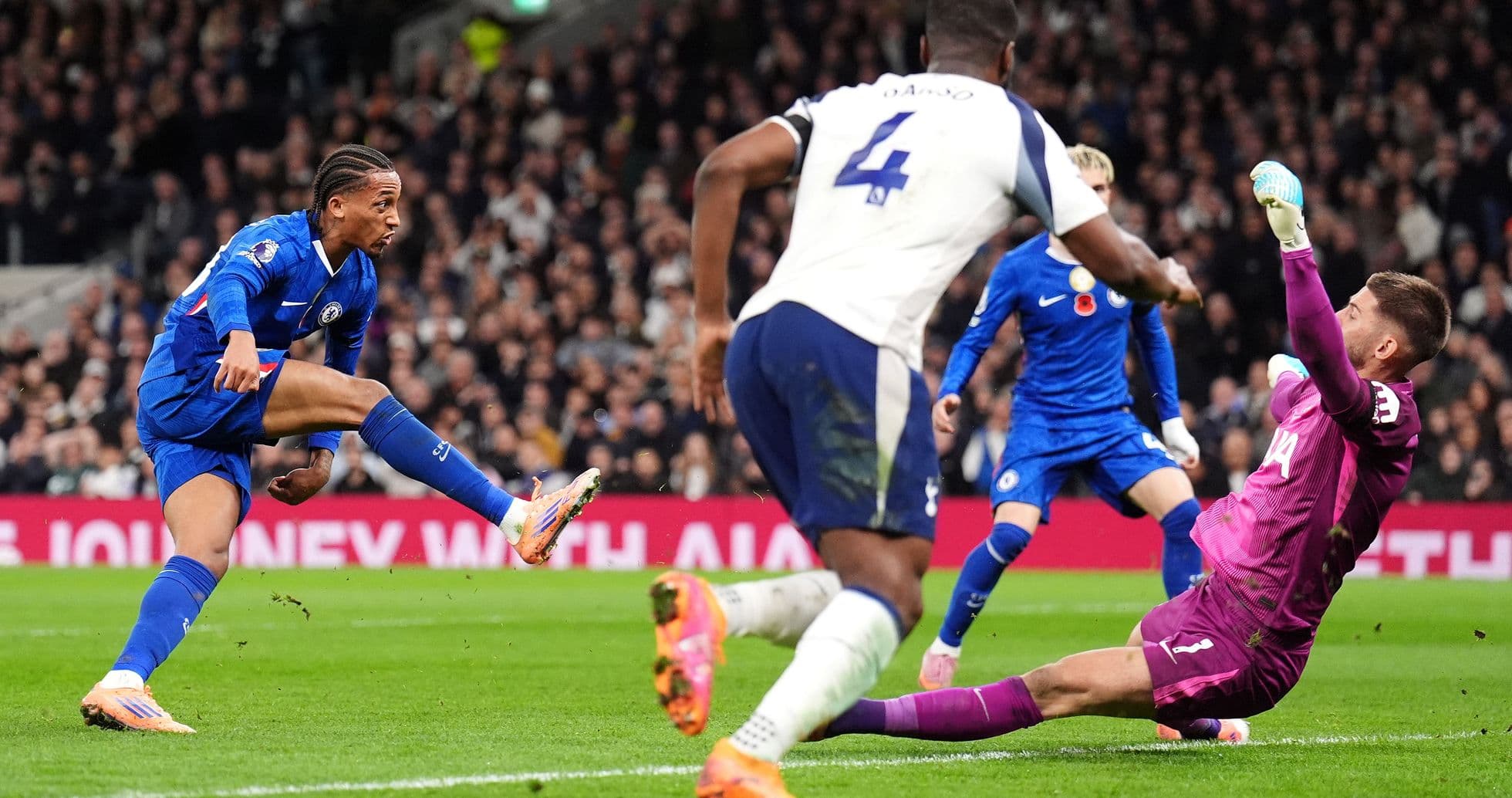
Chelsea's Tactical Masterclass in 2-1 Victory Over Tottenham
Chelsea’s 2-1 win over Tottenham at Stamford Bridge was a classic example of control without the ball. Despite ceding 56% possession and facing a higher xG (0.63 vs Tottenham’s 1.72), Calum McFarlane’s side used a compact 4-2-3-1 and sharp transitional play to dictate the game’s key moments.
Structurally, Chelsea’s 4-2-3-1 was built on the double pivot of Andrey Santos and M. Caicedo screening a relatively young back four. J. Acheampong and Marc Cucurella stayed narrower than typical attacking full-backs, prioritising access to Tottenham’s No.10 zone and wide half-spaces rather than overlapping relentlessly. Ahead of them, P. Neto and E. Fernandez worked as hybrid interiors from the flanks, frequently moving inside to form a box in midfield with Santos and Caicedo, while C. Palmer operated as the central connector behind Liam Delap.
The first goal on 18 minutes encapsulated Chelsea’s plan. With limited overall shots (9 total, 4 on goal), they focused on high-quality entries into the box from structured counters. Neto received in transition and, instead of driving wide, combined inside, finding E. Fernandez arriving from the left half-space. Fernandez’s finish reflected Chelsea’s emphasis on third-man runs from midfield rather than relying solely on Delap as a penalty-box target. That pattern – wingers narrowing, full-backs conservative, midfielders timing runs – allowed Chelsea to generate 4 shots inside the box from relatively modest territory.
Out of possession, Chelsea’s pressing was selective rather than high-risk. With only 11 fouls to Tottenham’s 18, they chose to drop into a mid-block and protect central lanes. Santos and Caicedo stayed tight to Tottenham’s double pivot, forcing Roberto De Zerbi’s side to circulate in front rather than slice through. Tottenham’s 8 shots inside the box suggest they eventually found entries, but the timing of those chances was often after Chelsea had numbers back, which helped limit the quality of finishes despite the higher xG.
The second Chelsea goal on 67 minutes, scored by Andrey Santos and assisted by E. Fernandez, underlined the growing influence of the double pivot in advanced zones. As Tottenham pushed up to chase the game, spaces opened between their lines. Fernandez, now drifting more centrally, was able to receive and slip Santos into a seam. This was less about raw counter-attacking speed and more about Chelsea exploiting poor vertical compactness in Tottenham’s 4-2-3-1, especially once their full-backs began to commit higher.
Tottenham’s own structure mirrored Chelsea’s on paper but functioned differently. With J. Palhinha and R. Bentancur as the double pivot, the visitors aimed to dominate possession (538 passes, 473 accurate at 88%) and progress methodically. The three behind Richarlison – R. Kolo Muani, C. Gallagher, and M. Tel – rotated frequently, particularly with Gallagher dropping into pockets to overload central zones. However, Chelsea’s narrow block meant much of this circulation was sterile, with Tottenham often funneled into wide areas where crosses were more predictable.
The away side’s frustration showed in their discipline and duels. Tottenham committed 18 fouls and picked up three yellow cards: Pedro Porro on 28 minutes for “Foul”, Micky van de Ven on 43 minutes for “Foul”, and Destiny Udogie on 63 minutes also for “Foul”. Each card reflected moments where Chelsea’s quick transitions or inside runs forced emergency defending, especially down the flanks when Neto or Palmer received between the lines.
Roberto De Zerbi’s triple substitution on 69 minutes – J. Maddison (IN) for R. Kolo Muani (OUT), D. Spence (IN) for D. Udogie (OUT), and P. M. Sarr (IN) for J. Palhinha (OUT) – was a clear tactical shift. Maddison’s introduction aimed to add creativity between Chelsea’s lines, while Spence provided more direct width on the left and P. M. Sarr injected energy and vertical running from midfield. The impact was immediate in terms of penetration: Tottenham’s goal on 74 minutes came from Richarlison, assisted by P. M. Sarr, highlighting how Sarr’s forward surges disrupted Chelsea’s midfield screen and created space for the striker.
Yet even as Tottenham increased their attacking threat, Chelsea managed the game through tempo control and strategic fouling. Their four yellow cards tell a story of game management rather than reckless defending: Jorrel Hato on 79 minutes for “Time wasting”, Marc Cucurella on 85 minutes for “Argument”, Liam Delap on 87 minutes for “Foul”, and Dário Essugo on 90+2 minutes for “Foul”. Hato’s card in particular signalled Chelsea’s shift into a more conservative, clock-killing mode once the lead was under threat.
Substitutions from McFarlane were largely defensive and control-oriented. T. Chalobah (IN) came on for J. Acheampong (OUT) on 74 minutes, adding experience and aerial stability just as Tottenham’s pressure was rising and moments before Richarlison’s goal. Later, M. Sarr (IN) replaced W. Fofana (OUT) on 81 minutes, allowing Chelsea to stiffen the left side and protect against late wide overloads. In the final minutes, A. Garnacho (IN) for P. Neto (OUT), D. Essugo (IN) for C. Palmer (OUT), and S. Mheuka (IN) for L. Delap (OUT) on 89 minutes refreshed the front line with legs geared more toward pressing and chasing loose balls than creating.
In goal, R. Sanchez (Chelsea) made 2 saves, aligning with Tottenham’s 3 shots on goal and underlining that while the visitors accumulated territory and xG, they did not bombard the target relentlessly. At the other end, A. Kinsky (Tottenham) also made 2 saves against Chelsea’s 4 shots on goal, which, combined with a goals prevented figure of -1.08 for both keepers, suggests that finishing quality – especially from Fernandez and Santos – outstripped the underlying shot profiles.
Statistically, Tottenham’s superiority in possession and passing (538 passes to Chelsea’s 425; 88% vs 84% accuracy) did not translate into control of the scoreboard. Chelsea’s 3 corner kicks to Tottenham’s 4 and equal total shots (9-9) show a relatively balanced chance volume, but the hosts’ sharper execution in key zones and better game-state management after going 2-0 up proved decisive.
Ultimately, this was a match where Chelsea’s structure without the ball, the intelligence of their midfield rotations, and the timing of their runs into the box outweighed Tottenham’s territorial dominance. De Zerbi’s side created enough on paper to merit more, but McFarlane’s Chelsea showed that a disciplined 4-2-3-1, combined with targeted transitions and controlled aggression, can bend a possession-heavy opponent to the rhythm of their own tactical plan.