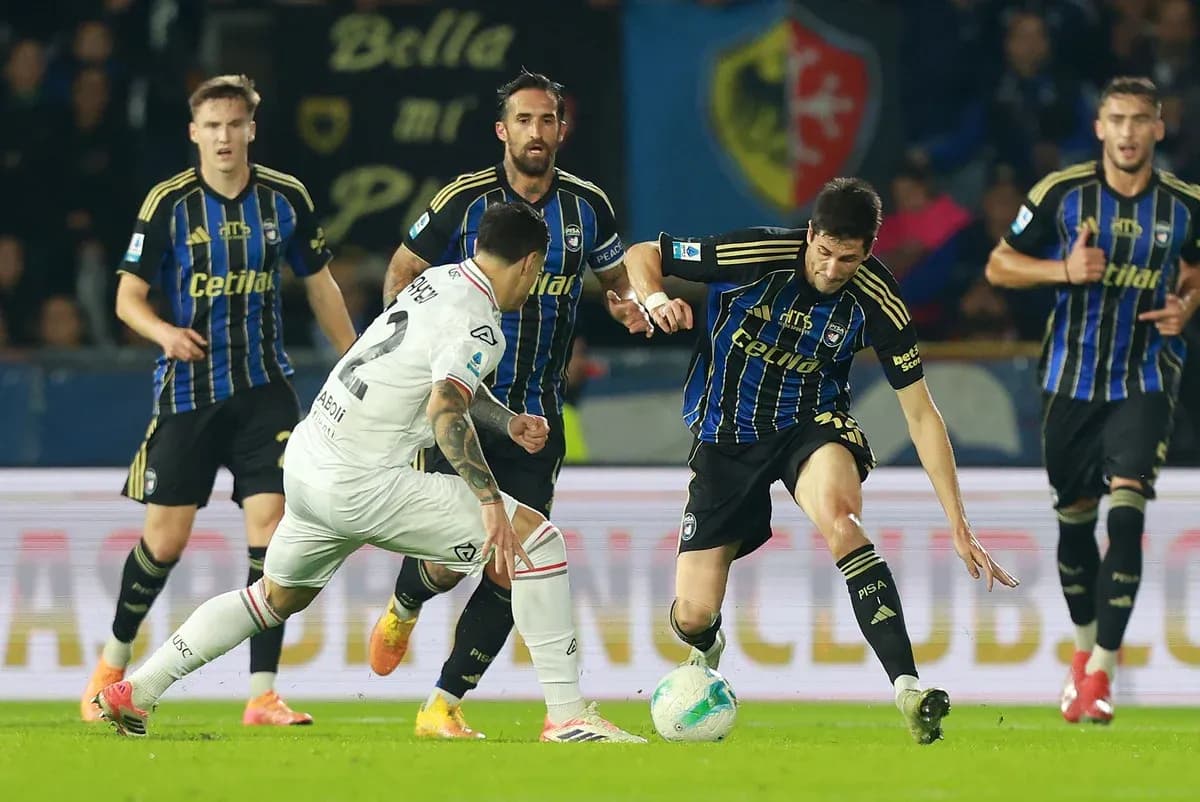
Cremonese's Statement Win Over Pisa: A 3-0 Masterclass
By the time the whistle went at Stadio Giovanni Zini, this was more than a routine home victory. Following this result, Cremonese’s 3-0 dismantling of Pisa in Serie A’s Regular Season - 36 felt like a late-season manifesto from a side marooned in 18th but refusing to accept their relegation fate.
The league table frames the stakes starkly. Heading into this game, Cremonese sat 18th with 31 points, a goal difference of -23 built from 30 goals scored and 53 conceded overall. Pisa were even deeper in trouble: 20th with 18 points, a brutal goal difference of -41 from 25 scored and 66 shipped in total. Two teams living in the red, two fanbases fearing Serie B.
Yet on this afternoon, under the eye of referee Giovanni Ayroldi, it was Cremonese who played with the clarity of a side still believing. The hosts, usually a low-scoring outfit at home with just 17 goals in 18 matches and an average of 0.9 goals per home game, suddenly hit their seasonal ceiling, matching their biggest home win of 3-0. Pisa, whose away record had been defined by fragility – 43 goals conceded on their travels at an average of 2.4 per away game – simply relived the same nightmare in a different stadium.
The tactical shapes told their own story. Marco Giampaolo rolled out a 4-4-2, a system he has used less often than his staple back-three but one that suited the emotional tenor of a must-win match. Oscar Hiljemark answered with Pisa’s familiar 3-4-2-1, a structure designed to compact the middle and counter through the front three, but one that has too often exposed a soft underbelly away from home.
Tactical voids – absences and discipline
Both squads came into the fixture carrying wounds. Cremonese were without F. Baschirotto (thigh injury), R. Floriani (muscle injury), F. Moumbagna (muscle injury) and M. Payero (knock). None were in the starting XI, and their absence stripped Giampaolo of depth in defence and energy in midfield. It forced a certain clarity: trust the core, keep the rotations minimal, lean on structure.
Pisa’s own list was no kinder. F. Coppola (muscle injury), D. Denoon (ankle injury), C. Stengs (inactive) and M. Tramoni (muscle injury) were all missing. For a team that has already failed to score in 20 league games overall and kept just 1 clean sheet away, those absences further blunted their options between the lines and in the final third.
Season-long disciplinary trends also framed the risk profile. Cremonese have shown a clear tendency toward late-game volatility: 27.27% of their yellow cards arrive between 76-90 minutes, and their red-card pattern is skewed toward added time, with 66.67% of reds in the 91-105 window. Pisa mirror that late edge: 25.33% of their yellows also fall in the 76-90 period, and their red cards are scattered across the first hour and stoppage time. This is why game states matter so much for both – they are emotionally volatile when chasing, and this match’s early home control kept those flashpoints from ever truly igniting.
Key matchups – Hunter vs Shield, Engine Room wars
Hunter vs Shield was always going to centre on Federico Bonazzoli against a Pisa back line that has been porous all season. Bonazzoli, Cremonese’s standout attacker with 9 league goals and 1 assist overall, arrived as a forward who marries volume with efficiency: 54 shots, 30 on target, and 2 penalties scored from 2 taken. He is not just a finisher but a worker – 803 passes with 13 key passes and 27 tackles underline his willingness to drop in and press.
Opposite him stood Antonio Aldo Caracciolo, Pisa’s defensive pillar and one of Serie A’s most card-prone defenders this season. Across 34 appearances and 2984 minutes, Caracciolo has produced 71 tackles, 24 successful blocked shots and 45 interceptions, but at a cost: 9 yellow cards. He is the classic last-ditch defender, thriving in duels (260 contested, 139 won) but living permanently on the disciplinary edge.
In a 3-4-2-1 that already asks the central defender to step out and confront strikers between the lines, Pisa’s structure left Caracciolo repeatedly exposed to Bonazzoli’s movement and to the second runs of J. Vardy. Once Cremonese’s front two pinned Pisa’s back three, the away side’s already fragile away defensive record – 43 conceded on their travels – looked exactly as the numbers suggest.
The Engine Room duel was no less decisive. For Cremonese, A. Grassi and Y. Maleh offered the ballast, but the creative axis ran through Jari Vandeputte. With 5 assists overall and 53 key passes in 30 league appearances, Vandeputte is the side’s primary chance architect. His 887 passes at 77% accuracy are not just volume; they are progression, often from the left half-space where he can combine with Giuseppe Pezzella.
Pezzella himself is a fascinating hybrid. Officially listed as a midfielder here, he brings full-back aggression and wide-midfield work rate: 48 tackles, 11 successful blocks, 11 interceptions and 8 yellow cards plus 1 red across the campaign. His high-intensity profile fits Giampaolo’s 4-4-2: aggressive pressing on the flank, hard overlaps, and a willingness to foul to break transitions.
Across from them, Pisa’s midfield spine of Idrissa Touré and E. Akinsanmiro was tasked with disrupting that rhythm. Touré, in particular, is a high-contact presence: 402 duels contested with 219 won, 42 tackles, 8 blocked shots and 24 interceptions. But his card profile – 4 yellows and 1 red this season – underlines the risk of leaving him isolated. In a match where Pisa trailed and had to step forward, the spaces behind Touré and the wing-backs became the channels Vandeputte and the Cremonese forwards ruthlessly attacked.
Statistical prognosis – xG logic and defensive reality
Even without explicit xG numbers, the season data sketches the expected pattern. Heading into this game, Cremonese were a low-output but structurally decent side: just 0.8 goals scored on average overall, 1.5 conceded, with 10 clean sheets in total suggesting that when their defensive block is set, they can suffocate weaker attacks. Pisa, by contrast, were built on sand: 0.7 goals scored on average overall, 1.8 conceded, and only 5 clean sheets across 36 matches.
On their travels, Pisa’s profile screams vulnerability: 16 goals scored away at 0.9 per away game, but 43 conceded at 2.4. Against a Cremonese team that had previously failed to score in 7 home matches but could point to a biggest home win of 3-0, the underlying probabilities leaned toward a tight but home-favoured contest. Once Cremonese struck first and went into half-time 1-0 up, Pisa’s need to chase played directly into that statistical trap: open the game, expose the worst unit on the pitch – their away defence – against a forward in form and a creator who thrives in space.
The 3-0 final scoreline is not an anomaly; it is the logical extreme of these trends. Cremonese’s defensive platform, anchored by S. Luperto and M. Bianchetti in front of E. Audero, finally married their clean-sheet potential with rare attacking efficiency. Pisa, already in free fall with a form line of “LLLLL” heading into the match, simply followed the curve of their season.
In tactical terms, this was a study in one team understanding its limitations and playing to them, and another being dragged once more into the same structural weaknesses. In statistical terms, the result sits exactly where the numbers pointed: a home side with just enough attacking quality and a disciplined, if often beleaguered, defence, punishing the league’s softest travellers in a match that felt like the season distilled into 90 minutes.